Artwork
Descent
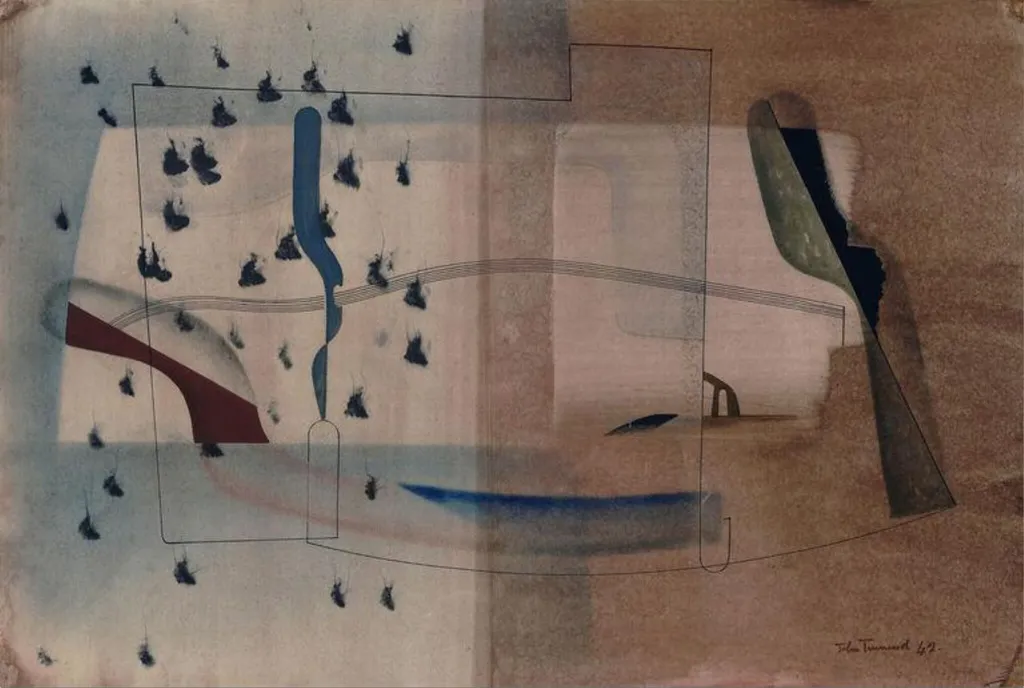
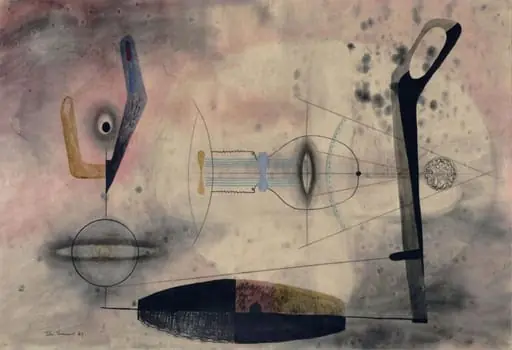
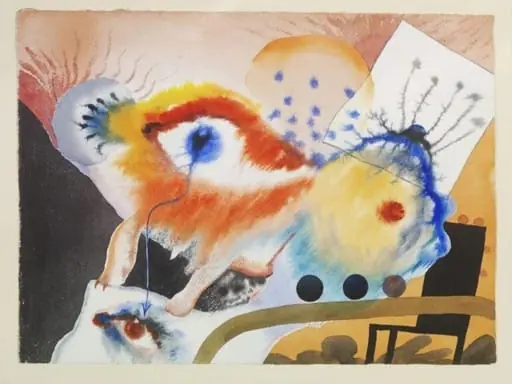
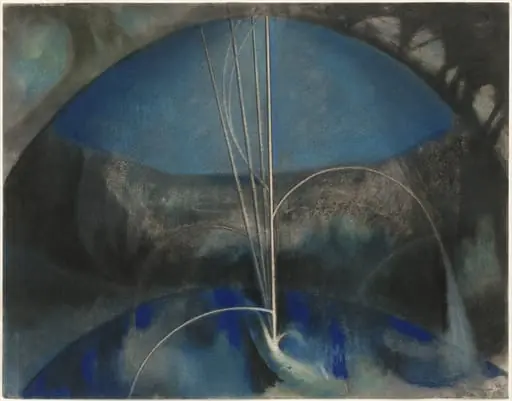
Descent is a watercolor work on paper by the Surrealist artist John Tunnard. It dates from 1942 and is held in the collection of the Victoria and Albert Museum.
About this work
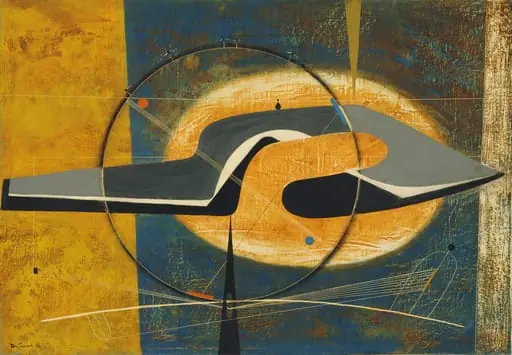
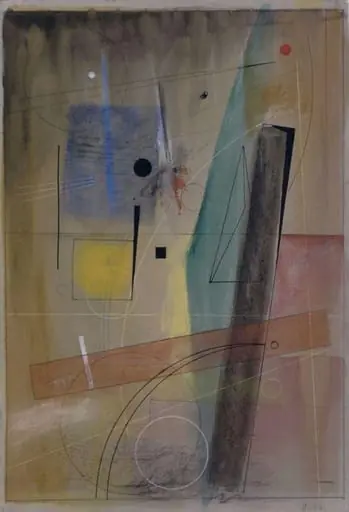
John Tunnard painted *Descent* in 1942 using watercolors. It’s an abstract piece with geometric shapes floating over blue and brown tones. The split colors hint at where the land meets the sea.
Tunnard made this while working as a coastguard during World War Two. His style blends Surrealist and Neo-Romantic ideas, inspired by artists like Miró and Klee.
Check out more work by Tunnard, John.
Overview
A conscientious objector, he used this period to develop his abstract style, distancing himself from traditional landscape representation.
John Tunnard created *Descent* in 1942 as a watercolour during his service as an auxiliary coastguard in World War Two. A conscientious objector, he used this period to develop his abstract style, distancing himself from traditional landscape representation. The work reflects his transition from textile design to fine art, begun in 1929, and his immersion in modernist currents emerging in Britain during the early 1930s.
Subject & Meaning
The painting presents no literal scene but evokes a boundary between sea and land through a stark division of blue and brown tones. Floating geometric forms suggest celestial or geological elements, neither fully organic nor mechanical. This ambiguity aligns with Surrealist interests in subconscious landscapes, while the muted palette and spatial tension reflect a Neo-Romantic sensitivity to place and isolation.
Technique & Style
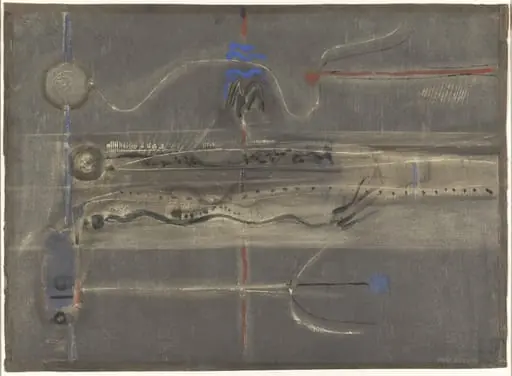
Tunnard employed watercolour’s fluidity to create layered, translucent fields of colour, allowing underlying washes to suggest depth and atmosphere. Sharp-edged geometric shapes contrast with soft, blended backgrounds, producing a tension between structure and dissolution. His approach draws from Miró’s biomorphic abstraction and Klee’s symbolic geometry, yet remains distinctly personal in its restraint and tonal harmony.
History & Provenance
Painted during Tunnard’s wartime service in Cornwall, *Descent* emerged from a period of personal and political displacement. His role as a coastguard provided proximity to the coastal environment he reimagined abstractly. The work was not exhibited publicly until after the war, when his association with Surrealist and Neo-Romantic circles in Britain began to gain recognition among avant-garde collectors and galleries.
Context
In wartime Britain, many artists turned inward, responding to disruption through abstraction. Tunnard’s work stood apart from official war art, avoiding propaganda in favour of introspective forms. His Cornish surroundings, combined with exposure to European modernism through publications and exhibitions, allowed him to develop a unique visual language that redefined the English landscape tradition without direct representation.
Legacy
Tunnard’s watercolours from this period, including *Descent*, contributed to a broader redefinition of British modernism in the mid-20th century. His synthesis of Surrealist abstraction and Neo-Romantic atmosphere influenced later generations of landscape-oriented abstract painters. Though less widely known than his contemporaries, his work remains a quiet but significant chapter in the history of British modern art.
Artist & collection
Artist
John Samuel Tunnard (7 May 1900 – 12 December 1971) was an English modernist designer and abstract painter, and anti-hunting activist. He was the cousin of landscape architect Christopher Tunnard.