Artwork
Isleworth
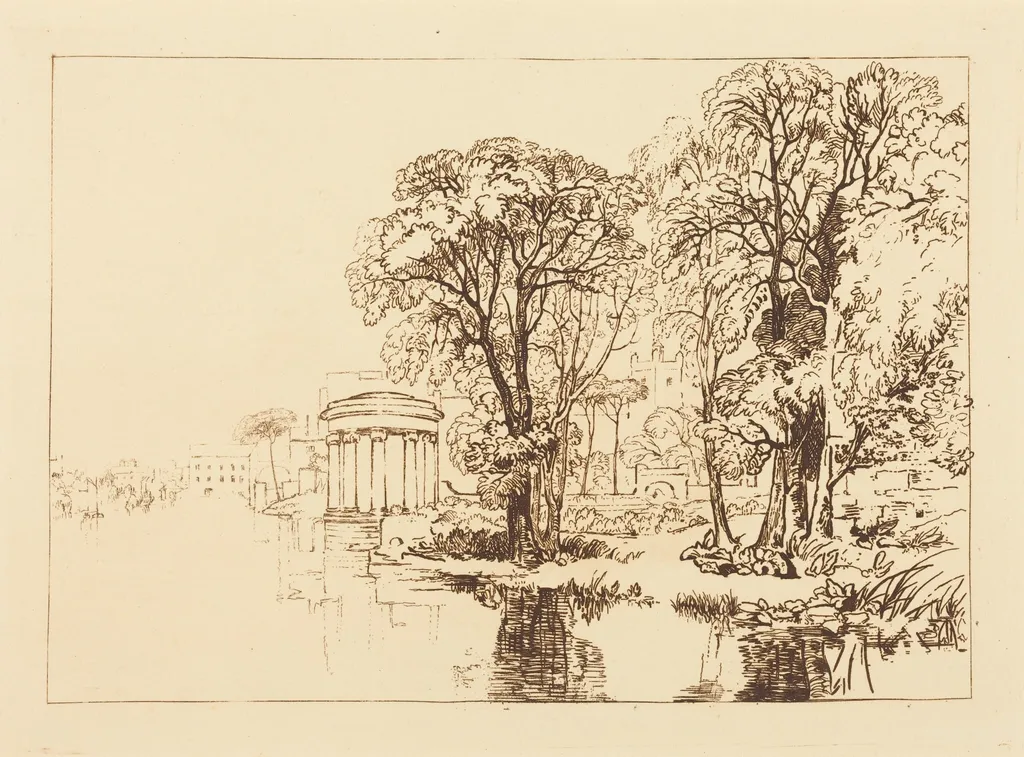
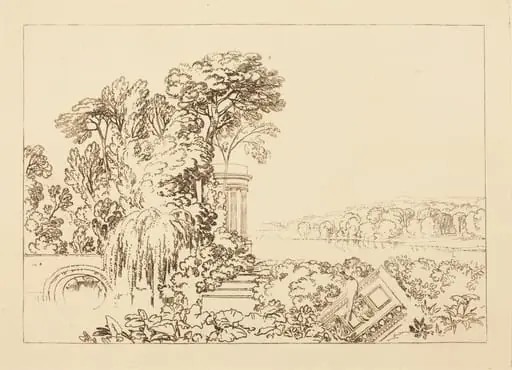
Isleworth is an ink print by the Romanticist artist Joseph Mallord William Turner. It dates from 1819 and is held in the collection of the National Gallery of Art.
About this work
Overview
It depicts a tranquil landscape near the Thames village of the same name, capturing a modest classical temple nestled beside a still pond.
Isleworth is an etching by Joseph Mallord William Turner, dated 1819. It depicts a tranquil landscape near the Thames village of the same name, capturing a modest classical temple nestled beside a still pond. The composition is dominated by dense, gnarled trees whose roots dip into the water, framing the structure with natural asymmetry. Soft, muted brown ink lines suggest depth without heavy contrast, evoking a quiet, contemplative atmosphere.
Subject & Meaning
The scene presents a modest architectural ruin amid overgrown nature, suggesting the passage of time and the quiet reclamation of human structures by the environment. The temple, though classical in form, is unadorned and isolated, lacking human figures or signs of activity. This understated treatment reflects Turner’s interest in landscape as a vessel for mood rather than narrative, emphasizing solitude and the subtleties of place.
Technique & Style
Turner employed etching to achieve fine, controlled lines with a slightly blurred, atmospheric quality. The plate was incised with acid, allowing for delicate gradations in tone rather than sharp definition. The ink’s soft edges and varying line weights mimic the effect of a drawn sketch, blending precision with spontaneity. This technique aligns with Turner’s broader approach to printmaking, where texture and suggestion often outweigh literal representation.
History & Provenance
Created during Turner’s period of active printmaking, Isleworth was likely produced as part of a series documenting English landscapes. It was not widely published at the time and remained in private collections for much of the 19th century. The work entered institutional holdings in the 20th century, where it is now recognized as an example of Turner’s intimate, lesser-known prints rather than his large-scale oil paintings.
Context
In 1819, Turner was exploring the English countryside through sketching and printmaking, responding to a growing public interest in topographical views. While contemporaries focused on detailed accuracy, Turner favored emotional resonance over topographical precision. Isleworth reflects this shift, aligning with Romantic sensibilities that valued nature’s quiet power over human intervention, even as classical forms lingered in the landscape.
Legacy
Isleworth exemplifies Turner’s contribution to the evolution of printmaking as a medium for personal expression rather than mere reproduction. Its understated beauty and technical nuance influenced later artists who sought to convey atmosphere through ink and line. Though not widely exhibited during his lifetime, it now stands as a quiet testament to his ability to transform simple scenes into evocative visual poetry.
Artist & collection
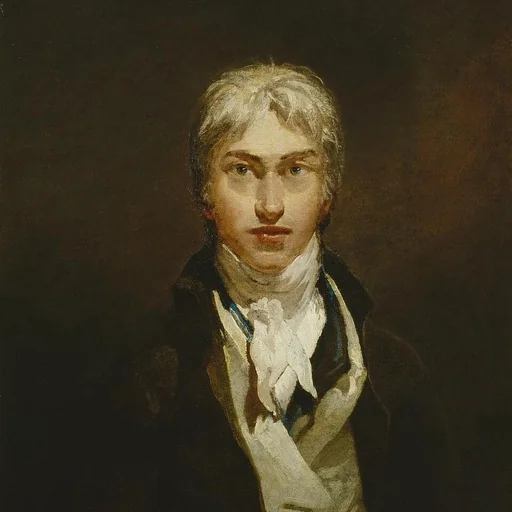
Artist
Joseph Mallord William Turner was born in 1775 at Maiden Lane, Covent Garden, where his father kept a barber and wig-making shop.