Artwork
二月堂焼経|Nigatsudō Burned Sutra
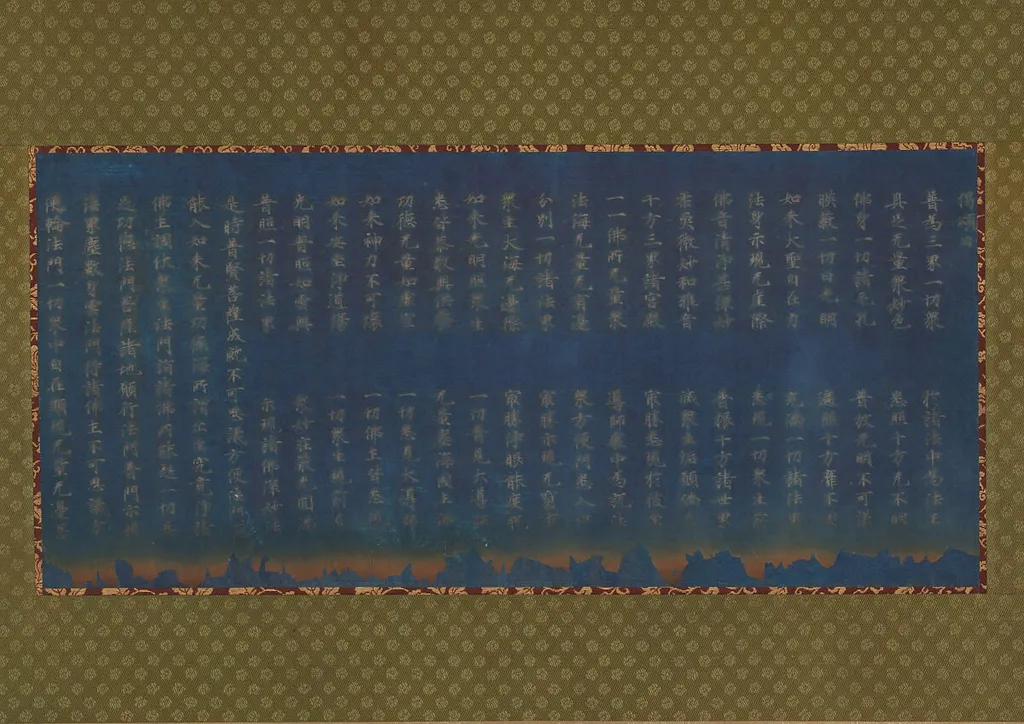
二月堂焼経|Nigatsudō Burned Sutra is an ink painting. It dates from 744 and is held in the collection of the Metropolitan Museum of Art. The work titled “Nigatsudō Burned Sutra” is a hanging scroll composed of indigo‑dyed paper on which silver ink has been applied.
About this work
Overview
The work titled “Nigatsudō Burned Sutra” is a hanging scroll composed of indigo‑dyed paper on which silver ink has been applied. The scroll is elongated and narrow, its edges framed by a gold pattern and a thin red border. The composition consists of dense, parallel black‑appearing lines that do not form legible characters, accompanied by a subtle orange waveline near the lower edge.
Technique & Style
Silver ink, mixed with a binding medium, creates a metallic sheen that contrasts with the deep blue background. The lines are executed in tight, repetitive rows, filling the surface in a rhythmical manner. A faint, undulating orange stripe suggests a stylised landscape element, while the gold edging provides a decorative border typical of Japanese scrolls.
Subject & Meaning
The scroll does not depict a narrative scene; instead it presents an abstract arrangement of lines that may evoke the visual density of sutra text without conveying readable script. The inclusion of a wavy orange band hints at natural motifs such as water or mountains, offering a minimal reference to landscape within an otherwise non‑representational field.
Context
Created as a painted sutra, the piece reflects a tradition of Buddhist devotional objects where text and ornamentation merge. The use of silver ink on indigo paper aligns with Japanese ritual scrolls, and the decorative gold border situates the work within the aesthetic conventions of temple art, where visual austerity often accompanies spiritual contemplation.
Artist & collection