Artwork
秋夜長物語絵巻断簡|The Final Scene from A Long Tale for an Autumn Night (Aki no yonaga monogatari)
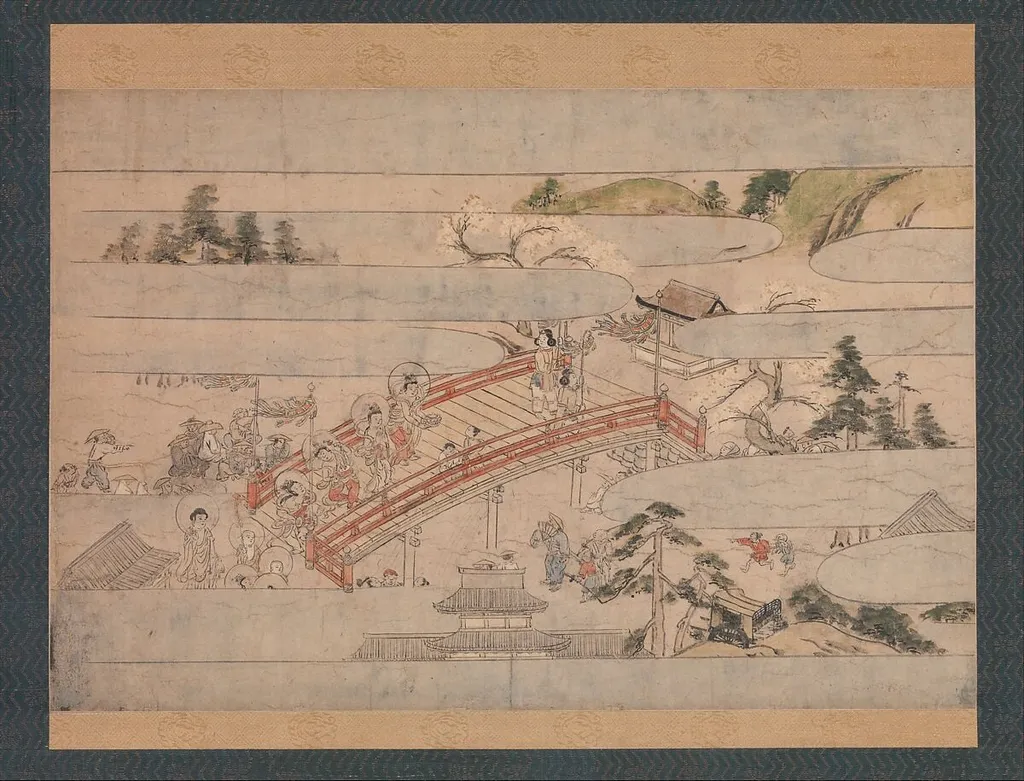
秋夜長物語絵巻断簡|The Final Scene from A Long Tale for an Autumn Night (Aki no yonaga monogatari) is an ink painting. It dates from 1400 and is held in the collection of the Metropolitan Museum of Art.
About this work
Overview
This artwork, titled The Final Scene from A Long Tale for an Autumn Night (Aki no yonaga monogatari), depicts a bridge within a Japanese landscape.
This artwork, titled The Final Scene from A Long Tale for an Autumn Night (Aki no yonaga monogatari), depicts a bridge within a Japanese landscape. Originally part of a longer handscroll, this piece is now presented as a hanging scroll. Executed with ink and color on paper, it represents a segment of a narrative whose complete content is not fully preserved, offering a glimpse into a broader, untold story.
Subject & Meaning
The painting portrays a bridge set within a detailed Japanese landscape, suggesting a specific moment in a narrative. Despite its title, The Final Scene from A Long Tale for an Autumn Night, the complete story from which this fragment originates remains largely unknown. The visual elements invite contemplation of the journey or transition symbolized by the bridge, hinting at the conclusion of an unspecified autumn night's tale.
Technique & Style
Created using ink and color applied to paper, this artwork demonstrates careful execution in rendering its landscape elements. The artist employed these traditional materials to capture the nuances of the Japanese scenery, particularly highlighting the architectural details of the bridge and the natural forms of its surroundings. This approach emphasizes precision in depicting both man-made structures and the environment.
History & Provenance
This artwork began its existence as a section of a larger handscroll, a format traditionally used for sequential narrative viewing. At some point in its history, this particular segment was separated from its original context and remounted as a hanging scroll. This transformation in presentation altered its display method, allowing it to be viewed as a singular, framed composition rather than as part of an unfolding narrative sequence.
Artist & collection