Artwork
Thomas Wentworth, Earl of Strafford
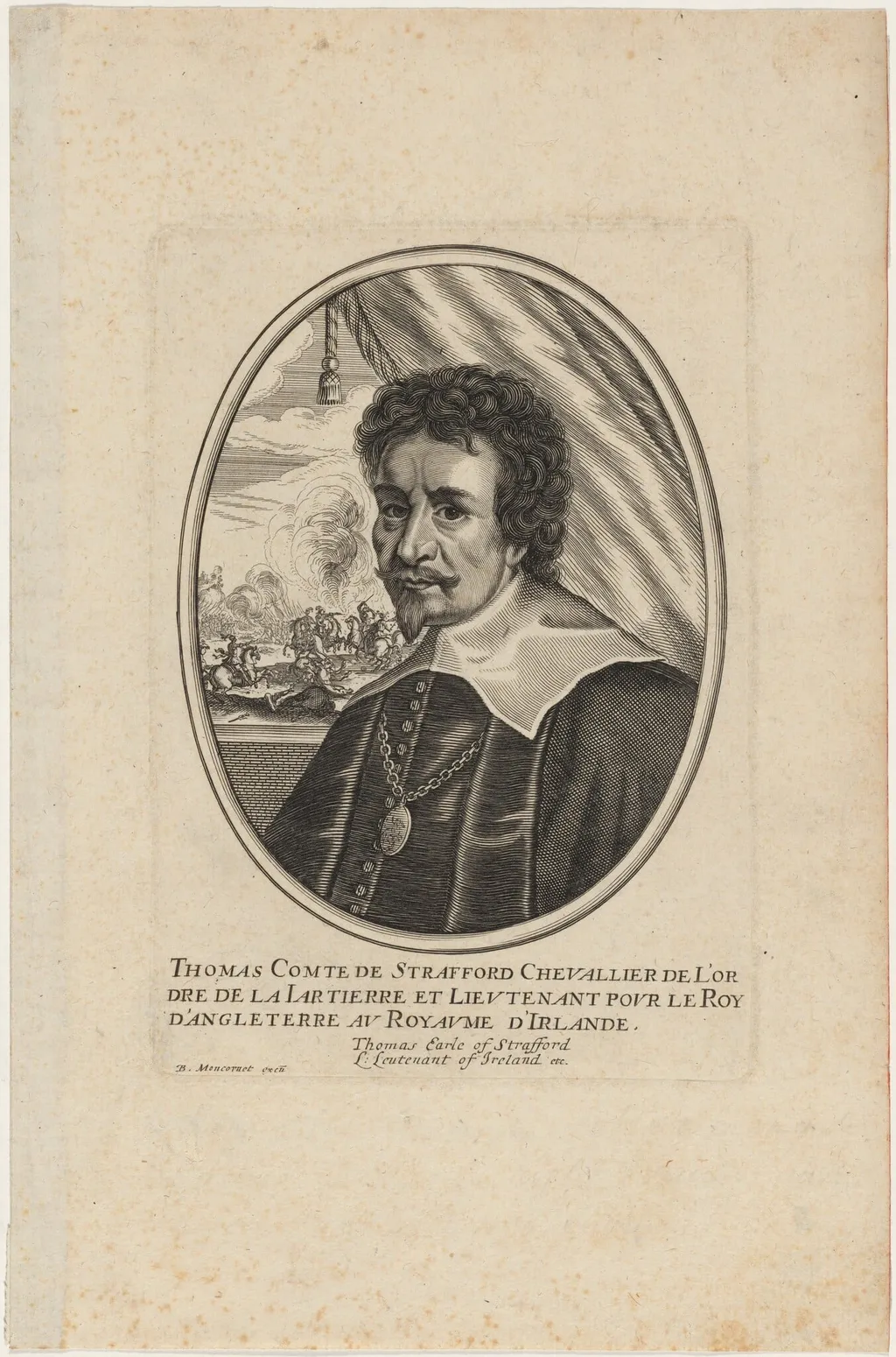
Thomas Wentworth, Earl of Strafford is an ink print by the Romanticist artist Unknown 19th Century. It dates from 1850 and is held in the collection of the National Gallery of Art.
About this work
Overview
The figure is shown in a dark, high‑collared shirt, a prominent medallion rests at his throat, and his curly hair frames a solemn, introspective expression.
This engraved portrait depicts Thomas Wentworth, Earl of Strafford, rendered in a finely detailed manner typical of early‑modern printmaking. The figure is shown in a dark, high‑collared shirt, a prominent medallion rests at his throat, and his curly hair frames a solemn, introspective expression. Behind him a muted landscape with a building and distant figures provides a subtle contextual backdrop.
Subject & Meaning
The work presents Strafford as a dignified statesman, emphasizing his status through the medallion and formal attire. The serious gaze directed to the left suggests contemplation, perhaps alluding to his political responsibilities and the turbulent era in which he served. The inclusion of a distant architectural element may hint at his connection to governance and public affairs.
Technique & Style
Executed entirely with line work, the engraving relies on dense cross‑hatching to model flesh, fabric and background, creating a convincing sense of volume and texture. The artist’s meticulous attention to fine lines produces a realistic rendering of hair, facial features and the sheen of metal on the medallion, while the lighter background contrasts with the darker foreground figure.
History & Provenance
The portrait was produced as a print, a common medium for disseminating the likenesses of notable figures in the 17th century. While the specific engraver is not recorded, such images were often commissioned to circulate among political allies and supporters, serving both commemorative and propagandistic purposes during Strafford’s career.
Context
Thomas Wentworth, Earl of Strafford, was a key advisor to King Charles I and a central figure in the political conflicts preceding the English Civil War. Portraits like this were part of a broader visual culture that reinforced aristocratic authority and loyalty to the crown, reflecting the period’s emphasis on hierarchical representation.
Legacy
Engravings of Strafford contributed to the visual record of the era’s political elite, influencing later depictions of English nobility. The work remains a valuable source for scholars studying portraiture, print technology, and the iconography of power in early modern England.
Artist & collection

Artist