Artwork
A Donor and his two Sons with Saint John the Evangelist, inner left wing of a triptych
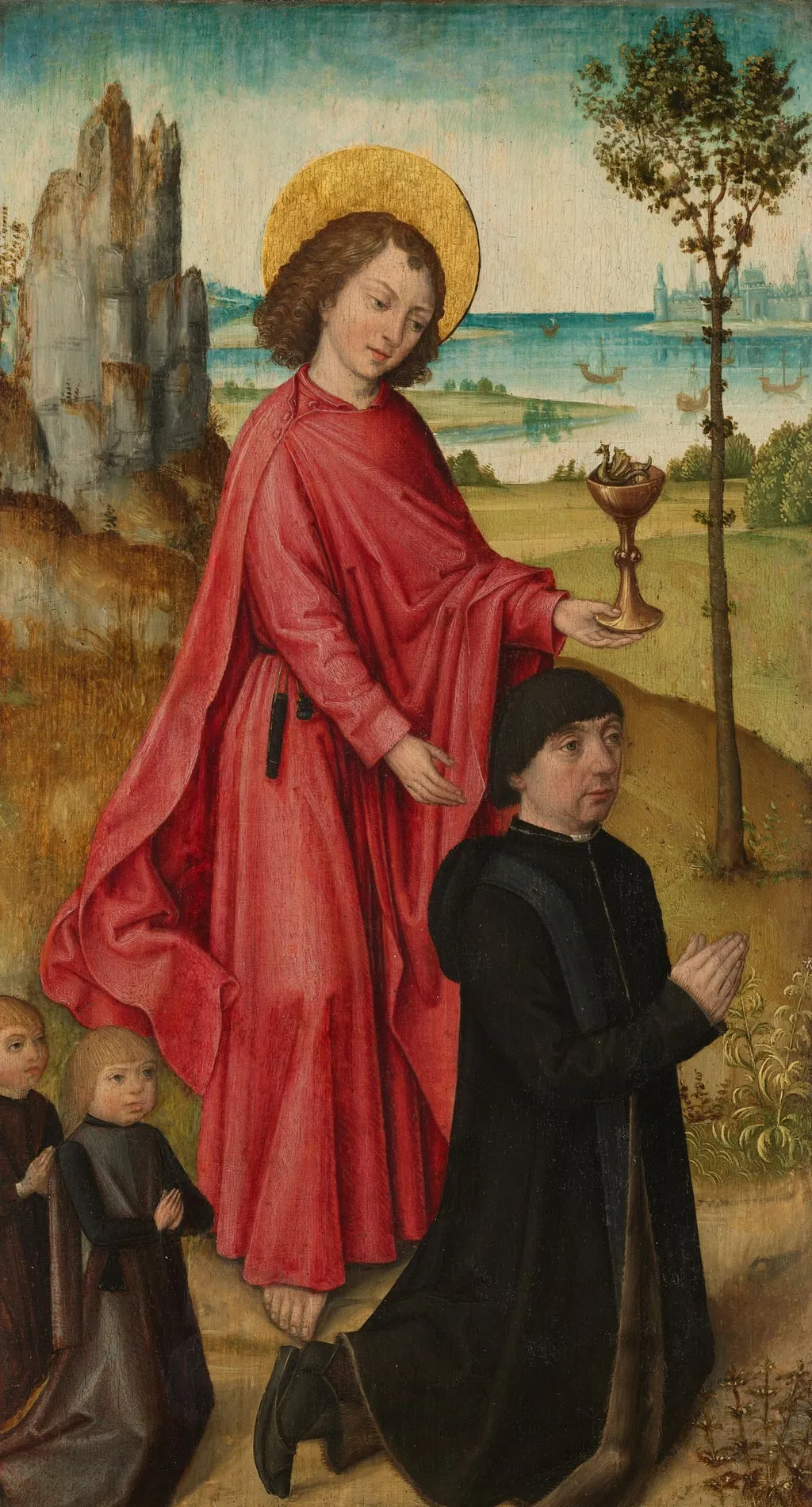
A Donor and his two Sons with Saint John the Evangelist, inner left wing of a triptych is an unspecified painting by the Northern Renaissance artist Unknown. It dates from 1480 and is held in the collection of the Rijksmuseum. This painting forms the inner left panel of a triptych, originally part of a devotional altarpiece.
About this work
Overview
This painting forms the inner left panel of a triptych, originally part of a devotional altarpiece. It depicts a kneeling donor, flanked by his two sons, in the presence of Saint John the Evangelist. The scene is set against a subdued, rolling landscape that extends behind the figures, creating a sense of spatial depth without overwhelming the devotional focus.
Subject & Meaning
The donor and his sons are shown in prayer, their postures reflecting piety and humility. Their faces lack individualized features, emphasizing their role as patrons rather than personalities. In contrast, Saint John is rendered with distinct expression and presence, suggesting his spiritual authority. The inclusion of the saint underscores the family’s desire for divine intercession.
Technique & Style
The figures are rendered with careful attention to textile detail, particularly in the donor’s red robe. The landscape background, though minimal, includes subtle elements—a distant church spire, a small bird in flight—that add quiet narrative depth. The composition is frontal and symmetrical, typical of early Netherlandish devotional panels, prioritizing clarity over dramatic movement.
History & Provenance
As the left wing of a triptych, this panel was likely commissioned for private worship, possibly in a chapel or domestic setting. The donor’s identity remains unknown, as was common; such works were often intended for personal or familial devotion rather than public display. Its survival as part of a larger ensemble is rare, given the dispersal of many altarpieces over time.
Context
In 15th-century Northern Europe, donor portraits were standard in religious art, serving both as acts of devotion and records of social status.
In 15th-century Northern Europe, donor portraits were standard in religious art, serving both as acts of devotion and records of social status. The inclusion of saints as intermediaries reflected contemporary beliefs in their protective power. This panel aligns with regional traditions seen in works by artists like Jan van Eyck or Rogier van der Weyden, where quiet realism and symbolic detail carried spiritual weight.
Legacy
The painting exemplifies the quiet intensity of early Netherlandish devotional art, where spiritual meaning emerges through restraint rather than spectacle. Its emphasis on minute details—the landscape, the saint’s gaze, the texture of fabric—invites contemplation. Such works influenced later generations in their fusion of the earthly and the divine through understated realism.
Artist & collection

 Domestic Scene
 Giacomo and Cardinal Marco, investing Andrea, Abbot of San Zeno, with his Benefice
 The Nymph of Fontainebleau
 Portrait of a Woman
 Madonna and Child with Saints in the Enclosed Garden
 Venus and Minerva
 Family Group of Four on Sofa
 Wall painting from Room H of the Villa of P. Fannius Synistor at Boscoreale
 De H. Johannes de Evangelist met Jan de Trompes en zijn zoon
 Altar Panel with a Portrait of a Donor in Scarlet under the Protection of St Anthony
 Virgin and Child Crowned by Angels
 The Nativity
 Justice of Emperor Otto III: The Trial by Fire
 Saint John the Baptist and Saint Jerome
 Enthroned Virgin and Child, with Angels