Artwork
A military review
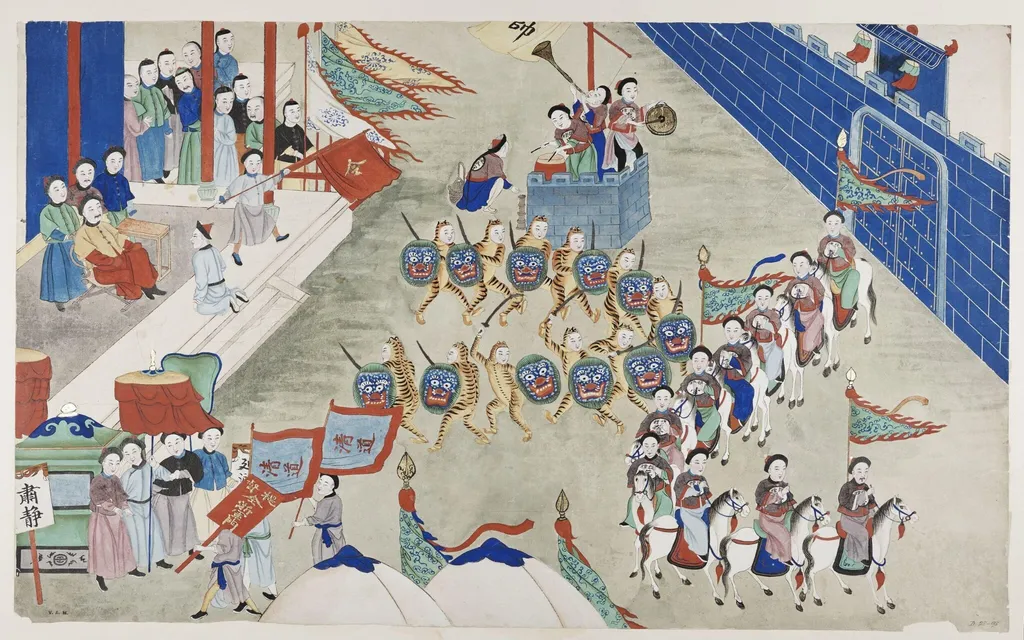
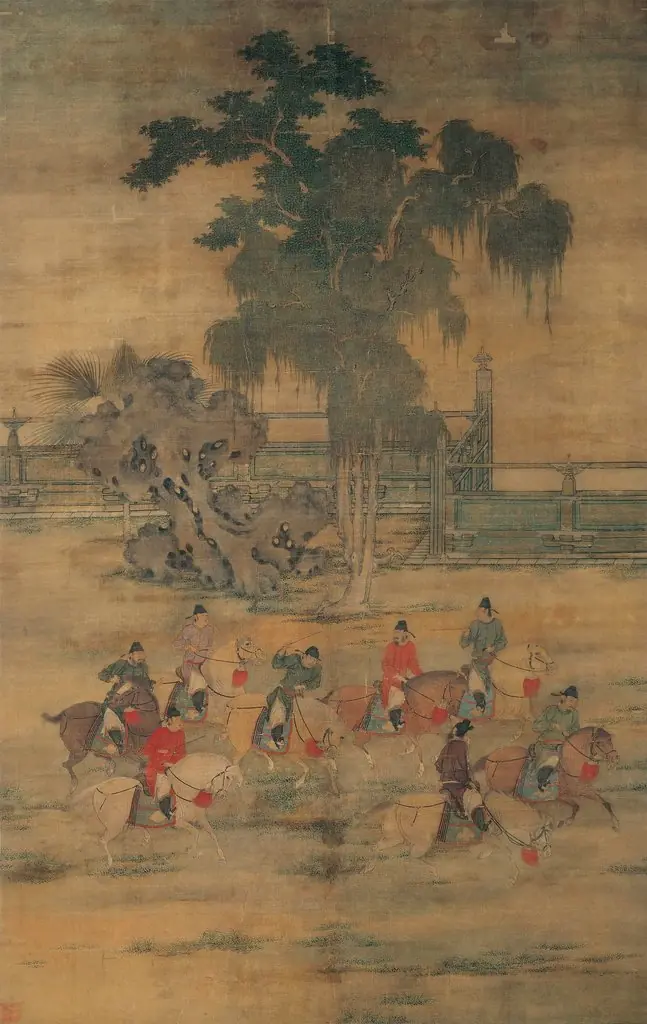
A military review is a paint painting by the Impressionist artist Unknown. It dates from 1880 and is held in the collection of the Victoria and Albert Museum. This painting is one of thirty-five works in a series documenting ceremonial processions from the Kangxi era.
About this work
Overview
The scene is structured around a central architectural backdrop, likely a palace or fortified gate, with figures arranged in disciplined groupings.
This painting is one of thirty-five works in a series documenting ceremonial processions from the Kangxi era. It captures a military review, a formal display of troops and pageantry, rendered in vivid pigments on paper. The scene is structured around a central architectural backdrop, likely a palace or fortified gate, with figures arranged in disciplined groupings. The album, acquired in 1898 from Parsons & Sons, served as a visual record of imperial rituals.
Subject & Meaning
The painting portrays a ceremonial military display featuring soldiers on horseback and figures mounted on tigers, bearing shield-like emblems resembling faces. Flags inscribed with Chinese characters mark authority and identity. Elevated observers on a balcony suggest imperial presence, while a musician plays a wind instrument, underscoring the ritual’s formal character. The tiger riders may symbolize strength or supernatural protection, reinforcing the authority of the reviewing figure.
Technique & Style
The work employs opaque watercolor with bold, saturated hues—deep blues, reds, and golds—contrasted against a pale background to enhance visual clarity. Figures are rendered with precise linework and minimal shading, typical of courtly Chinese painting traditions. The composition is flattened, prioritizing symbolic arrangement over spatial depth, and details like facial features and inscriptions are carefully delineated to convey status and meaning.
History & Provenance
The painting originated as part of a curated album commissioned during the Kangxi reign, likely for imperial use or archival purposes. It remained in private hands until 1898, when it was acquired by a museum alongside the other thirty-four works in the series. The album’s full set, cataloged under D.2-1898 to D.36-1898, reflects a systematic effort to document state ceremonies, possibly for administrative or propagandistic ends.
Context
Created during the Kangxi reign (1662–1722), the painting aligns with a broader imperial project to visually codify state rituals. Military reviews were key displays of power, reinforcing loyalty and order. Similar albums recorded weddings, funerals, and court proceedings, suggesting a systematic approach to documenting the rituals that sustained Qing authority. The inclusion of tiger riders and inscribed flags points to symbolic layers beyond mere documentation.
Legacy
The series remains a rare visual archive of early Qing court ceremonies, offering insight into how authority was performed and perceived. While individual paintings were not widely exhibited in their time, their preservation allows modern scholars to study the intersection of art, politics, and ritual. The tiger-mounted soldiers and inscribed banners continue to intrigue researchers seeking to decode symbolic language in imperial imagery.
Artist & collection

 Domestic Scene
 Giacomo and Cardinal Marco, investing Andrea, Abbot of San Zeno, with his Benefice
 The Nymph of Fontainebleau
 Portrait of a Woman
 Madonna and Child with Saints in the Enclosed Garden
 Venus and Minerva
 Family Group of Four on Sofa
 Wall painting from Room H of the Villa of P. Fannius Synistor at Boscoreale
 Untitled
 A procession
 One scene of a wedding: the bride and her dowry on her way to her new home
 Untitled
 清 那爾敦布 順治皇帝進京之隊伍賽馬全圖 卷|Horsemanship Competition for the Shunzhi Emperor
 Funeral procession of a woman
 The Banquet of Seowangmo (Xiwangmu), Queen Mother of the West
 Resisting Japanese Pirates
 明 佚名 胡笳十八拍圖 卷|Eighteen Songs of a Nomad Flute: The Story of Lady Wenji
 Qasam al-Abbas Arrives from Mecca and Crushes Tahmasp with a Mace
 A magistrate's court
 Eight Princes on a Spring Excursion