Artwork
A Mughal warrior and his wife
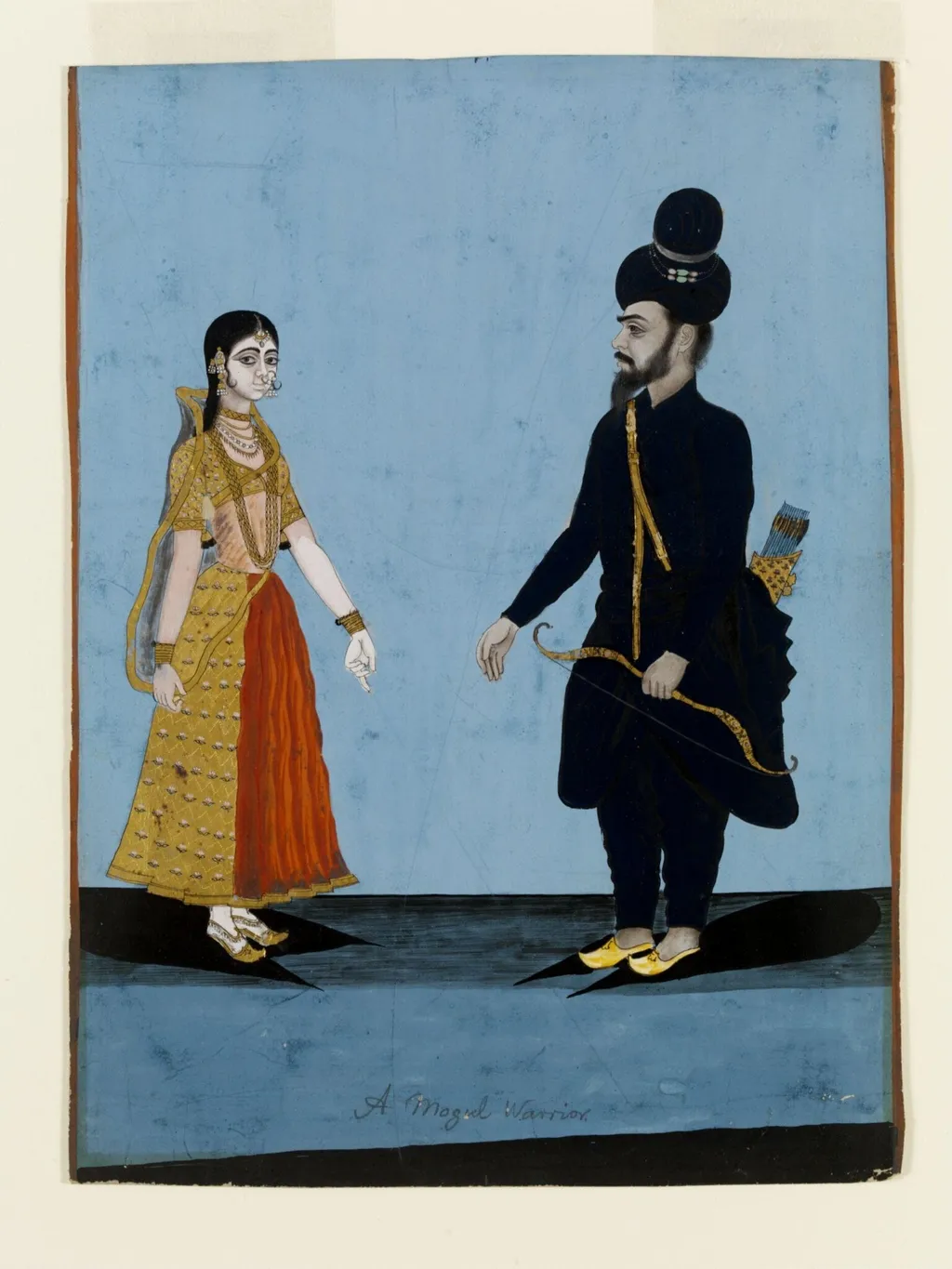
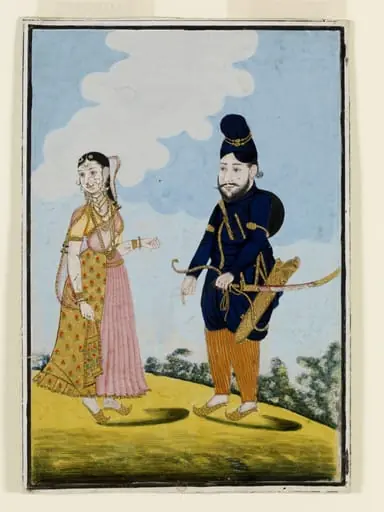
A Mughal warrior and his wife is a paint painting by the Mughal Painting artist Unknown. It dates from 1790 and is held in the collection of the Victoria and Albert Museum.
About this work
The title says this is a "Mughal warrior and his wife," which hints at a mix of cultures.
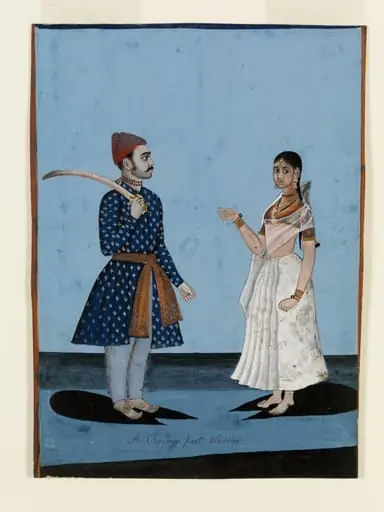
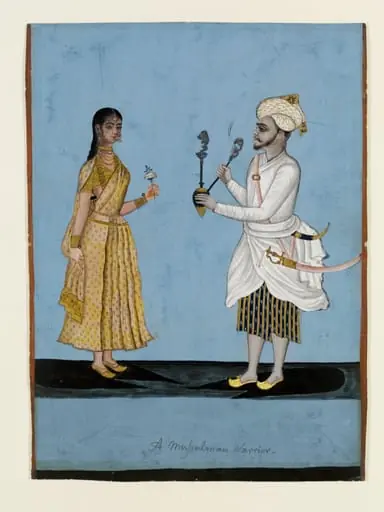
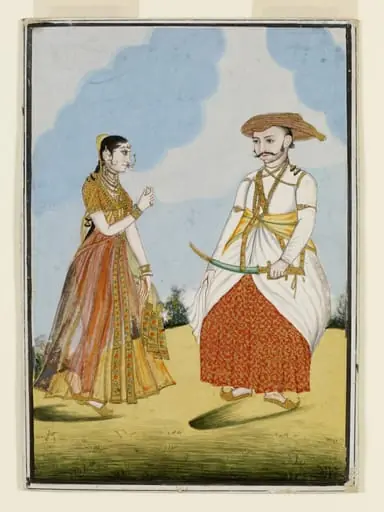
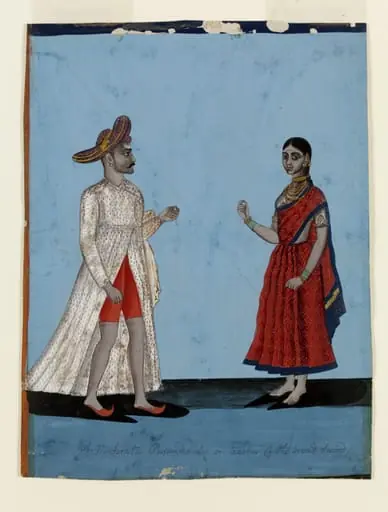
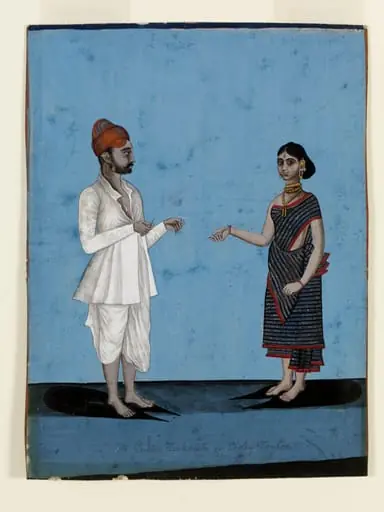
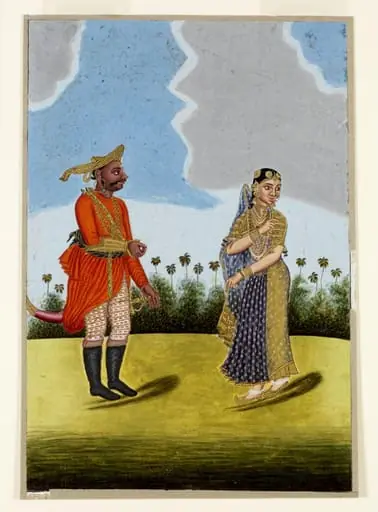
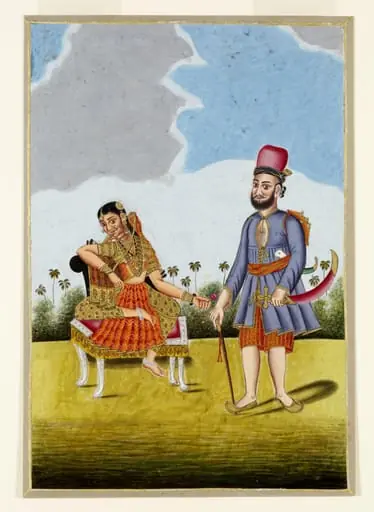
This painting shows a man and woman standing side by side. The man wears a dark coat, a tall black hat, and a bow and quiver on his belt. The woman has a long yellow dress with red trim and gold jewelry. The background is a flat blue color, and the figures look stiff and slightly flat.
The title says this is a "Mughal warrior and his wife," which hints at a mix of cultures. The man’s bow and the woman’s jewelry suggest they might be from South Asia around 1800.
Next, check out the Victoria and Albert Museum to see more paintings like this.
Overview
This painting is one of a series depicting individuals by caste or occupation, created in the Mughal tradition during the early 19th century. Rendered on paper with opaque watercolor, it presents a man and woman standing side by side against a uniform blue background. The figures are rendered with minimal spatial depth, emphasizing their roles over individual identity. The work entered the British collection in 1879 after being transferred from the India Museum.
Subject & Meaning
The man, identified as a warrior, wears a dark coat and tall turban, carrying a bow and quiver—symbols of martial status. His wife is dressed in a yellow robe with red edging and ornate gold jewelry, suggesting her position within a refined social sphere. Together, they represent a composite ideal of Mughal-era nobility, blending Persianate military imagery with South Asian domestic elegance, likely intended to document social hierarchy rather than portray specific individuals.
Technique & Style
The painting employs flat, opaque pigments with little modeling or shading, characteristic of late Mughal and Company school styles. Figures are outlined clearly, with attention to textile patterns and jewelry details, but lack three-dimensional volume. The uniform blue background isolates the subjects, focusing attention on costume and posture. This stylistic choice reflects a shift toward documentary precision over poetic idealization common in earlier Mughal portraiture.
History & Provenance
The painting was part of a set of twelve illustrated panels presented to the India Museum by P. F. Campbell-Johnston in the late 1870s. It was transferred to the South Kensington Museum (later the Victoria and Albert Museum) in 1879 and cataloged in the 1880 register. Its origin likely lies in northern India, possibly commissioned by a British official or local patron interested in ethnographic documentation during the colonial period.
Context
Created during a period of cultural transition, the work reflects the blending of Mughal artistic conventions with British colonial interests in categorizing Indian society. Similar series were produced to visually classify occupations and social groups, often for administrative or ethnographic purposes. While rooted in Mughal miniature traditions, the style shows increasing influence from European naturalism and the demands of colonial record-keeping.
Legacy
This painting contributes to a broader archive of 19th-century Indian visual ethnography preserved in British institutions. Though not widely exhibited today, it remains a key example of how colonial-era collectors framed Indian social structures through art. Its preservation offers insight into the intersection of indigenous artistic practice and imperial documentation, serving as a historical record of identity construction under colonial rule.
Artist & collection

 Domestic Scene
 Giacomo and Cardinal Marco, investing Andrea, Abbot of San Zeno, with his Benefice
 The Nymph of Fontainebleau
 Portrait of a Woman
 Madonna and Child with Saints in the Enclosed Garden
 Venus and Minerva
 Family Group of Four on Sofa
 Wall painting from Room H of the Villa of P. Fannius Synistor at Boscoreale