Artwork
A Newly-Cut Print of Illustrations from The Classic of Mountains and Seas
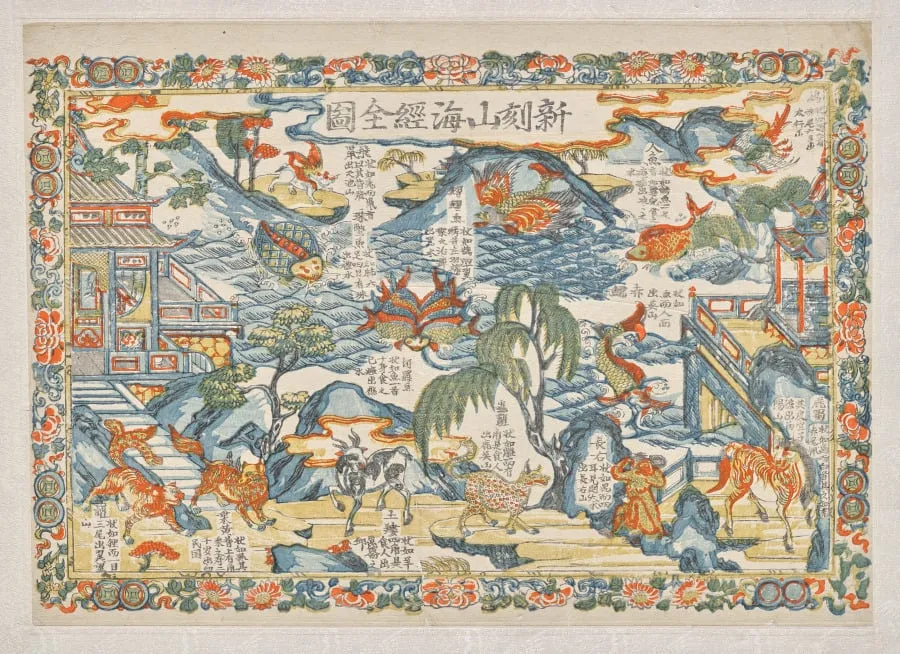
A Newly-Cut Print of Illustrations from The Classic of Mountains and Seas is a print by the Romanticist artist Unknown. It dates from 1808 and is held in the collection of the Cleveland Museum of Art.
About this work
You see a bright, busy sheet of paper covered with tiny black-and-white pictures of mountains, rivers, and strange creatures—some real, some made-up.
You see a bright, busy sheet of paper covered with tiny black-and-white pictures of mountains, rivers, and strange creatures—some real, some made-up.
This is a woodblock print from a book called *The Classic of Mountains and Seas*, an old Chinese text full of myths and geography. Instead of keeping it private, someone turned it into a wall print for homes, like a poster. The lines are sharp, almost like a comic.
If you like these old Chinese stories, look up *Qing dynasty (1644–1911)*.
Overview
This woodblock print is a single-sheet reproduction derived from illustrations in *The Classic of Mountains and Seas*, a classical Chinese text dating back centuries. Produced in the 17th century in the Jiangnan region, it reflects a shift from private, book-bound imagery to publicly displayed wall art. The print’s dense composition of finely carved lines made it suitable for domestic decoration, aligning with growing urban demand for visual culture beyond manuscript formats.
Subject & Meaning
The image depicts a constellation of mythic and natural elements drawn from ancient Chinese cosmology: winding rivers, towering peaks, and hybrid creatures—some based on observed animals, others entirely fantastical. These figures were not merely decorative; they encoded beliefs about the natural world’s spiritual dimensions, serving as visual anchors for stories passed down through generations. Displayed in homes, they invited contemplation of the unseen forces shaping the landscape.
Technique & Style
Executed in black ink on paper using woodblock carving, the print relies on precise, linear engraving to render intricate details without color. The sharp, unbroken contours resemble early graphic storytelling, emphasizing clarity over atmospheric depth. Each figure is tightly packed, creating a rhythmic visual field that mirrors the textual density of the original manuscript. The technique prioritized reproducibility and legibility for mass domestic use.
History & Provenance
Originating in the late Ming or early Qing period, this print emerged from commercial printing centers like Nanjing and Suzhou, where artisans adapted literary illustrations for broader audiences. Unlike earlier hand-copied editions, this version was mass-produced as a standalone wall hanging, likely sold in urban markets. Its survival suggests it was valued enough to be preserved, though its exact ownership history remains undocumented.
Context
During the 17th century, rising literacy and urban prosperity in Jiangnan fueled demand for affordable visual art. Illustrated texts, once confined to scholarly circles, were repurposed into decorative prints for middle-class homes. This print reflects a cultural moment when mythological knowledge became part of everyday domestic life, bridging elite literature and popular taste through accessible imagery.
Legacy
This print exemplifies how ancient Chinese mythologies were kept alive through visual reproduction. Its format influenced later folk art and commercial illustrations, establishing a precedent for mythic imagery in public spaces. While the original text remained a scholarly reference, such prints ensured its creatures and landscapes entered the collective imagination of non-elite audiences across generations.
Artist & collection

 Domestic Scene
 Giacomo and Cardinal Marco, investing Andrea, Abbot of San Zeno, with his Benefice
 The Nymph of Fontainebleau
 Portrait of a Woman
 Madonna and Child with Saints in the Enclosed Garden
 Venus and Minerva
 Family Group of Four on Sofa
 Wall painting from Room H of the Villa of P. Fannius Synistor at Boscoreale
 The Dragon Boat Festival
 清 緙絲龍舟競渡圖|Dragon-boat festival performance
 秋夜長物語絵巻断簡|The Final Scene from A Long Tale for an Autumn Night (Aki no yonaga monogatari)
 Outing on a Lake
 「籠細工 浪花細工人一田庄七郎」|Basketry Work: By the Craftsman Ichida Shōshichirō of Naniwa (Kagosaiku Naniwa saikujin Ichida Shōshichirō)
 The Banquet of Seowangmo (Xiwangmu), Queen Mother of the West
 Untitled