Artwork
A watchman and his wife
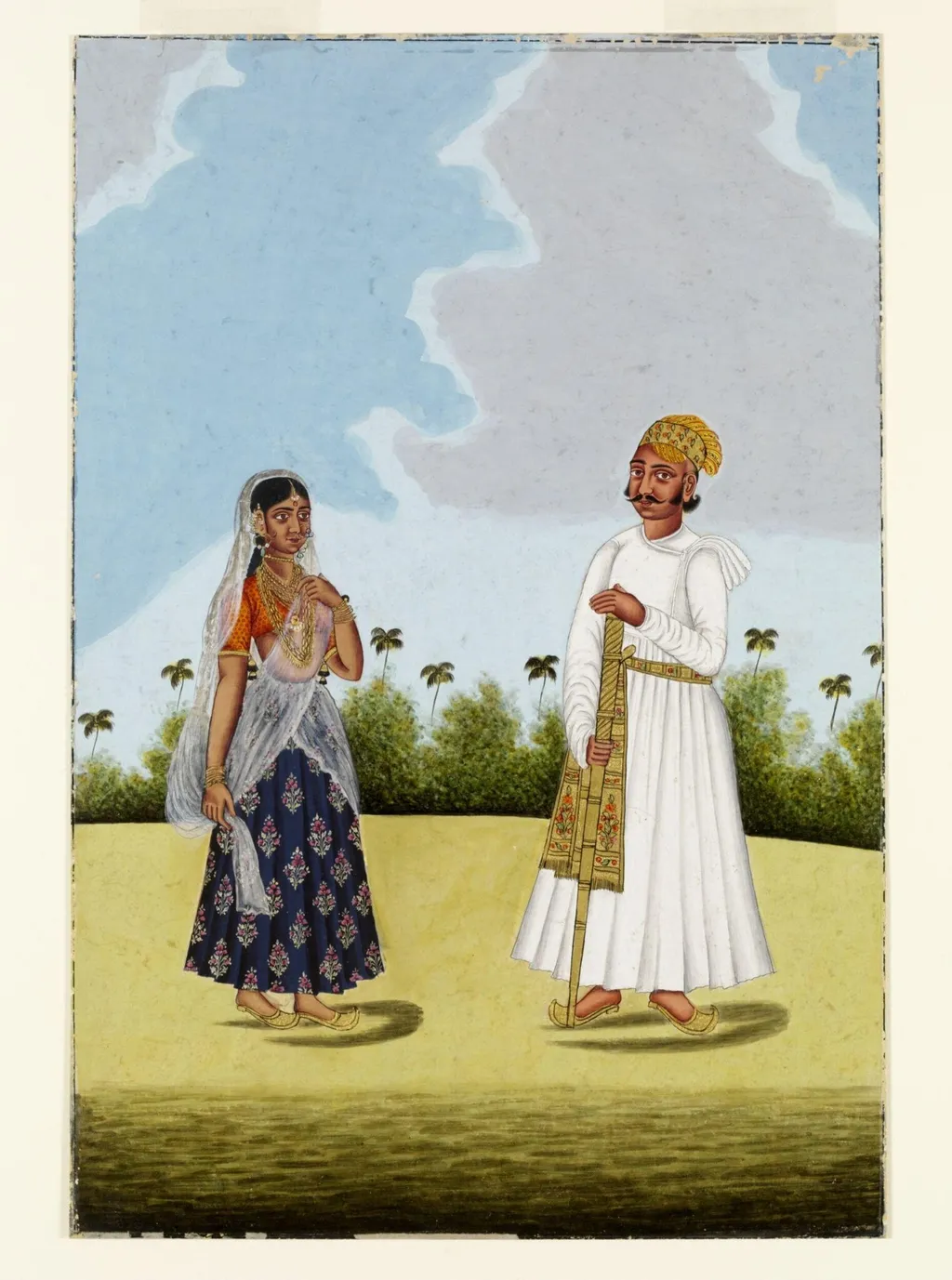
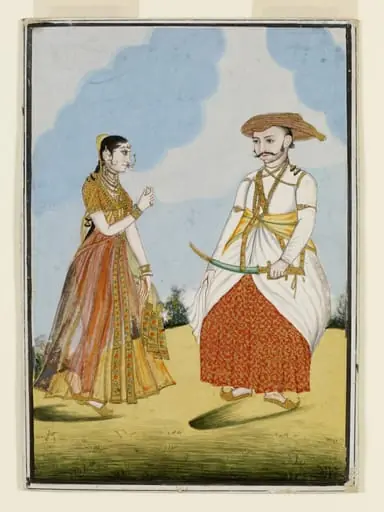
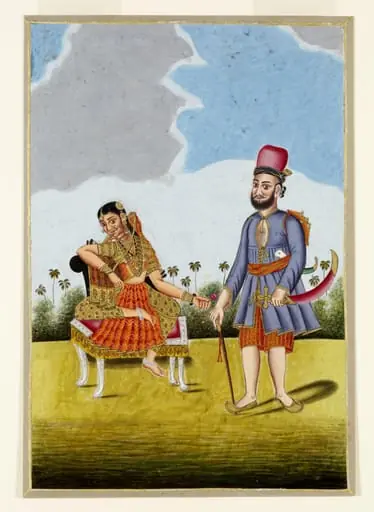
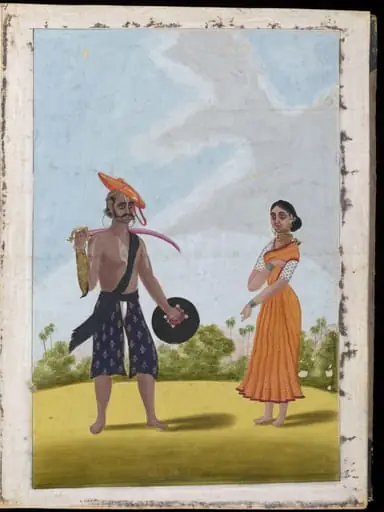
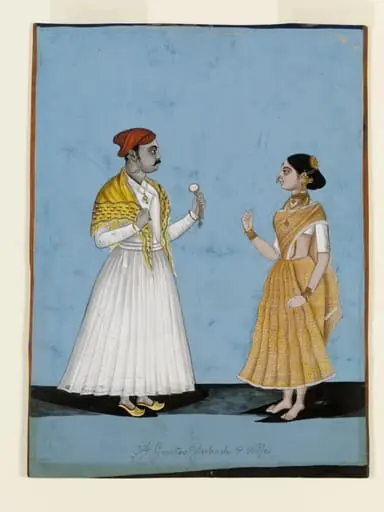
A watchman and his wife is a paint painting by the Romanticist artist Unknown. It dates from 1800 and is held in the collection of the Victoria and Albert Museum.
About this work
Overview
The background features sparse vegetation and a soft sky, grounding the scene in a recognizable environment rather than an idealized one.
This painting portrays a watchman and his wife, part of a series documenting social roles in upper India. The figures stand side by side in an open landscape, their attire and posture reflecting their domestic and civic duties. The composition emphasizes stillness and quiet dignity, avoiding theatricality. The background features sparse vegetation and a soft sky, grounding the scene in a recognizable environment rather than an idealized one.
Subject & Meaning
The man, a chobdar, served as a gatekeeper, using his gold-tipped staff to announce arrivals—a role tied to status and trust. His sword suggests authority beyond ceremonial duty. His wife, dressed in a patterned blue skirt and veil, occupies a complementary space: her stillness implies domestic vigilance. Together, they represent a household unit bound by duty, where public service and private life intersect without hierarchy.
Technique & Style
The painting employs fine brushwork to render textures: the sheen of the man’s robe, the weave of the woman’s veil, and the delicate patterning on her skirt. Colors are muted yet deliberate—white, gold, deep blue, and red—creating contrast without vibrancy. The figures are rendered with subtle modeling, avoiding exaggerated expression, reinforcing the quiet realism characteristic of regional portraiture from this period.
History & Provenance
Created as part of a larger set illustrating occupational castes, the work likely originated in a north Indian atelier during the late 18th or early 19th century. It was probably commissioned by a local patron or colonial official interested in documenting social structures. Its survival suggests it was preserved within a private collection, later entering institutional hands, though its exact provenance before modern cataloging remains undocumented.
Context
Such paintings emerged during a period when regional courts and British administrators sought to classify Indian society through visual means. The chobdar, though not elite, held a recognized position in urban and palace settings. These images were not merely ethnographic—they reflected a cultural moment where identity, function, and appearance were being systematically recorded, often for external audiences.
Legacy
The painting contributes to a visual archive of everyday roles in pre-colonial and early colonial India. While not widely exhibited, it remains a quiet testament to the dignity assigned to service-based professions. Its inclusion in museum collections underscores its value as a historical document, offering insight into social organization beyond the realm of royalty or religious iconography.
Artist & collection

 Domestic Scene
 Giacomo and Cardinal Marco, investing Andrea, Abbot of San Zeno, with his Benefice
 The Nymph of Fontainebleau
 Portrait of a Woman
 Madonna and Child with Saints in the Enclosed Garden
 Venus and Minerva
 Family Group of Four on Sofa
 Wall painting from Room H of the Villa of P. Fannius Synistor at Boscoreale