Artwork
A woman and a young boy
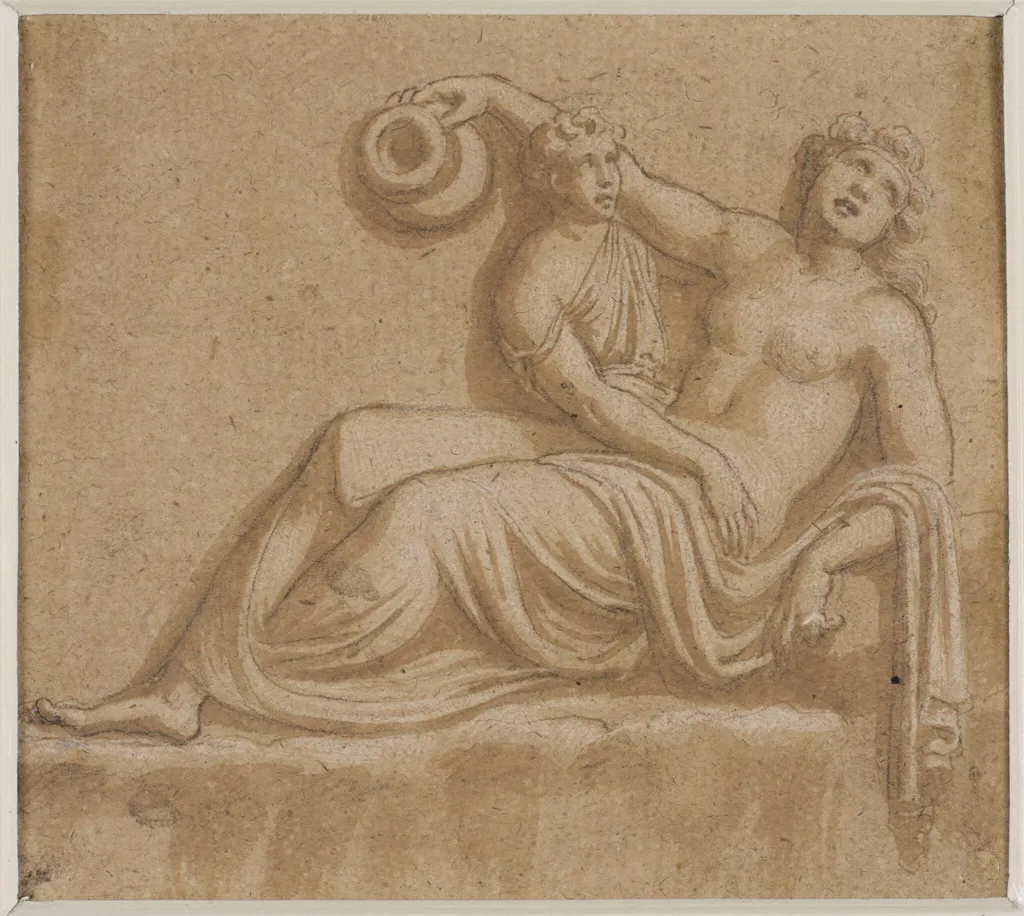
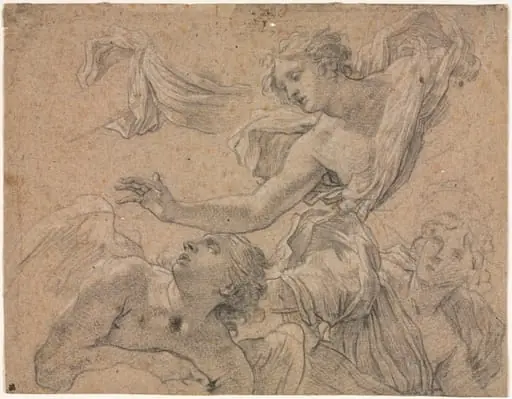
A woman and a young boy is a drawing by Unknown. It dates from 1650 and is held in the collection of the Victoria and Albert Museum. This drawing depicts a reclining woman supported by a young boy, rendered in ink with careful cross-hatching to suggest volume and drapery.
About this work
Overview
Its function appears to be a preparatory study, possibly for a sculptural relief, aligning with Poussin’s practice of designing for multiple media.
This drawing depicts a reclining woman supported by a young boy, rendered in ink with careful cross-hatching to suggest volume and drapery. Though not authored by Nicolas Poussin, it reflects the stylistic influence of his circle, likely created by an assistant or close follower. Its function appears to be a preparatory study, possibly for a sculptural relief, aligning with Poussin’s practice of designing for multiple media.
Subject & Meaning
The figures suggest an allegorical scene, possibly representing mercy, grief, or a mythological narrative involving care and dependence. The woman’s reclining posture and the boy’s supportive role imply a symbolic relationship, common in Poussin’s moralizing compositions. The absence of overt narrative cues invites interpretation rooted in classical or Christian ideals of compassion and duty.
Technique & Style
The drawing employs fine ink lines and layered cross-hatching to model forms and convey texture, particularly in the folds of fabric. The composition is restrained and balanced, echoing Poussin’s classical sensibility. Figures are rendered with deliberate economy, emphasizing structure over ornament, consistent with studio practices of the time aimed at clarity and preparatory function.
History & Provenance
The work emerged from a milieu closely associated with Poussin’s studio in Rome or Paris during the mid-17th century. While its exact origin remains undocumented, its stylistic affinity to Poussin’s designs suggests it was produced by a trained follower, perhaps during the execution of a larger commission. No definitive record links it to a specific sculpture or series.
Context
In the 1630s–1660s, Poussin and his followers frequently explored themes drawn from antiquity and scripture through drawings intended as studies for paintings or sculptures. This piece reflects a broader trend in French and Italian academies where preparatory work was valued for its intellectual rigor and formal discipline, serving as a bridge between concept and finished art.
Legacy
Though unsigned and unattributed to Poussin, the drawing contributes to understanding the transmission of his aesthetic among contemporaries. It exemplifies how his compositional principles—clarity, restraint, allegorical depth—were absorbed and replicated in studio practice, influencing later generations of draftsmen committed to classical ideals.
Artist & collection

 Domestic Scene
 Giacomo and Cardinal Marco, investing Andrea, Abbot of San Zeno, with his Benefice
 The Nymph of Fontainebleau
 Portrait of a Woman
 Madonna and Child with Saints in the Enclosed Garden
 Venus and Minerva
 Family Group of Four on Sofa
 Wall painting from Room H of the Villa of P. Fannius Synistor at Boscoreale