Artwork
Actor Holding a Razor
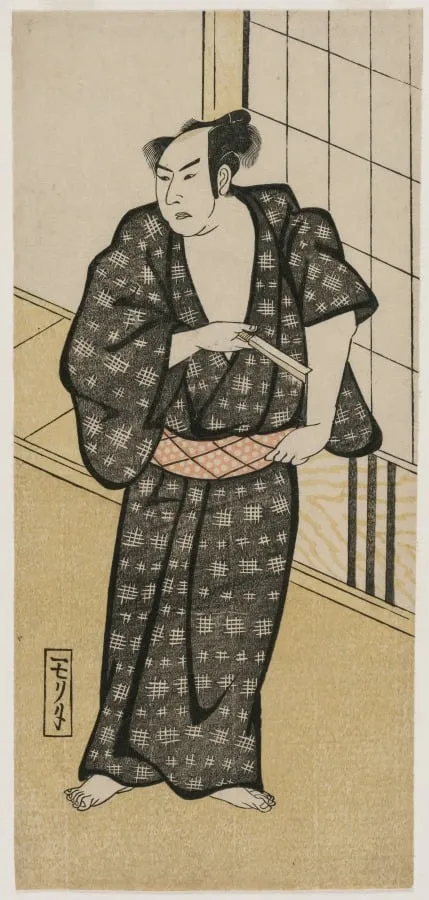
Actor Holding a Razor is a print by the Romanticist artist Unknown. It dates from 1800 and is held in the collection of the Cleveland Museum of Art.
About this work
Overview
This Japanese print depicts a kabuki actor in mid-performance, dressed in a dark checkered kimono and hakama, barefoot on a minimalist stage. He holds a small, folded object near his waist, its purpose ambiguous but suggestive of ritual or danger. The composition isolates the figure against a plain wooden backdrop, emphasizing his presence through stark contrasts and deliberate stillness.
Subject & Meaning
The figure represents a kabuki performer embodying a dramatic role, likely one involving tension or imminent action. The razor-like object may symbolize honor, violence, or a moment of decision common in kabuki narratives. His intense expression and rigid posture convey psychological weight, aligning with the genre’s emphasis on emotional extremes and theatrical gesture.
Technique & Style
The print employs bold outlines and flat areas of color typical of ukiyo-e, with heightened contrast to accentuate form and emotion. The actor’s face is rendered with sharp, angular features, while the checkered fabric adds rhythmic texture. Background elements are simplified, directing focus to the figure’s gesture and expression without narrative distraction.
History & Provenance
Created during the Edo period, this print likely originated from a series illustrating popular kabuki roles. Such prints were mass-produced for public consumption, serving as both entertainment and cultural documentation. While the artist and exact date remain unconfirmed, the style aligns with late 18th- to early 19th-century actor portraits from Osaka or Edo workshops.
Context
Kabuki theater flourished in Edo-period Japan as a vibrant urban art form, and actor prints were its visual counterpart. These images allowed audiences to connect with performers beyond the stage, immortalizing iconic roles and expressions. The focus on a single figure in a stripped-down setting reflects the theatrical convention of minimalism and heightened emotional expression.
Legacy
This print contributes to a broader tradition of ukiyo-e that documented performance culture and shaped global perceptions of Japanese art. Its emphasis on psychological intensity and stylized form influenced later Western artists, particularly in the 19th century, as interest in Japanese aesthetics grew. It remains a quiet testament to the power of theatrical representation in print.
Artist & collection

 Domestic Scene
 Giacomo and Cardinal Marco, investing Andrea, Abbot of San Zeno, with his Benefice
 The Nymph of Fontainebleau
 Portrait of a Woman
 Madonna and Child with Saints in the Enclosed Garden
 Venus and Minerva
 Family Group of Four on Sofa
 Wall painting from Room H of the Villa of P. Fannius Synistor at Boscoreale
 Untitled
 Young Woman Standing Beside a Pine Tree Within the Precincts of a Temple
 Young Woman Standing Under an Umbrella in the Snow
 当世美人三遊 芸妓|“Geisha” from the series Three Amusements of Contemporary Beauties (Tōsei bijin san’yū: Geigi)
 Untitled
 Two Geisha on a Balcony
 四代目岩井半四郎|Kabuki Actor Iwai Hanshirō IV
 勝川春章画 三代目吾妻藤蔵|Kabuki Actor Azuma Tōzō III
 Untitled