Artwork
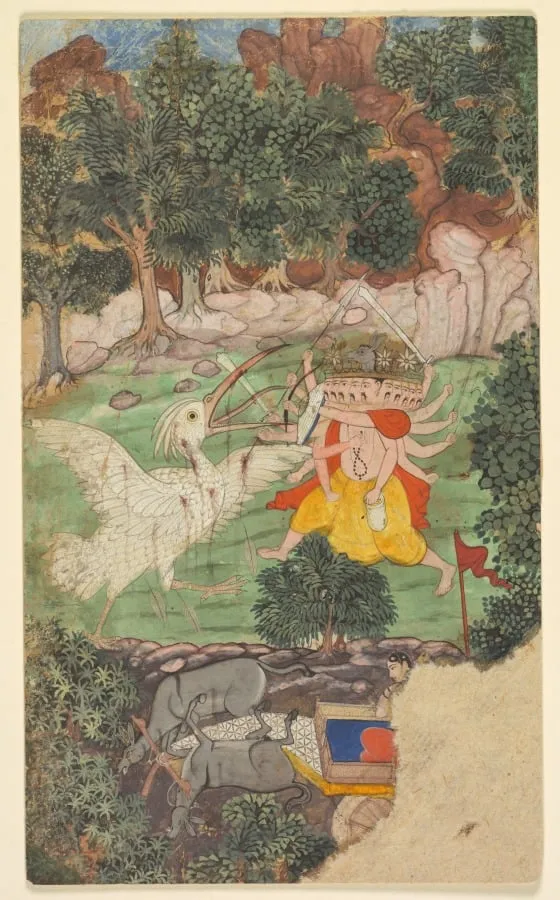
Battle of Ravana and Jatayu, from Chapters 50 and 51 of the Aranya Kanda (Book of the Forest) of Valmiki's Ramayana (Rama’s Journey); folio from the "Burnt" Ramayana
Battle of Ravana and Jatayu, from Chapters 50 and 51 of the Aranya Kanda (Book of the Forest) of Valmiki's Ramayana (Rama’s Journey); folio from the "Burnt" Ramayana is an unspecified painting by the Mughal Painting artist Unknown. It dates from 1605 and is held in the collection of the Cleveland Museum of Art.
About this work
The story comes from an old Hindu epic, but the artist added local details—like the donkeys, which the text says were the first to die.
You see a bright, busy fight: a giant vulture with red blood on his wings slashes at a ten-headed king in a chariot pulled by donkeys.
This painting was made for a king in central India around 1605. The story comes from an old Hindu epic, but the artist added local details—like the donkeys, which the text says were the first to die. A fire later damaged the painting, so the kidnapped woman, Sita, is now just a faint shape in the corner.
To see more paintings like this, look up the Rajput kingdom of Datia.
Overview
The work depicts a dramatic episode from the Aranya Kanda of Valmiki’s Ramayana, showing the vulture‑king Jatayu battling the ten‑headed demon Ravana as the latter flees with Sita in a donkey‑drawn chariot. The scene is rendered in a crowded, vivid composition, with Jatayu’s wounded wings stained in red and Ravana’s chariot dominating the centre.
Subject & Meaning
Jatayu, the lord of birds, is shown in a desperate struggle to rescue Sita, whose faint figure appears in the lower right corner of the painting. The artist follows the epic’s narrative, emphasizing Jatayu’s sacrifice and Ravana’s ruthless advance, while Sita’s contemplative expression hints at her impending fate.
Technique & Style
Executed in the early‑17th‑century Rajput tradition, the painting combines bright colours with intricate detailing of figures and animals. The composition is dense, with dynamic lines conveying movement; the red blood on Jatayu’s wings provides a stark visual contrast against the surrounding palette.
History & Provenance
Created around 1605 for a central Indian monarch, the piece originally included clear depictions of the donkey‑pulled chariot, reflecting a textual note that the donkeys were the first casualties of the clash. Decades later, a fire damaged the work, erasing much of Sita’s image and leaving only a ghostly outline.
Context
The episode derives from the Ramayana’s Book of the Forest, chapters 50 and 51, where Jatayu confronts Ravana after the latter abducts Sita. The inclusion of local elements, such as the donkeys, demonstrates the artist’s adaptation of the pan‑Indian epic to regional visual conventions.
Artist & collection

 Domestic Scene
 Giacomo and Cardinal Marco, investing Andrea, Abbot of San Zeno, with his Benefice
 The Nymph of Fontainebleau
 Portrait of a Woman
 Madonna and Child with Saints in the Enclosed Garden
 Venus and Minerva
 Family Group of Four on Sofa
 Wall painting from Room H of the Villa of P. Fannius Synistor at Boscoreale