Artwork
A Woman Charms Snakes in the Wilderness: Asavari Ragini, from a Ragamala
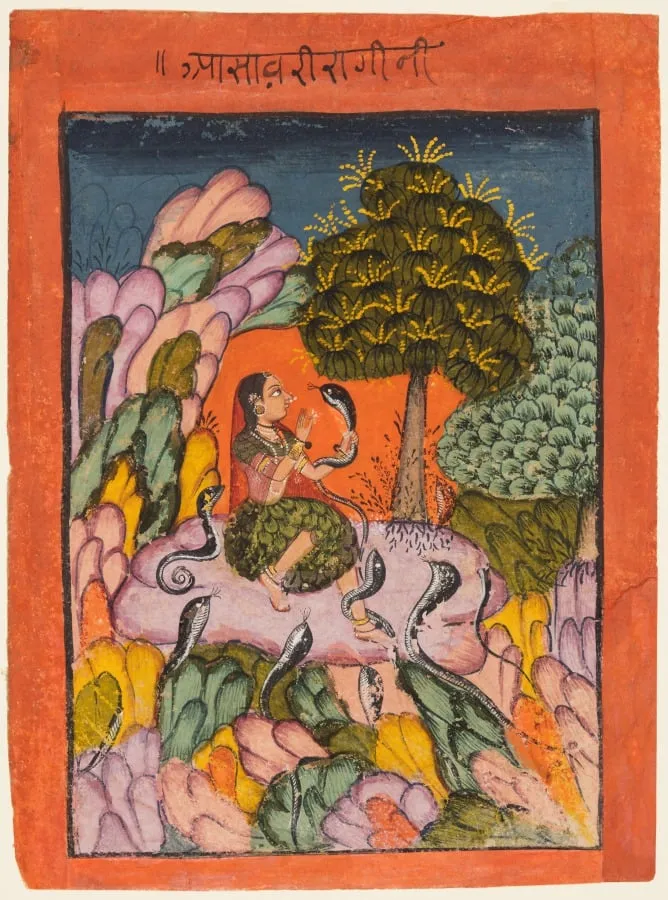
A Woman Charms Snakes in the Wilderness: Asavari Ragini, from a Ragamala is an unspecified painting by the Baroque artist Unknown. It dates from 1704 and is held in the collection of the Cleveland Museum of Art.
About this work
Overview
This painting is part of a Ragamala series, a visual interpretation of Indian classical ragas, each linked to a specific time, emotion, or narrative.
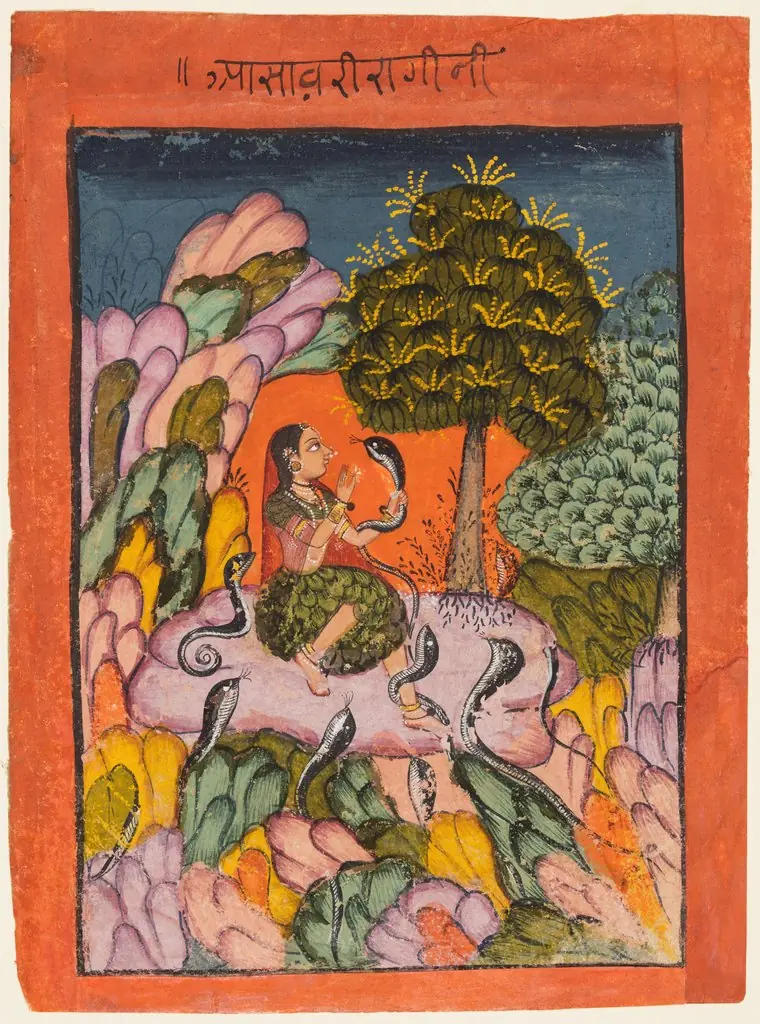
This painting is part of a Ragamala series, a visual interpretation of Indian classical ragas, each linked to a specific time, emotion, or narrative. Depicting the Asavari raga, it illustrates a woman in a wild landscape who, through her presence and music, draws serpents toward her. The scene merges natural elements with symbolic resonance, reflecting the raga’s contemplative and melancholic character.
Subject & Meaning
The central figure, a woman adorned in jewelry and a sheer veil, embodies the raga’s emotional depth. Surrounded by serpents drawn to her, she represents harmony between human grace and the natural world. Her leafy garments suggest retreat from society, while her continued adornment implies inner dignity. The snakes, often symbols of danger, become tranquil, reflecting the raga’s power to transform fear into serenity.
Technique & Style
The artist employs vivid, non-naturalistic hues—pink, blue, and green—to render the rocks, creating an ethereal atmosphere that blurs the boundary between reality and the spiritual. Fine brushwork defines the woman’s delicate veil and jewelry, contrasting with the fluid, organic forms of the snakes. The composition centers her stillness amid motion, reinforcing the raga’s meditative mood through visual rhythm.
History & Provenance
Created in the Rajput kingdom of Sirohi during the late 17th or early 18th century, this work belongs to a regional tradition of Ragamala painting that flourished under royal patronage. Sirohi artists were known for their lyrical style and integration of local landscapes with devotional themes. The painting likely originated in a manuscript or album commissioned for courtly contemplation or musical performance.
Context
Ragamala paintings emerged as a visual counterpart to North Indian classical music, translating abstract musical modes into poetic imagery. The Asavari raga, associated with late afternoon and longing, was often depicted through solitary figures in nature. In Sirohi, such works reflected a fusion of spiritual ideals and aristocratic aesthetics, where music, nature, and emotion intertwined in ritualized visual form.
Legacy
This painting exemplifies how regional Rajput schools adapted broader devotional and musical traditions into distinct visual languages. While many Ragamala sets were dispersed or lost, surviving examples like this one inform modern understandings of Indian aesthetic theory. They remain key references for scholars studying the intersection of music, painting, and spiritual symbolism in pre-colonial India.
Artist & collection

 Domestic Scene
 Giacomo and Cardinal Marco, investing Andrea, Abbot of San Zeno, with his Benefice
 The Nymph of Fontainebleau
 Portrait of a Woman
 Madonna and Child with Saints in the Enclosed Garden
 Venus and Minerva
 Family Group of Four on Sofa
 Wall painting from Room H of the Villa of P. Fannius Synistor at Boscoreale
 A Woman Charms Snakes in the Wilderness: Asavari Ragini, from a Ragamala
 Ascetic Princess with Snakes in a Wilderness: Asavari Ragini, from a Ragamala
 Asavari Ragini: A Female Yogini (Page from a Ragamala Set)
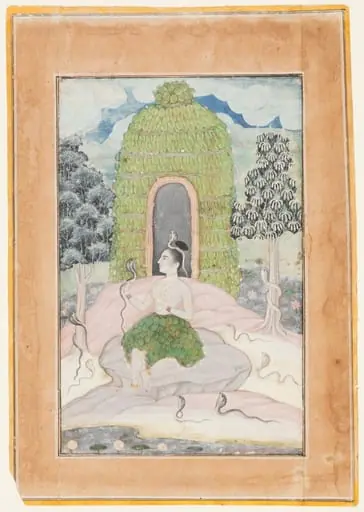 Ascetic Princess with Snakes in a Wilderness: Asavari Ragini, from a Ragamala
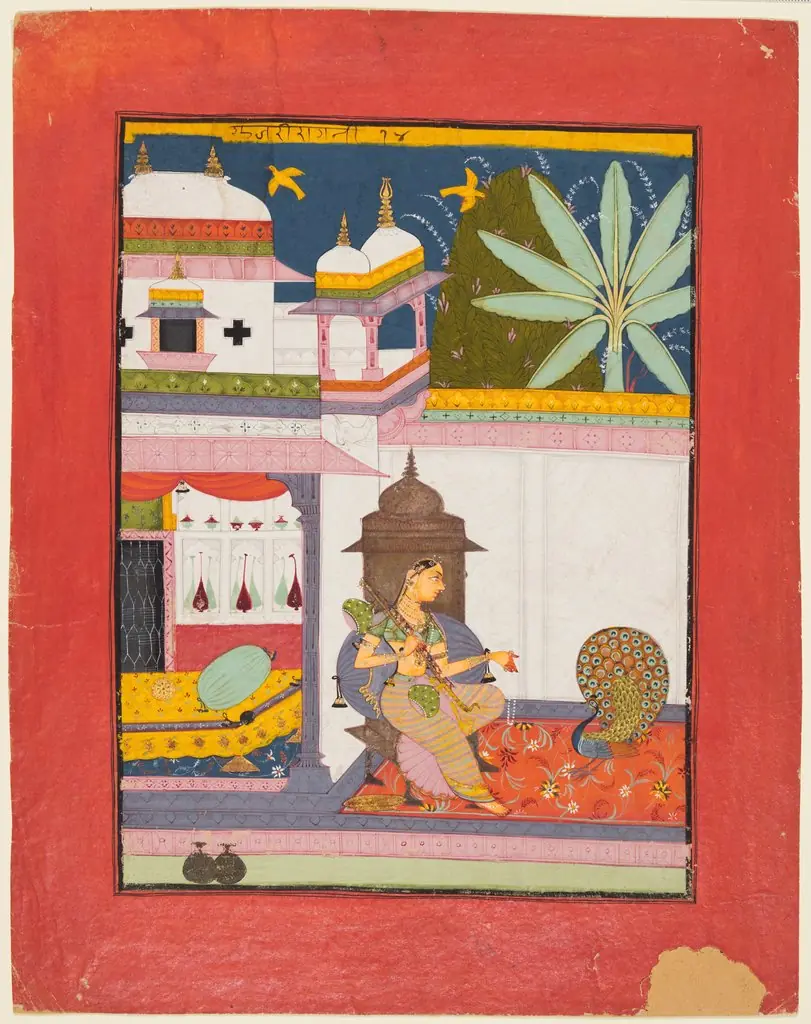 Woman Addressing a Peacock: Gujari Ragini of Megh, from a Ragamala
 Woman Addressing a Peacock: Gujari Ragini of Megh, from a Ragamala
 Asavari Ragini
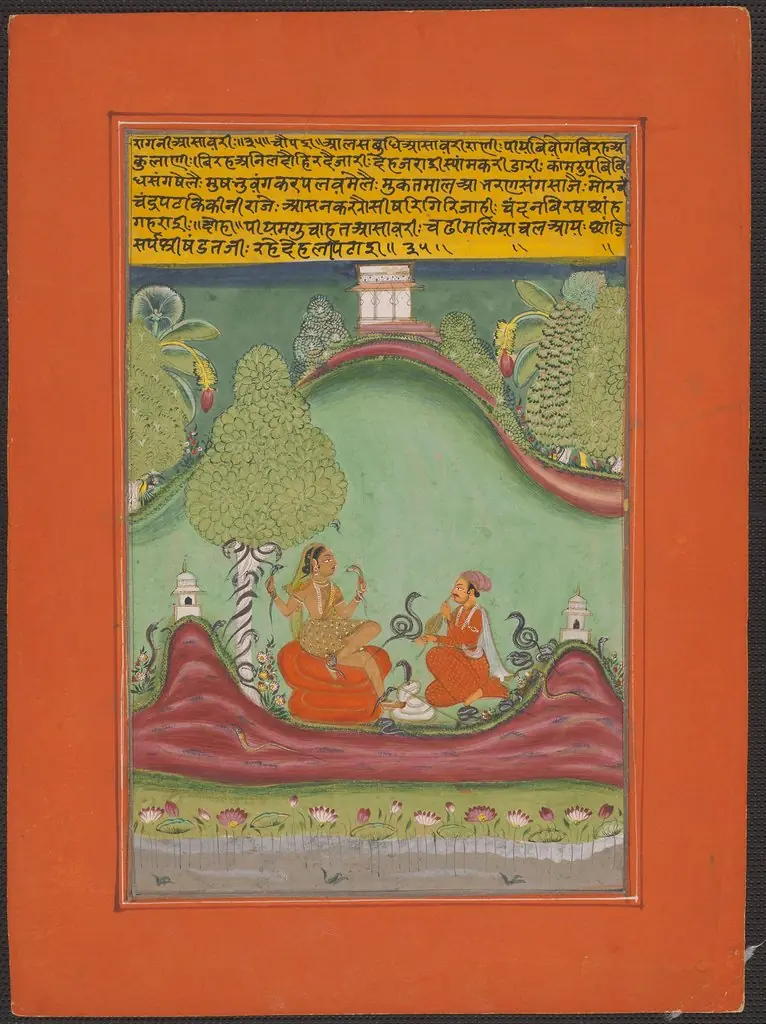 Ragini Asavari, Page from a Jaipur Ragamala Set