Artwork
Bookplate: W. M. T.
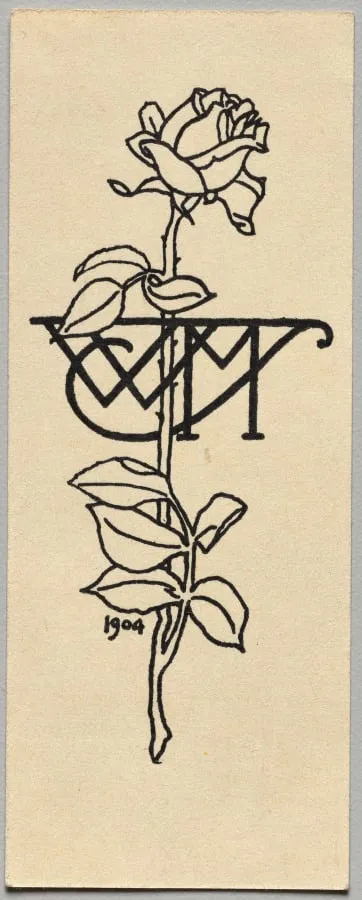
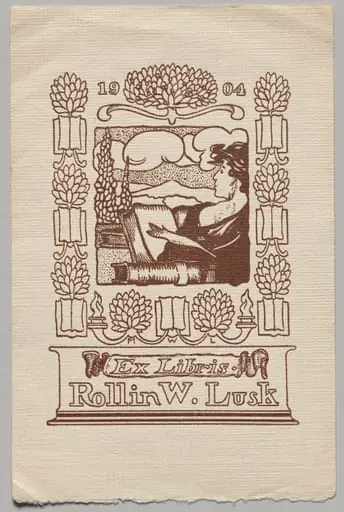
Bookplate: W. M. T. is a print by Unknown. It dates from 1904 and is held in the collection of the Cleveland Museum of Art. This print is a bookplate, a small adhesive label used to denote ownership of a book.
About this work
To learn more about the artist's use of floral motifs, you can explore the work of other artists who have used similar techniques, such as Unknown.
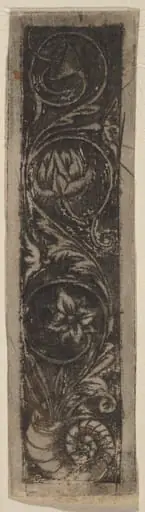
This image depicts a black line drawing on a beige background, featuring a rose with leaves and stems. The rose is positioned vertically, with the flower at the top and the stem extending downwards. The leaves are arranged along the stem, with some facing upwards and others downwards.
A decorative letter "W" is situated behind the rose, with the letters "M" and "T" placed to the right of the stem. The year "1904" is written in small letters at the bottom left of the image.
The image appears to be a bookplate, possibly created for a specific book or collection. To learn more about the artist's use of floral motifs, you can explore the work of other artists who have used similar techniques, such as Unknown.
Overview
This print is a bookplate, a small adhesive label used to denote ownership of a book. Executed in fine black lines on a pale background, it features a stylized rose with accompanying foliage, arranged vertically. The initials W.M.T. are integrated into the design, with a decorative W positioned behind the bloom and M and T placed to the right. The date 1904 appears in small script at the lower left, anchoring the work in time.
Subject & Meaning
The rose, a traditional symbol of beauty and personal identity, serves as the central motif, likely chosen to reflect the owner’s taste or name. The inclusion of initials suggests a private, personalized marker rather than a public statement. The vertical composition and delicate linework convey quiet elegance, aligning with early 20th-century ideals of refined domesticity and individual distinction in private collections.
Technique & Style
The design is rendered in precise, continuous line engraving or etching, typical of bookplate production in the early 1900s. The absence of tone or shading emphasizes contour and form, creating a graphic clarity suited to reproduction. The floral elements are stylized rather than naturalistic, with leaves arranged symmetrically to balance the composition. The lettering is integrated as part of the ornamentation, not as separate text.
History & Provenance
Created in 1904, this bookplate was likely commissioned by or for W.M.T., possibly a collector, scholar, or member of a private library. Such plates were commonly affixed to the inside front cover of books to assert ownership and convey personal identity. While the artist’s name is unrecorded, the style reflects the Arts and Crafts movement’s influence on private printing and design in Britain and North America during this period.
Context
Bookplates flourished in the late 19th and early 20th centuries as literacy and private book collecting expanded. They often combined heraldic, floral, or classical motifs with initials or names, serving both functional and aesthetic roles. This example aligns with a broader trend of using botanical imagery to evoke refinement and permanence, contrasting with the industrial mass production of the era.
Legacy
Though modest in scale, this bookplate exemplifies the quiet craftsmanship of personal library culture before the rise of institutional cataloging. Its survival offers insight into individual collecting habits and the visual language of ownership in pre-digital eras. Similar designs remain of interest to bibliophiles and historians studying the material culture of reading.
Artist & collection

 Domestic Scene
 Giacomo and Cardinal Marco, investing Andrea, Abbot of San Zeno, with his Benefice
 The Nymph of Fontainebleau
 Portrait of a Woman
 Madonna and Child with Saints in the Enclosed Garden
 Venus and Minerva
 Family Group of Four on Sofa
 Wall painting from Room H of the Villa of P. Fannius Synistor at Boscoreale