Artwork
Cathedral Tower in Antwerp
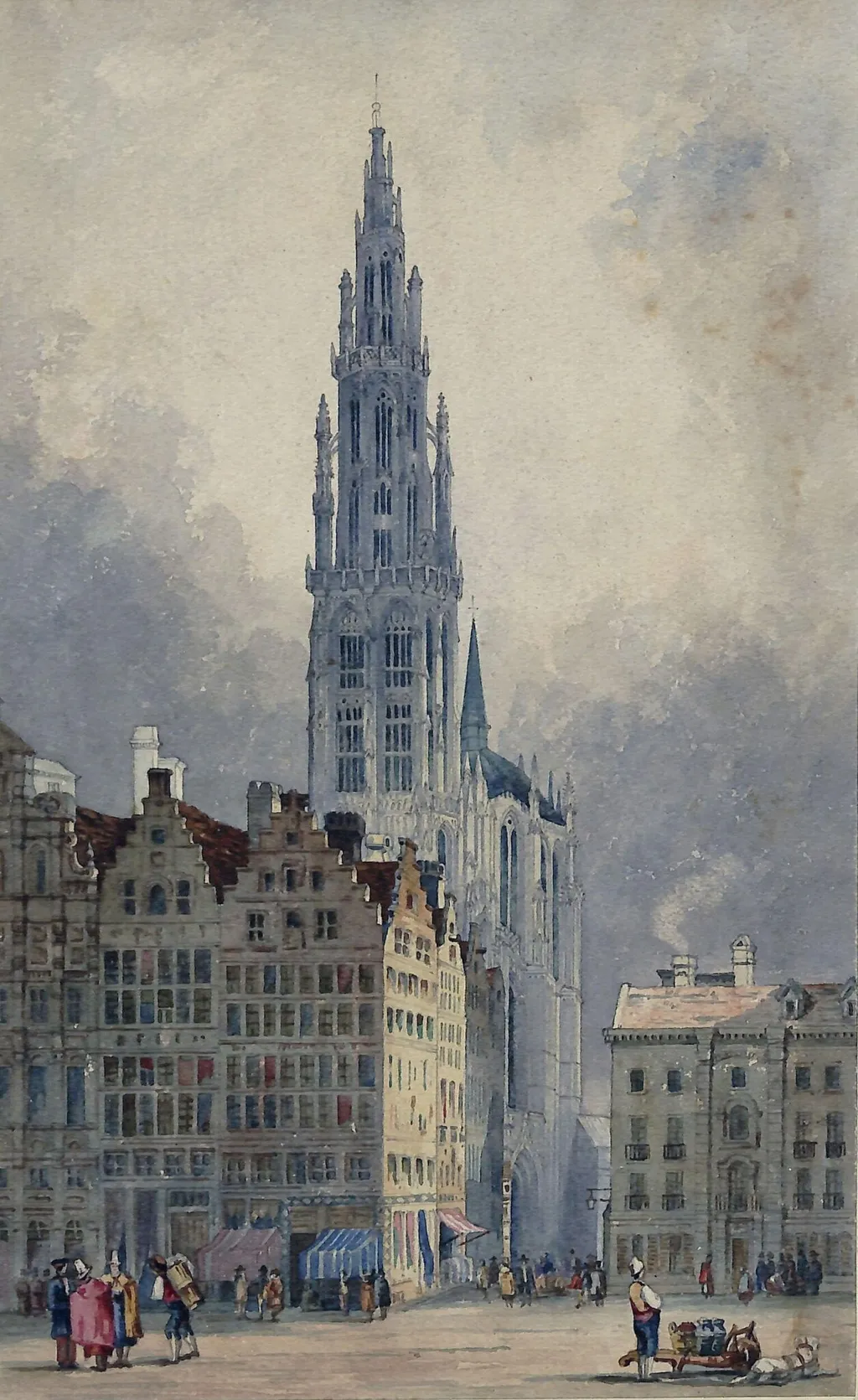
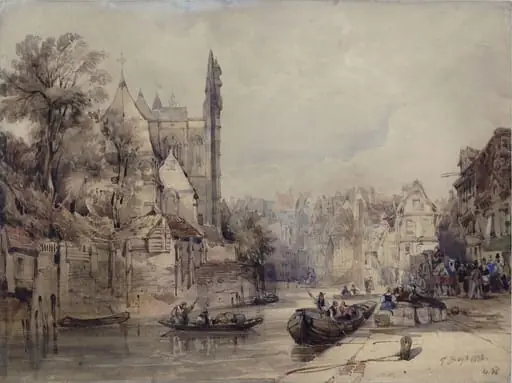
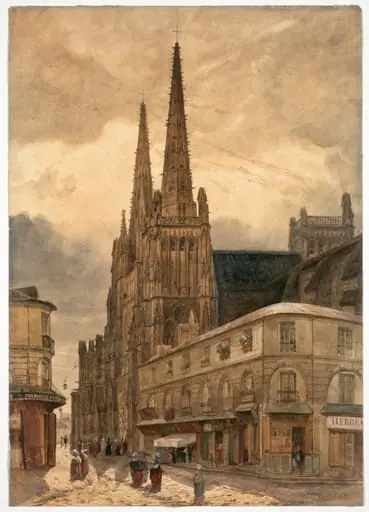
Cathedral Tower in Antwerp is a watercolor work on paper by Unknown. It dates from 1850 and is held in the collection of the Victoria and Albert Museum. This watercolour, dated 1850, captures the spire of Antwerp’s Cathedral of Our Lady as seen from a nearby street.
About this work
Overview
This watercolour, dated 1850, captures the spire of Antwerp’s Cathedral of Our Lady as seen from a nearby street. The composition centers on the towering structure, framed by surrounding buildings and figures moving through the urban space. Rendered with precision, the work conveys a quiet, observational tone, emphasizing architectural form and atmospheric conditions over dramatic effect.
Subject & Meaning
The subject is the cathedral tower, a dominant landmark in Antwerp’s skyline and a symbol of civic and religious identity.
The subject is the cathedral tower, a dominant landmark in Antwerp’s skyline and a symbol of civic and religious identity. Its prominence in the scene reflects its centrality to the city’s physical and spiritual landscape. The inclusion of pedestrians and neighboring structures situates the tower within daily life, suggesting its role not as a distant monument but as an integrated part of urban existence.
Technique & Style
The artist employed transparent watercolour washes to build subtle gradations of light and shadow, enhancing the tower’s verticality and the depth of the surrounding streetscape. Fine brushwork defines architectural details—stone tracery, windows, and spire finials—while muted tones in the sky and buildings unify the scene. The absence of bold outlines reinforces a soft, observational realism.
History & Provenance
The work entered the collection of the Victoria and Albert Museum in London, where it remains part of its holdings of 19th-century British and European watercolours. Its origin as a private study or travel sketch is likely, though the artist’s identity is not documented in public records. The piece reflects a broader 19th-century interest in topographical accuracy and urban documentation.
Context
In the mid-19th century, watercolour was widely used by amateur and professional artists to record architectural subjects during periods of rapid urban change. Antwerp, recovering from years of conflict and undergoing modernization, attracted artists keen to document its historic structures. This work aligns with a European trend of preserving visual records of heritage buildings before industrial transformation.
Legacy
Though not attributed to a major artist, the watercolour contributes to a body of work that preserves the visual character of Antwerp’s skyline before 20th-century alterations. Its preservation in a major museum underscores its value as a documentary artifact, offering insight into how ordinary observers engaged with monumental architecture in the Victorian era.
Artist & collection

 Domestic Scene
 Giacomo and Cardinal Marco, investing Andrea, Abbot of San Zeno, with his Benefice
 The Nymph of Fontainebleau
 Portrait of a Woman
 Madonna and Child with Saints in the Enclosed Garden
 Venus and Minerva
 Family Group of Four on Sofa
 Wall painting from Room H of the Villa of P. Fannius Synistor at Boscoreale