Artwork
Dandin and Ashvini
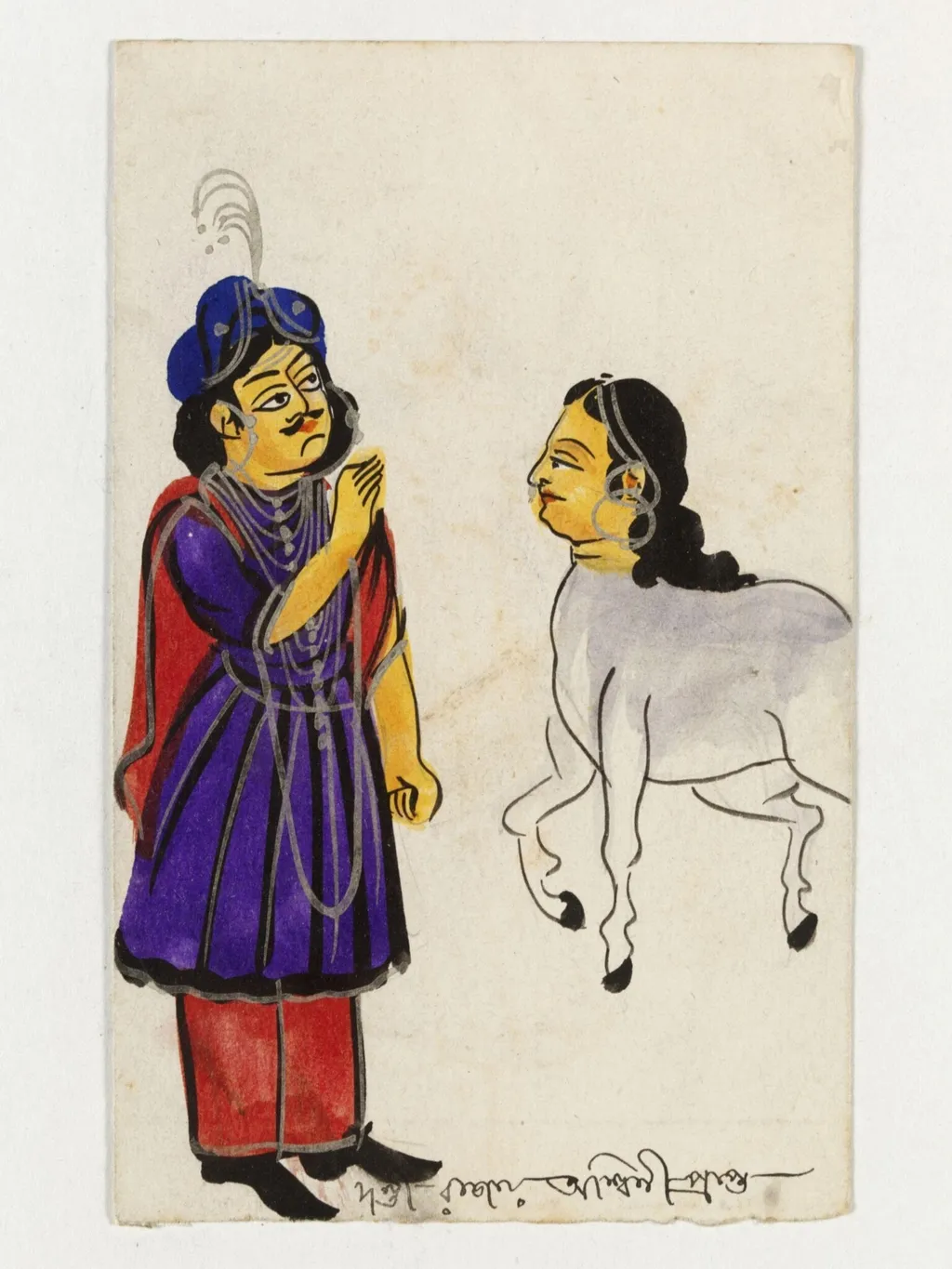
Dandin and Ashvini is a paint painting by the Impressionist artist Unknown. It dates from 1890 and is held in the collection of the Victoria and Albert Museum.
About this work
Overview
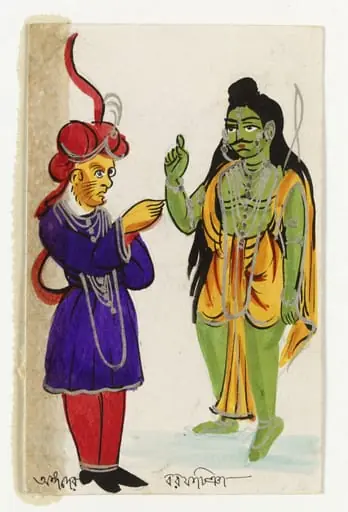
This painting illustrates a moment from the Sanskrit narrative *Dashakumaracharita*, portraying the encounter between Dandin and Ashvini.
This painting illustrates a moment from the Sanskrit narrative *Dashakumaracharita*, portraying the encounter between Dandin and Ashvini. Executed in watercolour and tin alloy on cardboard, the work employs a stylized, two-dimensional approach. The figures dominate the composition against an empty background, emphasizing their interaction over environmental detail. The materials and technique reflect a deliberate simplification of form, characteristic of certain modern Indian illustrative traditions.
Subject & Meaning
The scene captures Dandin, a literary figure, reaching toward Ashvini, a woman associated with his journey. The gesture suggests a moment of recognition or invitation, central to the episodic structure of the *Dashakumaracharita*. Neither figure is depicted with elaborate emotion; their expressions are restrained, inviting contemplation rather than drama. The interaction implies a narrative turning point, rooted in classical Indian storytelling conventions that value subtlety over spectacle.
Technique & Style
The figures are rendered with flat, unmodulated colours and thick, black outlines, creating a graphic, almost silhouette-like effect. Tin alloy adds a subtle metallic sheen, particularly on Dandin’s robe and hat, contrasting with the matte watercolour of Ashvini’s attire. The lack of shading or perspective reinforces a decorative, non-naturalistic aesthetic. This approach prioritizes symbolic clarity over realism, aligning with illustrated manuscript traditions adapted into modern formats.
History & Provenance
The painting’s origin is tied to early 20th-century Indian artists revisiting classical texts through contemporary visual languages. While specific attribution remains unverified, its materials and style suggest production in a regional studio familiar with both Mughal miniature conventions and emerging modernist simplifications. It likely served as a study or illustrated page rather than a standalone exhibition piece, reflecting a broader interest in literary revival during the colonial period.
Context
Created during a time when Indian artists were re-engaging with pre-colonial literature, this work reflects a cultural movement to reclaim indigenous narratives through visual art. It stands apart from Western academic styles dominant in art schools, instead drawing from folk and manuscript traditions. The choice of *Dashakumaracharita*—a lesser-known text—indicates a deliberate focus on regional literary heritage over mainstream epics.
Legacy
This painting contributes to a quiet but persistent lineage of Indian illustrative art that privileges narrative economy and formal restraint. Its aesthetic echoes in later modernist experiments with flatness and symbolic representation. Though not widely exhibited, it remains a reference point for scholars examining how classical texts were visually reinterpreted in the early 20th century, influencing regional art practices beyond major urban centers.
Artist & collection

 Domestic Scene
 Giacomo and Cardinal Marco, investing Andrea, Abbot of San Zeno, with his Benefice
 The Nymph of Fontainebleau
 Portrait of a Woman
 Madonna and Child with Saints in the Enclosed Garden
 Venus and Minerva
 Family Group of Four on Sofa
 Wall painting from Room H of the Villa of P. Fannius Synistor at Boscoreale