Artwork
Arjuna and Bhishma
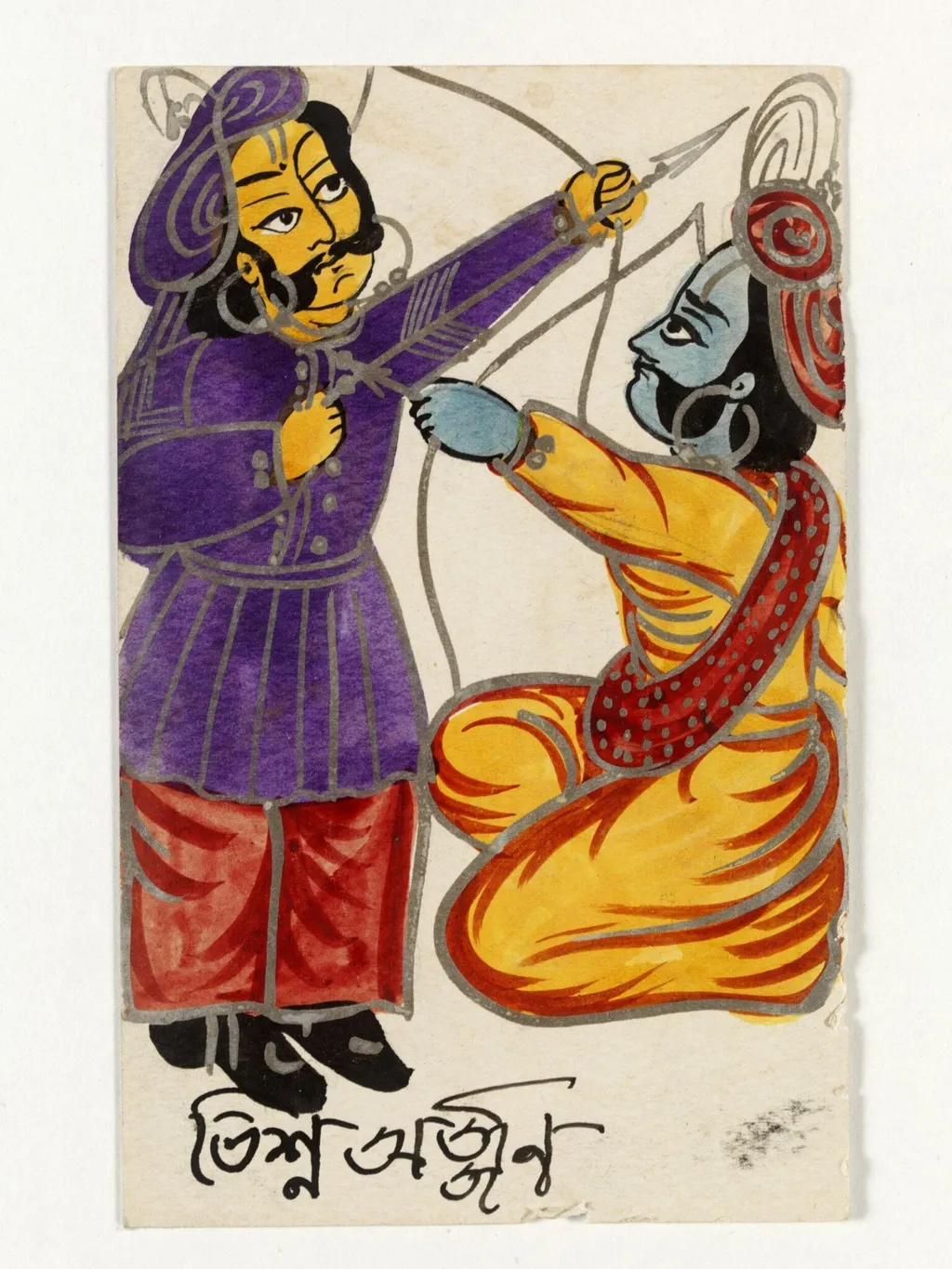
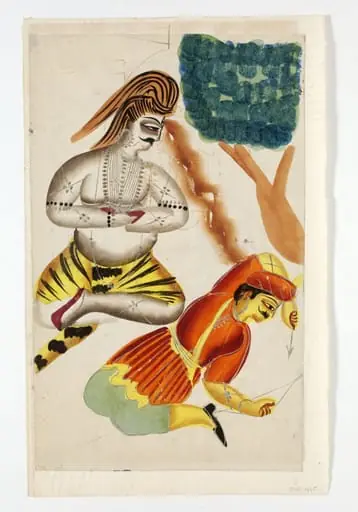
Arjuna and Bhishma is a paint painting by the Impressionist artist Unknown. It dates from 1890 and is held in the collection of the Victoria and Albert Museum. This watercolour and tin alloy painting on paper, dated to around 1890, originates from the Kalighat school in Calcutta.
About this work
Overview
It captures a moment of conflict between two figures from Hindu epic tradition, rendered with the distinctive immediacy of late 19th-century Bengali folk art.
This watercolour and tin alloy painting on paper, dated to around 1890, originates from the Kalighat school in Calcutta. It captures a moment of conflict between two figures from Hindu epic tradition, rendered with the distinctive immediacy of late 19th-century Bengali folk art. The work reflects a broader movement in which local artists adapted mythological narratives for urban audiences, blending religious themes with contemporary visual sensibilities.
Subject & Meaning
The scene portrays Arjuna, the Pandava warrior, loosing arrows at Bhishma, the aged commander of the Kaurava forces. Though drawn from the Mahabharata, not the Ramayana, the depiction emphasizes moral tension: Bhishma, bound by duty, remains still despite being struck, while Arjuna acts with force. The composition suggests a confrontation between duty and action, a theme resonant in colonial Bengal’s shifting social order.
Technique & Style
Executed in bold, fluid brushwork and saturated pigments, the painting exemplifies Kalighat’s signature style: simplified anatomy, strong outlines, and flat planes of colour. Tin alloy was used to add metallic sheen to garments, enhancing visual impact without depth. The background remains unadorned, focusing attention on the figures’ dynamic postures and expressive faces, conveying emotion through minimal detail.
History & Provenance
Created in Calcutta during a period of rapid urbanization and colonial influence, the painting likely originated as a devotional or decorative item sold near the Kalighat temple. It entered the Victoria and Albert Museum’s collection as part of a broader 19th-century effort to document Indian artistic production, preserving works that responded to both religious devotion and changing societal norms.
Context
Kalighat artists emerged in the 1830s as a response to growing urban markets and colonial cultural pressures. By reinterpreting mythological scenes with sharp, accessible forms, they offered visual commentary on contemporary issues—authority, resistance, moral ambiguity. This painting, though rooted in ancient epic, speaks to the anxieties of a society navigating identity under British rule.
Legacy
The Kalighat style influenced later Indian modernist movements by demonstrating how traditional iconography could be adapted for modern audiences. Though initially dismissed as folk art, works like this are now recognized for their formal innovation and cultural insight. They remain vital records of how visual language evolved in response to colonialism and urban change in 19th-century Bengal.
Artist & collection

 Domestic Scene
 Giacomo and Cardinal Marco, investing Andrea, Abbot of San Zeno, with his Benefice
 The Nymph of Fontainebleau
 Portrait of a Woman
 Madonna and Child with Saints in the Enclosed Garden
 Venus and Minerva
 Family Group of Four on Sofa
 Wall painting from Room H of the Villa of P. Fannius Synistor at Boscoreale