Artwork
Deksel van een klavecimbel
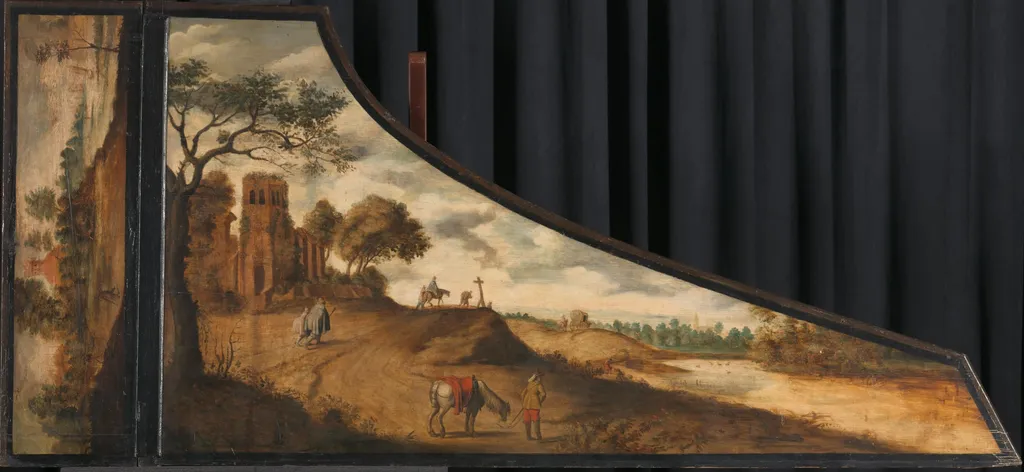
Deksel van een klavecimbel is an unspecified painting by the Dutch Golden Age artist Unknown. It dates from 1625 and is held in the collection of the Rijksmuseum. This painted panel once adorned the case of a harpsichord, serving both decorative and functional purposes.
About this work
Overview
Figures—a man guiding a donkey and two horseback riders—move quietly through the scene, their presence modest and unobtrusive.
This painted panel once adorned the case of a harpsichord, serving both decorative and functional purposes. It depicts a tranquil rural landscape with a dirt path winding through gentle hills. Figures—a man guiding a donkey and two horseback riders—move quietly through the scene, their presence modest and unobtrusive. The composition invites contemplation rather than drama, emphasizing stillness and the passage of time.
Subject & Meaning
The scene suggests a quiet journey through the countryside, possibly symbolizing daily life or pilgrimage. The ruined tower in the distance hints at decay or forgotten history, contrasting with the enduring natural landscape. The red bundle on the donkey introduces a subtle focal point, perhaps indicating transport of goods or personal belongings. No overt narrative is given, allowing the image to evoke solitude and routine.
Technique & Style
The artist employs soft chiaroscuro to model forms with gentle gradations of light and shadow, enhancing depth without harsh contrast. Earth tones—ochres, olive greens, and pale blues—dominate, creating a muted harmony. Brushwork is restrained, favoring smooth transitions over detail, which reinforces the scene’s calm atmosphere. The figures are scaled to suggest distance, reinforcing perspective through subtle diminution rather than linear precision.
History & Provenance
As a harpsichord decoration, this panel likely originated in the Low Countries during the late 16th or early 17th century, a period when such instruments often featured painted interiors. Its survival suggests it was preserved as part of the instrument’s casing rather than displayed independently. Its original context as functional art, rather than fine art, contributes to its understated aesthetic.
Context
During this era, landscape elements frequently appeared on musical instruments as symbols of harmony between nature and art. The inclusion of ruins and travelers reflects broader cultural interests in transience and the passage of time. Unlike grand historical scenes, this work aligns with a growing preference for intimate, everyday views, anticipating later Dutch genre painting traditions.
Legacy
Though not widely known today, the panel exemplifies a quiet tradition of integrating landscape into domestic musical objects. Its restrained palette and contemplative mood reflect a regional aesthetic that valued subtlety over spectacle. It remains a quiet testament to the blending of utility and art in early modern European households.
Artist & collection

 Domestic Scene
 Giacomo and Cardinal Marco, investing Andrea, Abbot of San Zeno, with his Benefice
 The Nymph of Fontainebleau
 Portrait of a Woman
 Madonna and Child with Saints in the Enclosed Garden
 Venus and Minerva
 Family Group of Four on Sofa
 Wall painting from Room H of the Villa of P. Fannius Synistor at Boscoreale
 A painting on a harpsichord lid with a hilly landscape and travelers
 Death of Euridice
 A painting on a harpsichord lid with a party by a river
 Road through a Forest
 Paisagem com as Tentações de Santo Antão
 Rocky Landscape with a Castle
 Rocky Landscape
 Ruinenlandschaft mit Christus und dem kanaanäischen Weib
 Landschaft mit Reiter
 Architectural Landscape