Artwork
Ely Festival
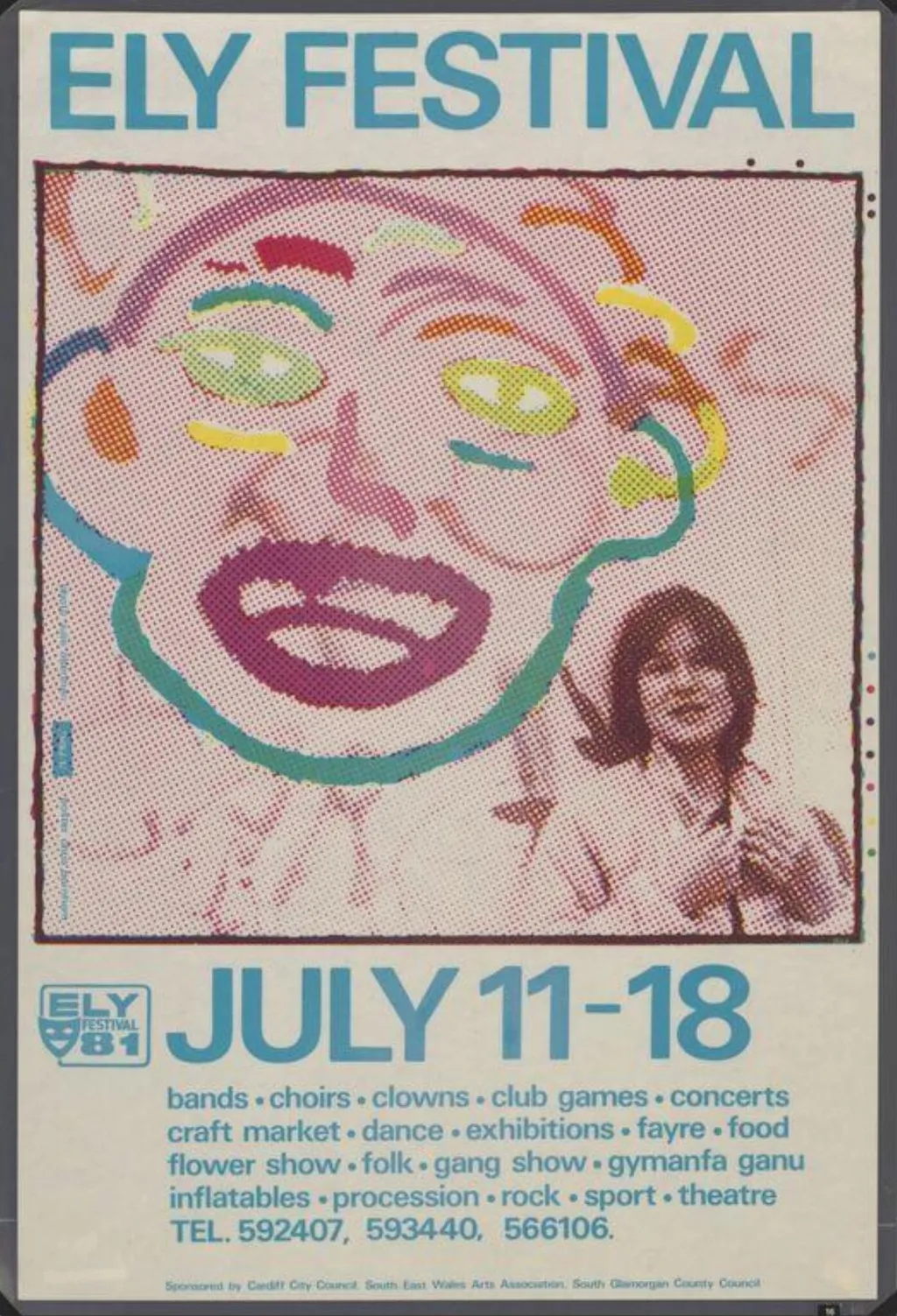
Ely Festival is a poster by Unknown. It dates from 1980 and is held in the collection of the Victoria and Albert Museum.
About this work
Overview
The composition centers on a pixelated image of a reclining figure, surrounded by abstract, colorful forms, with clear blue text providing event details.
Created in 1980, this poster advertised the Ely Festival, held from July 11 to 18. Designed as part of the Greenwich Mural Workshop’s exhibition 'Printing is easy...?', it blends analog and early digital aesthetics. The composition centers on a pixelated image of a reclining figure, surrounded by abstract, colorful forms, with clear blue text providing event details. Its visual language reflects experimental graphic design practices of the era.
Subject & Meaning
The central figure, stretched in a starfish pose, suggests openness and relaxation, aligning with the festival’s communal, informal spirit. The abstract swirls of red, yellow, and green evoke movement and energy, hinting at music and performance without literal representation. The pixelation, reminiscent of early video games, grounds the design in contemporary digital experimentation, signaling a break from traditional poster conventions.
Technique & Style
The poster combines a low-resolution photographic image with hand-drawn, crayon-like overlays, merging mechanical reproduction with manual mark-making. Text is rendered in bold, blocky sans-serif type with rounded variants for visual rhythm. The cream background provides contrast, allowing the saturated blue text and vivid shapes to stand out. This hybrid approach reflects a deliberate fusion of emerging digital tools and analog craft.
History & Provenance
Produced for the Greenwich Mural Workshop’s 1980 exhibition, the poster was part of a broader inquiry into the accessibility and possibilities of print media. It was not commissioned by a commercial entity but emerged from an artist collective exploring the boundaries of graphic design. The work entered the Victoria and Albert Museum’s collection as an example of late 20th-century experimental poster design.
Context
In the early 1980s, British graphic design was increasingly influenced by punk aesthetics, early computer graphics, and DIY culture. This poster reflects those currents, using pixelation not as a limitation but as a stylistic choice. It aligns with other experimental works from artist-run collectives that challenged commercial design norms and embraced imperfection as a form of expression.
Legacy
The poster remains a reference point in discussions of analog-digital hybrid design. Its unpolished aesthetic anticipated later movements that valued authenticity over refinement. While not widely reproduced, its inclusion in the V&A’s collection ensures its place in the history of British graphic design, illustrating how grassroots creativity shaped visual culture beyond mainstream advertising.
Artist & collection

 Domestic Scene
 Giacomo and Cardinal Marco, investing Andrea, Abbot of San Zeno, with his Benefice
 The Nymph of Fontainebleau
 Portrait of a Woman
 Madonna and Child with Saints in the Enclosed Garden
 Venus and Minerva
 Family Group of Four on Sofa
 Wall painting from Room H of the Villa of P. Fannius Synistor at Boscoreale