Artwork
Floor Mosaic Panel: Grape Harvester with Peacock
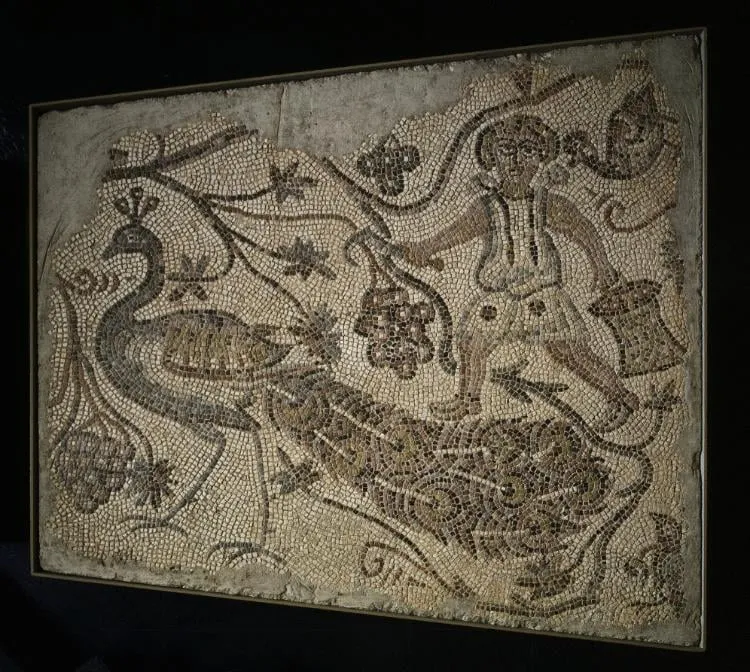
Floor Mosaic Panel: Grape Harvester with Peacock is a mosaic by Unknown. It dates from 450 and is held in the collection of the Cleveland Museum of Art.
About this work
Overview
The floor mosaic panel, titled Grape Harvester with Peacock, dates to the fifth century and is part of the Cleveland Museum of Art’s collection.
The floor mosaic panel, titled Grape Harvester with Peacock, dates to the fifth century and is part of the Cleveland Museum of Art’s collection. Executed in stone tesserae, the work originally formed part of a larger decorative floor, likely in a church situated in the northern Syrian region of Maaut El Naaman. Its surviving fragment illustrates the integration of biblical symbolism within early Christian architectural ornamentation.
Subject & Meaning
The scene combines a figure harvesting grapes with a perched peacock. Within early Christian iconography, the grapes allude to the wine of the Eucharist, symbolizing the blood of Christ, while the peacock, whose feathers were thought to renew annually, represents the promise of eternal life. Together, the motifs convey themes of sacramental nourishment and resurrection.
Technique & Style
Crafted from small stone tesserae set into lime mortar, the mosaic employs a limited palette of natural colors to render figures with modest modeling. The composition follows a frontal, narrative arrangement typical of Byzantine floor decorations, emphasizing clarity of symbol over naturalistic detail. The careful placement of light and dark stones creates a subtle sense of depth within the limited space.
History & Provenance
Scholars attribute the panel to a church floor in Maaut El Naaman, a site known for its early Christian mosaics. The fragment entered the Cleveland Museum of Art through 20th‑century acquisitions, joining a broader collection of Syrian Byzantine art. Its preservation offers insight into the liturgical and decorative practices of early Christian communities in the Near East.
Artist & collection

 Domestic Scene
 Giacomo and Cardinal Marco, investing Andrea, Abbot of San Zeno, with his Benefice
 The Nymph of Fontainebleau
 Portrait of a Woman
 Madonna and Child with Saints in the Enclosed Garden
 Venus and Minerva
 Family Group of Four on Sofa
 Wall painting from Room H of the Villa of P. Fannius Synistor at Boscoreale