Artwork
Gadadhara Raga
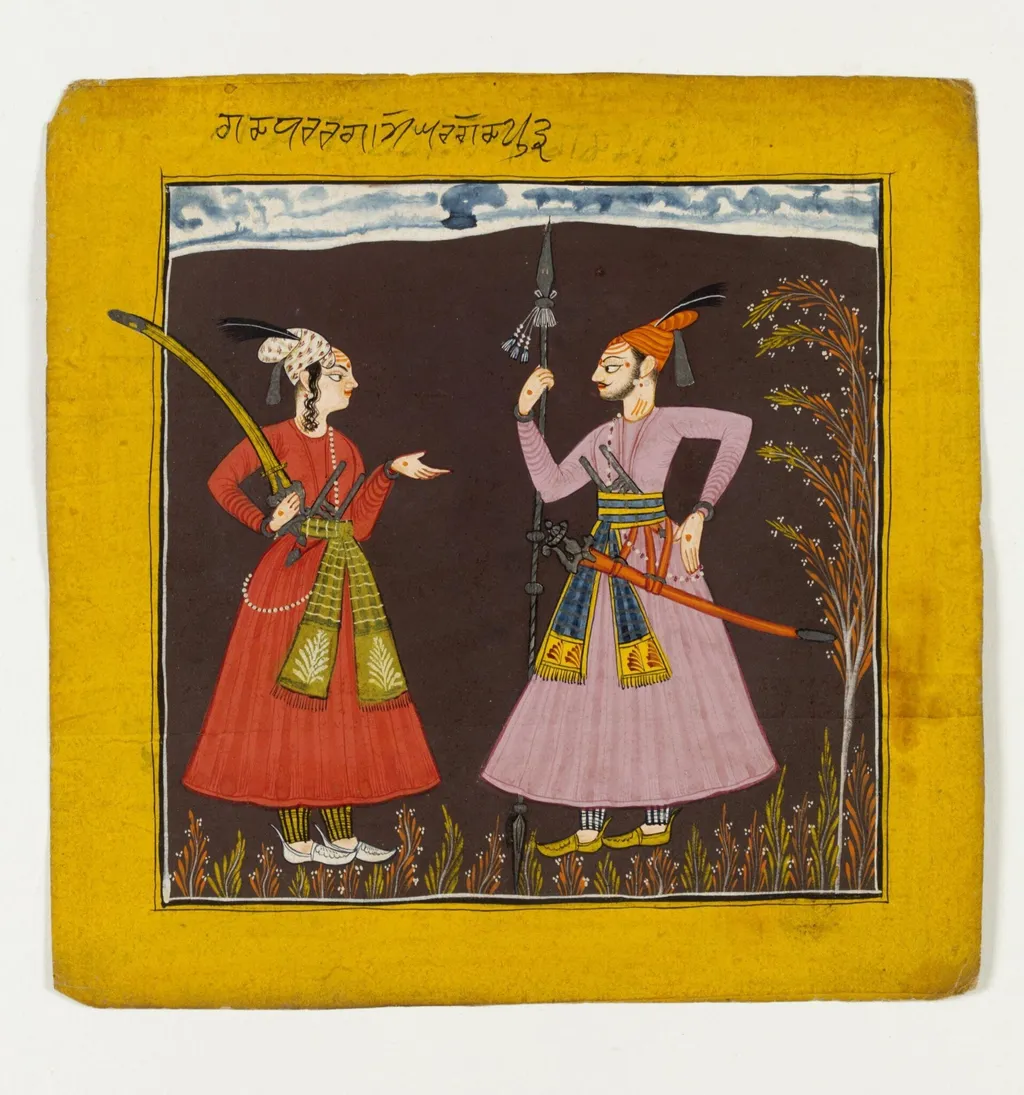
Gadadhara Raga is a paint painting by the Baroque artist Unknown. It dates from 1700 and is held in the collection of the Victoria and Albert Museum.
About this work
Overview
The composition is framed by an inscription in Takri script along the upper edge, linking visual imagery to musical tradition.
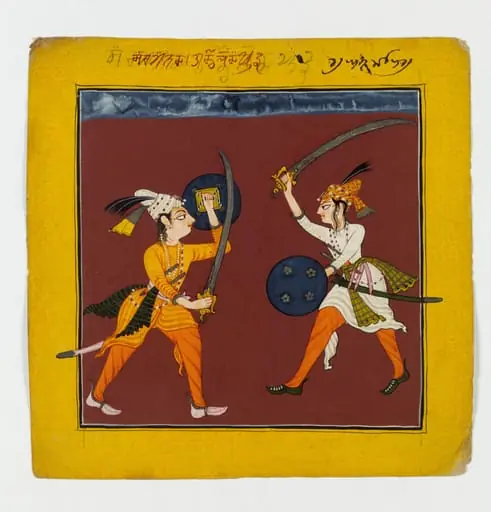
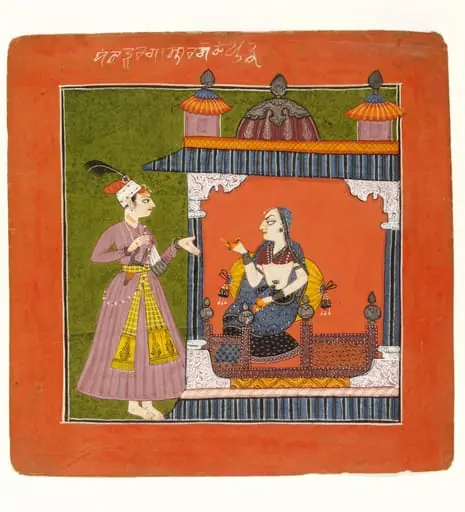
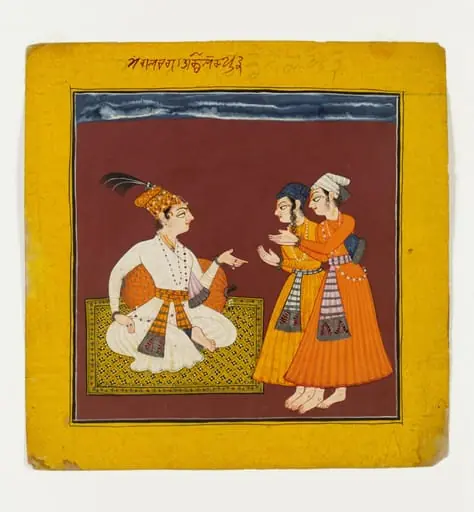
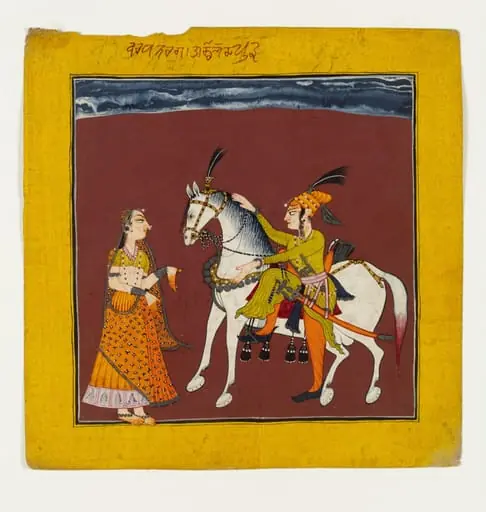
This 18th-century Ragamala painting depicts the musical mode Gadadhara Raga through a narrative scene on paper. It features two figures in elaborate attire, standing in a garden setting under a cloudy sky. The composition is framed by an inscription in Takri script along the upper edge, linking visual imagery to musical tradition. The palette is vivid yet unmodulated, emphasizing symbolic form over naturalistic depth.
Subject & Meaning
The two figures, dressed in richly patterned garments and adorned with jewelry, are shown holding bows and arrows, suggesting martial readiness or ritualized action. Their postures imply dialogue or mutual recognition, evoking the emotional tone associated with Gadadhara Raga. The garden setting and celestial elements may symbolize the interplay between human resolve and cosmic order, common in Rajput musical iconography.
Technique & Style
Executed in opaque watercolor on paper, the painting employs flat planes of bright pigment with minimal shading. Figures are rendered with precise outlines and decorative detailing in clothing and accessories, reflecting regional Rajput conventions. The background features stylized trees and cloud forms, contributing to a symbolic rather than spatially coherent environment. The Takri script inscription anchors the image within a specific musical and linguistic tradition.
History & Provenance
Created around 1700, this work originates from the Pahari or Punjabi hill states, where Ragamala series were commonly produced for royal patrons. The use of Takri script suggests a northern Indian provenance, possibly from the Punjab Hills. Such paintings were often part of illustrated manuscripts or albums, used to accompany musical performance or meditative practice in courtly settings.
Context
Ragamala paintings visualized the emotional and seasonal associations of Indian musical modes. Gadadhara Raga, linked to themes of valor or introspective strength, was rendered through symbolic figures rather than literal narratives. This work reflects a broader tradition in which music, poetry, and painting converged in elite cultural life, serving both aesthetic and devotional purposes in early modern North India.
Legacy
Though largely overlooked in Western art histories, such Ragamala works influenced later Indian miniature traditions and remain important for understanding pre-colonial South Asian aesthetics. Their integration of text, music, and image offers a model of interdisciplinary art-making. Today, they are studied as cultural artifacts that encode regional identity, spiritual practice, and performative memory.
Artist & collection

 Domestic Scene
 Giacomo and Cardinal Marco, investing Andrea, Abbot of San Zeno, with his Benefice
 The Nymph of Fontainebleau
 Portrait of a Woman
 Madonna and Child with Saints in the Enclosed Garden
 Venus and Minerva
 Family Group of Four on Sofa
 Wall painting from Room H of the Villa of P. Fannius Synistor at Boscoreale