Artwork
Girls and Two Babies, illustration to A Day in a Child's Life
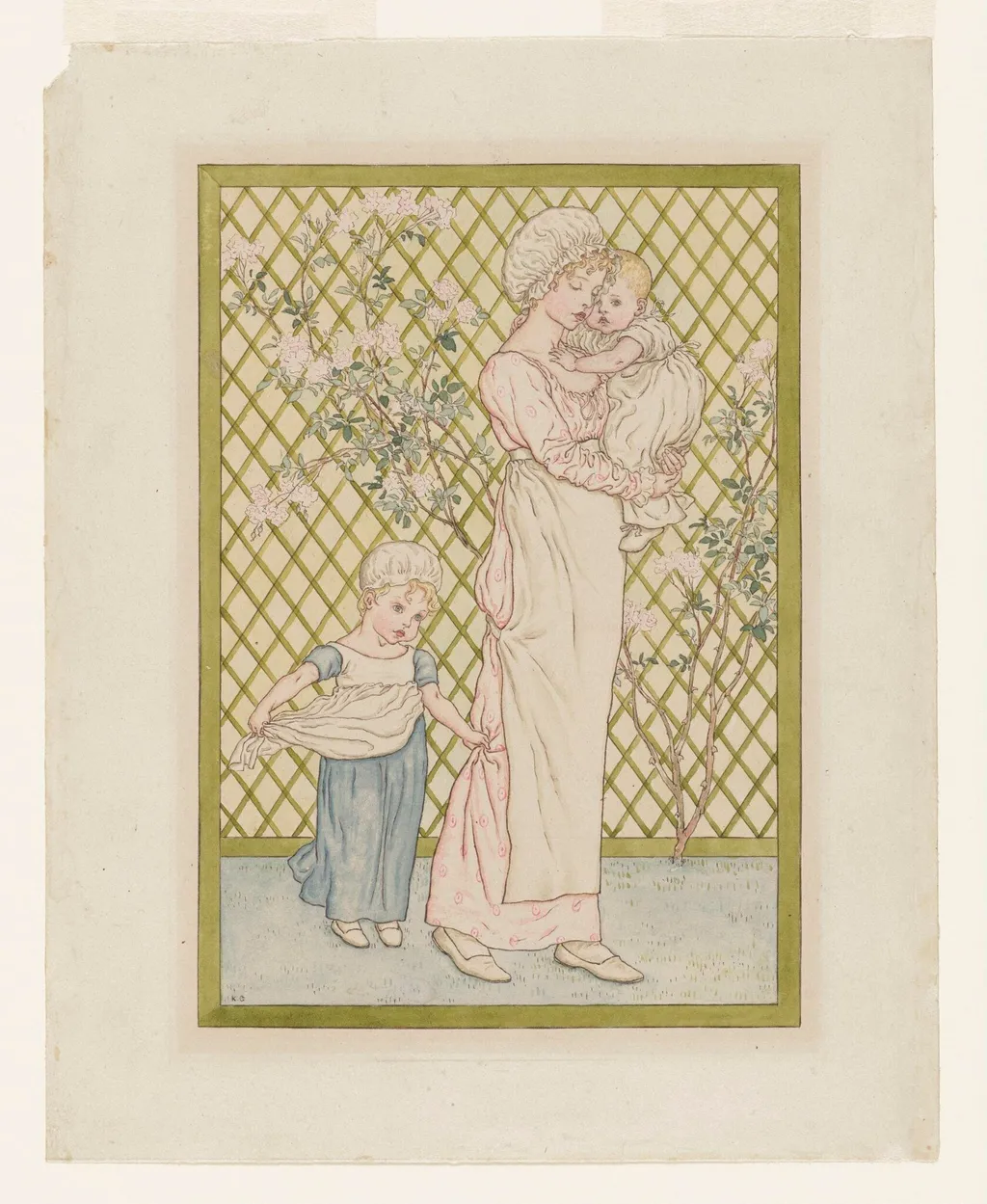
Girls and Two Babies, illustration to A Day in a Child's Life is a watercolor work on paper by the Romanticist artist Unknown. It dates from 1846 and is held in the collection of the Victoria and Albert Museum. This 1846 watercolour illustration accompanies a narrative on childhood routines.
About this work
Overview
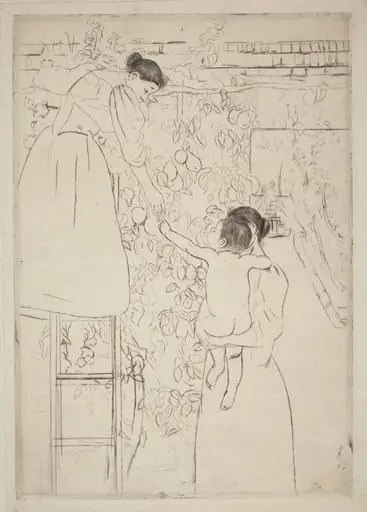
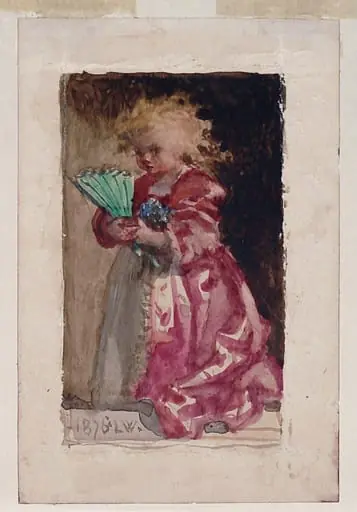
This 1846 watercolour illustration accompanies a narrative on childhood routines. It depicts two young girls attending to an infant, set against a softly rendered garden trellis. The scene is intimate and quiet, emphasizing daily care rather than dramatic action. The medium’s transparency lends a delicate, luminous quality to the figures and foliage.
Subject & Meaning
The image portrays an unidealized moment of domestic responsibility, with an older girl guiding a toddler while holding a baby. The interaction suggests generational continuity in childcare, common in 19th-century family life. The absence of adult figures implies the girl’s role as caretaker, reflecting societal expectations without sentimentality.
Technique & Style
Executed in watercolour, the work uses soft washes to define forms and subtle gradations for skin tones and fabric. The trellis and flowers are rendered with loose, fluid strokes, creating depth without detail. The figures are outlined with minimal line, relying on tone and placement to convey spatial relationships and emotional quietude.
History & Provenance
Created as an illustration for a published children’s narrative, the piece was likely produced for mass reproduction. Its survival as a standalone watercolour suggests it was valued beyond its original context, possibly retained by the artist or publisher. No documented ownership before the 20th century is known.
Context
Produced during the height of Romanticism, the work aligns with the movement’s interest in domestic emotion and natural settings. Unlike grand Romantic themes, however, it focuses on ordinary, unheroic moments. The garden backdrop reflects contemporary ideals of moral purity linked to nature and family life.
Legacy
The illustration remains a quiet example of 19th-century visual storytelling for children. It contributes to understanding how childhood and caregiving were visually codified in print culture. Though not widely exhibited, it offers insight into the aesthetic and social norms of domestic life in mid-Victorian Britain.
Artist & collection

 Domestic Scene
 Giacomo and Cardinal Marco, investing Andrea, Abbot of San Zeno, with his Benefice
 The Nymph of Fontainebleau
 Portrait of a Woman
 Madonna and Child with Saints in the Enclosed Garden
 Venus and Minerva
 Family Group of Four on Sofa
 Wall painting from Room H of the Villa of P. Fannius Synistor at Boscoreale