Artwork
Hawfinch
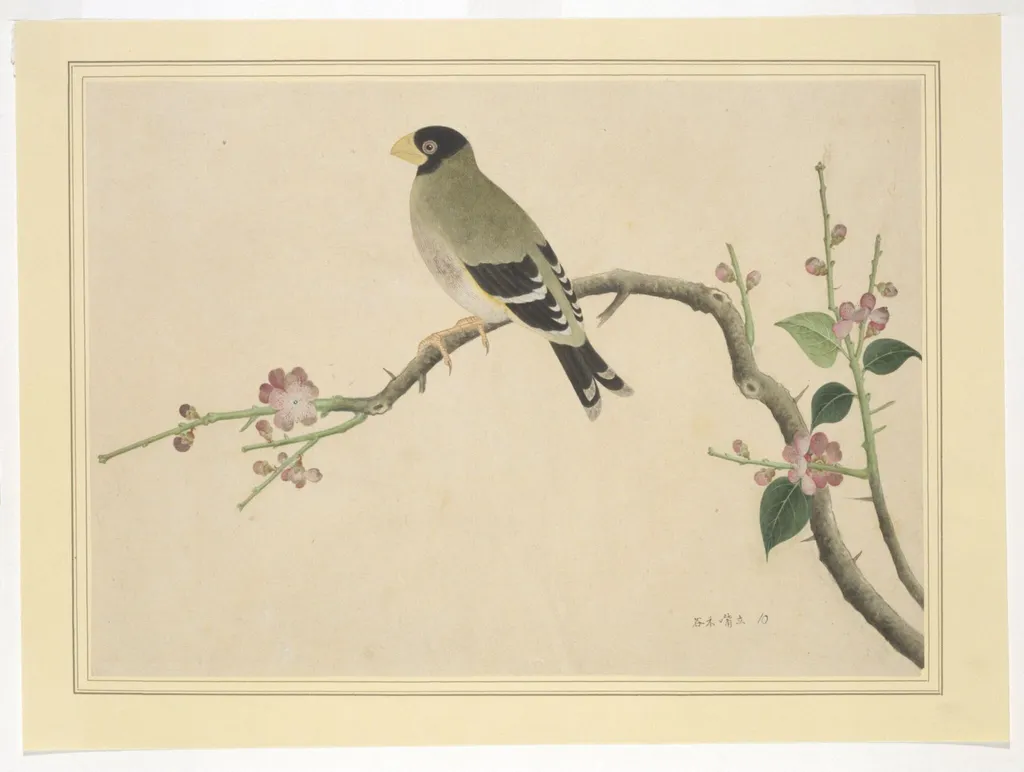
Hawfinch is a paint painting by the British Romanticist artist Unknown. It dates from 1800 and is held in the collection of the Victoria and Albert Museum.
About this work
Overview
The work was not created for scientific documentation but as a keepsake for travelers seeking tangible reminders of foreign wildlife encountered abroad.
This small oil painting depicts a hawfinch perched on a branch, rendered with careful attention to plumage and posture. Produced in quantity for the tourist market, it reflects a broader 18th- and 19th-century demand for portable natural history imagery. The work was not created for scientific documentation but as a keepsake for travelers seeking tangible reminders of foreign wildlife encountered abroad.
Subject & Meaning
The hawfinch, a native European bird, was depicted not for its rarity but for its visual distinctiveness—its robust beak and mottled brown feathers made it a compelling subject. Though not exotic by biological standards, it was chosen for its aesthetic appeal to British buyers. The painting served as a symbol of travel and observation, embodying the era’s fascination with natural forms, even when the subject was locally common.
Technique & Style
The bird is rendered with precise, lifelike detail against a muted, dark background that eliminates distraction. The foliage is simplified, serving only to frame the subject. Repetitive brushwork and standardized compositions suggest production in a workshop setting, where artists replicated established models rather than painting from direct observation. Color is restrained, emphasizing form over atmospheric effect.
History & Provenance
These small-scale bird paintings were commonly produced in continental Europe for British tourists during the Grand Tour era. They were sold in markets and shops frequented by travelers returning home. While individual artists are rarely recorded, the style aligns with commercial studios in cities like Rome or Paris. Many such works entered British collections through private purchases, later finding their way into institutions like the Victoria and Albert Museum.
Context
The popularity of these paintings coincided with rising public interest in natural history, fueled by colonial expansion and scientific cataloging. Though botanists and zoologists pursued systematic study, the general public engaged with nature through accessible imagery. These works bridged science and sentiment, offering a visual language of curiosity that turned wildlife into personal mementos of travel.
Legacy
Though dismissed as mass-produced curiosities in their time, these paintings now offer insight into how ordinary people encountered and interpreted the natural world. Their uniformity reveals the commercialization of natural history, while their persistence in museum collections underscores their role as cultural artifacts—testaments to a time when seeing a bird abroad became a reason to own its image.
Artist & collection

 Domestic Scene
 Giacomo and Cardinal Marco, investing Andrea, Abbot of San Zeno, with his Benefice
 The Nymph of Fontainebleau
 Portrait of a Woman
 Madonna and Child with Saints in the Enclosed Garden
 Venus and Minerva
 Family Group of Four on Sofa
 Wall painting from Room H of the Villa of P. Fannius Synistor at Boscoreale
 Flowers and Birds
 Untitled
 Swallow on Flowering Peach Branch
 Untitled
 Flowers and Birds
 Parakeet on the Branch of a Cherry Tree
 Rose and Peony
 摺物帖 『春雨集』 『花鳥六番之内 下野宇都宮』 桃に山鳩|Spring Rain Collection (Harusame shū), vol. 3: Mountain Dove and Peach Flowers
 Untitled
 Paintings after Ancient Masters: A Bird and Peach-Blossom Branch