Artwork
Head of Medusa
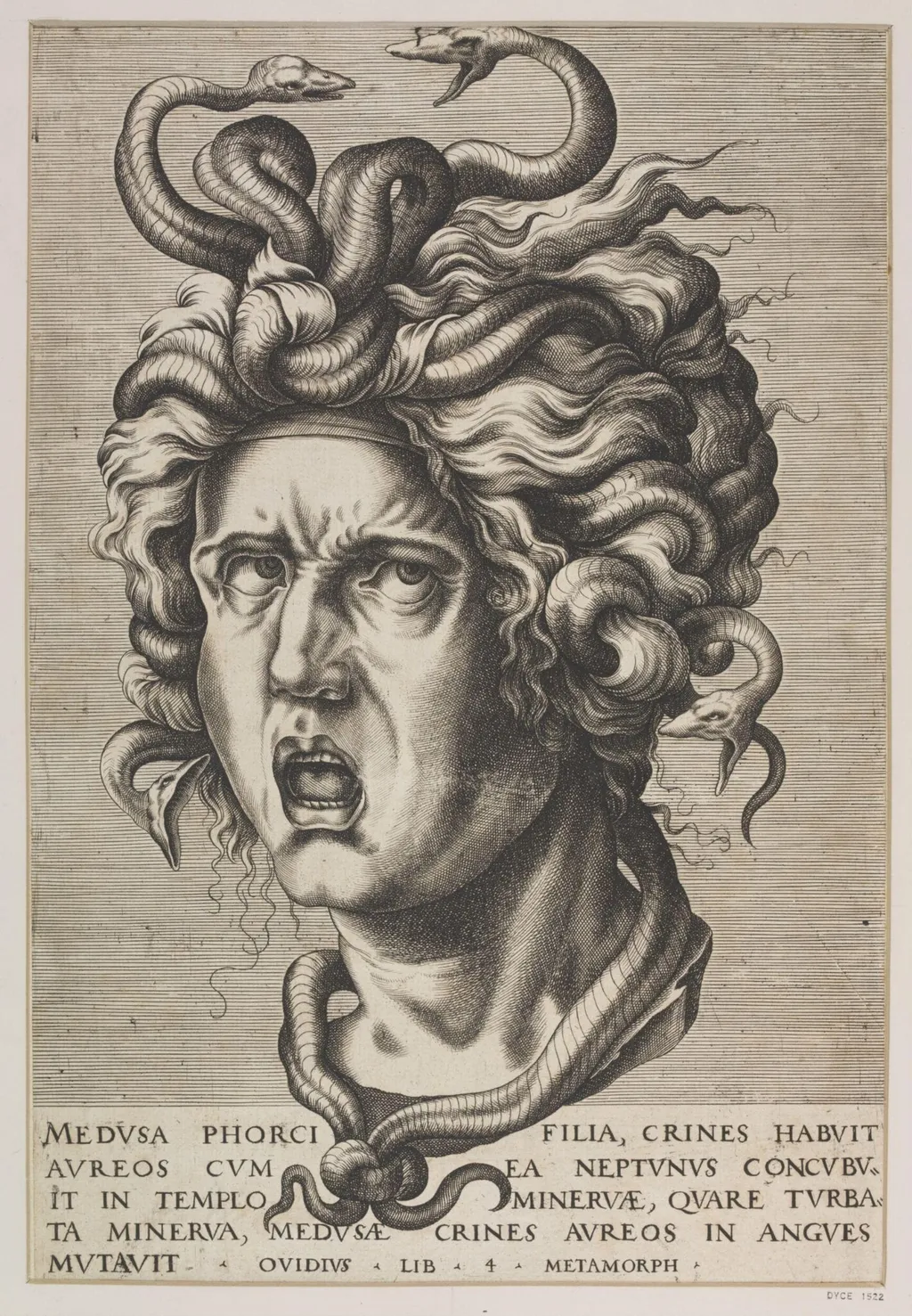
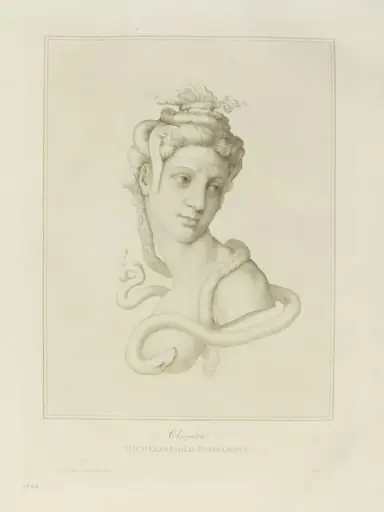
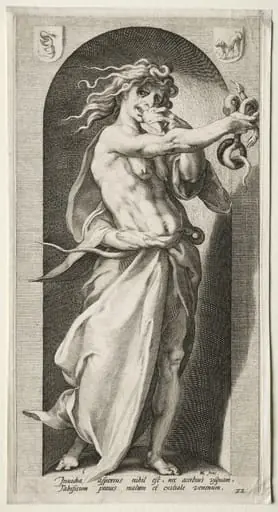
Head of Medusa is a print by Unknown. It dates from 1650 and is held in the collection of the Victoria and Albert Museum. The print presents a close‑up of Medusa’s head, rendered in a near‑frontal perspective.
About this work
Overview
The print presents a close‑up of Medusa’s head, rendered in a near‑frontal perspective. Snakes coil tightly around her neck, their tails interlaced at the front, while her eyes are wide and her mouth appears open in a scream. Executed solely in black ink on paper, the image relies on stark line work to convey intensity.
Subject & Meaning
Identified by the Latin inscription “Medusa Phorci filia,” the work references the Gorgon from Greek mythology, daughter of Phorcys. The composition emphasizes the terrifying aspect of the mythic monster, focusing on the snarling expression and the chaotic tangle of serpents that symbolize her lethal power.
Technique & Style
The engraving employs dense, scratchy lines to model form and texture, creating a dramatic chiaroscuro effect despite the absence of color. The contrast between deep shadows and bright highlights intensifies the facial features and the serpents’ bodies, producing a rough, vigorous surface quality characteristic of early printmaking.
History & Provenance
The piece is a black‑ink print on paper, typical of early modern European engraving practices. The presence of the Latin caption suggests a learned audience and points to a period when classical subjects were popular among humanist collectors, though specific details of its creation and ownership remain undocumented.
Artist & collection

 Domestic Scene
 Giacomo and Cardinal Marco, investing Andrea, Abbot of San Zeno, with his Benefice
 The Nymph of Fontainebleau
 Portrait of a Woman
 Madonna and Child with Saints in the Enclosed Garden
 Venus and Minerva
 Family Group of Four on Sofa
 Wall painting from Room H of the Villa of P. Fannius Synistor at Boscoreale