Artwork
Hoeing the Ground
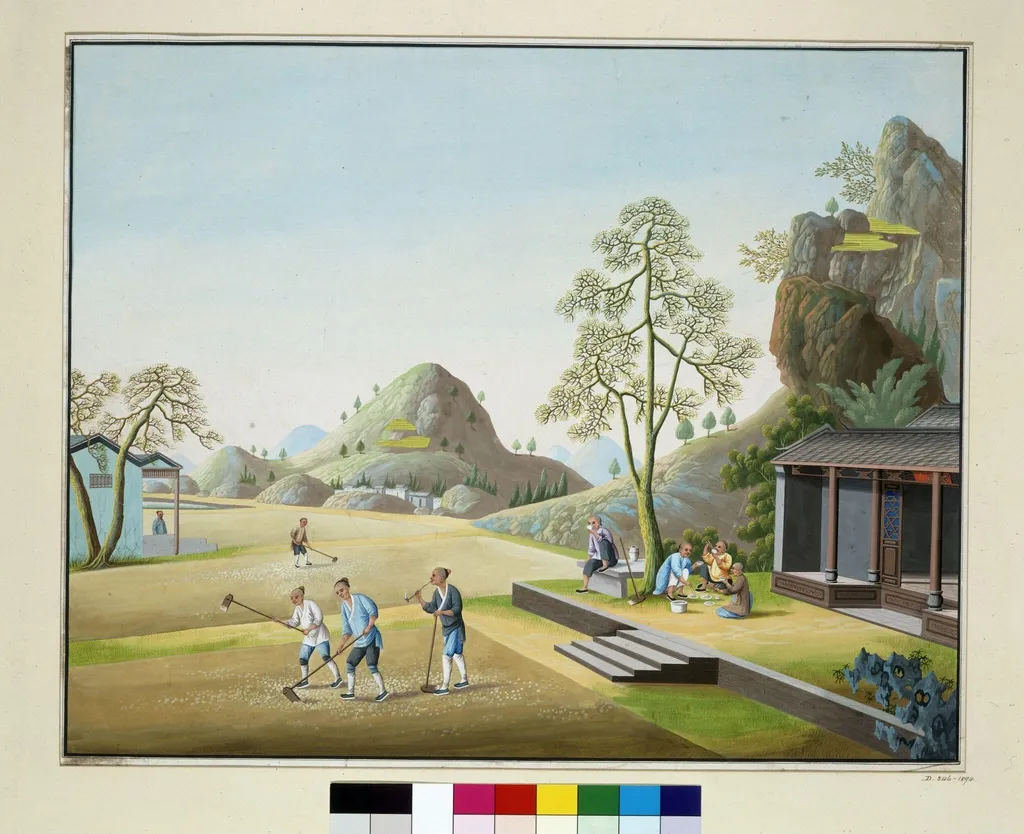
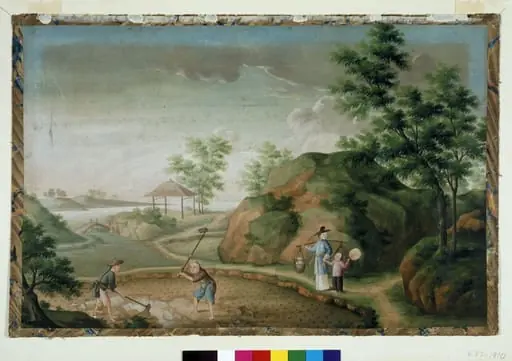
Hoeing the Ground is a paint painting by the Romanticist artist Unknown. It dates from 1800 and is held in the collection of the Victoria and Albert Museum. The work is a painted panel that forms part of a twelve‑image series illustrating various stages of China’s tea production.
About this work
These paintings were made for Europeans who were curious about how tea was grown and processed.
This painting shows men hoeing the ground in a field.
It's one of a set of 12 paintings about the tea industry in China. These paintings were made for Europeans who were curious about how tea was grown and processed.
The scene is simple, but it gives us a glimpse into China's tea industry, which supplied tea to the entire world before 1750, and to learn more, you can look into the technique of sfumato.
Overview
The work is a painted panel that forms part of a twelve‑image series illustrating various stages of China’s tea production. In this particular scene, several laborers are depicted using hoes to turn the soil of a cultivated field. The series was created to satisfy European curiosity about the origins and cultivation methods of the tea that dominated global trade before the mid‑18th century.
Subject & Meaning
The composition focuses on agricultural workers engaged in the preparatory phase of tea cultivation, emphasizing the manual effort required to ready the land. By portraying this routine activity, the image conveys the foundational role of agrarian labor in a commodity that had become a staple of European consumption, subtly highlighting the human dimension behind the prized leaf.
Technique & Style
Executed with a restrained palette and soft transitions, the painting employs a subtle gradation of tones reminiscent of the sfumato approach, allowing forms to emerge gently from the background. The brushwork remains delicate, rendering the figures and terrain with a modest realism that avoids dramatic embellishment, aligning with the instructional intent of the series.
History & Provenance
Commissioned in the early 18th century, the series was produced for a European market eager for visual documentation of Chinese tea agriculture. The panels were likely circulated among merchants and collectors involved in the tea trade, serving both as educational material and as exotic curiosities within private collections.
Context
At the time of the painting’s creation, China supplied virtually all of the world’s tea, a status that would begin to shift after 1750 with the rise of British colonial production in India. The series thus captures a moment when Chinese tea cultivation was both an economic engine and a cultural phenomenon that fascinated distant audiences.
Artist & collection

 Domestic Scene
 Giacomo and Cardinal Marco, investing Andrea, Abbot of San Zeno, with his Benefice
 The Nymph of Fontainebleau
 Portrait of a Woman
 Madonna and Child with Saints in the Enclosed Garden
 Venus and Minerva
 Family Group of Four on Sofa
 Wall painting from Room H of the Villa of P. Fannius Synistor at Boscoreale
 Sowing Seeds
 Transport of Tea by River
 Mining China Stone
 Digging China Clay
 Applying Fertiliser
 Shaping Outsides and Footrims of Bowls
 Packing Tea Into Pewter Tins With Straw Wrapping
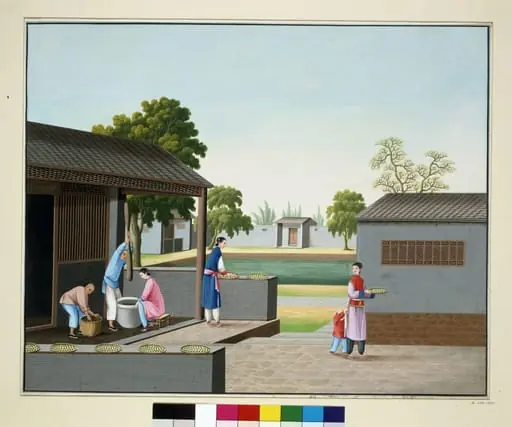 Pounding Tea Leaves and Forming Tea Cakes
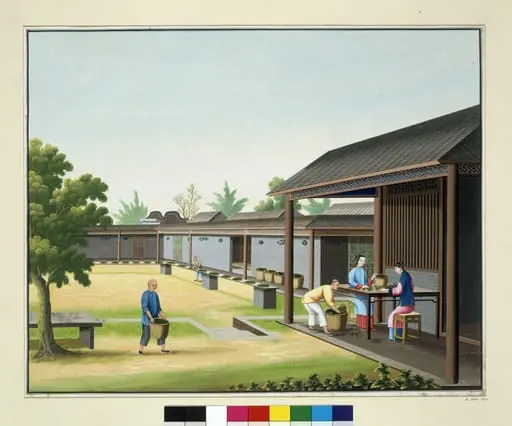 Drying Tea Leaves
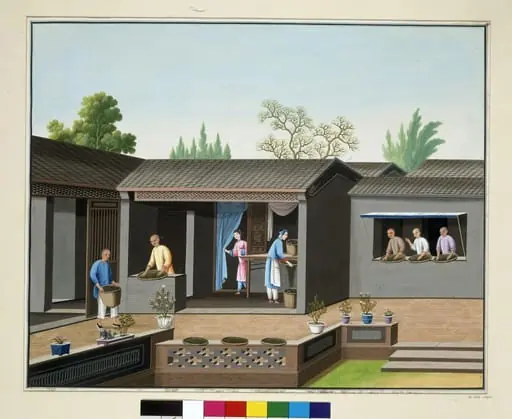 Rolling and Sieving
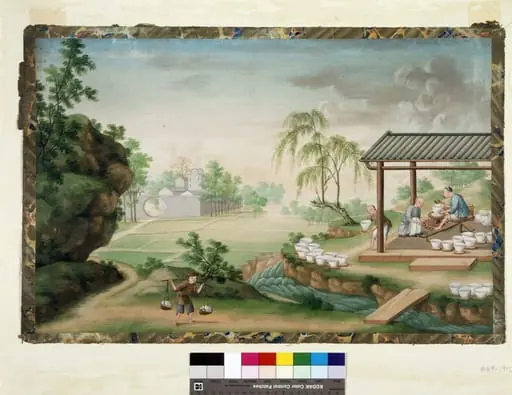 Making Basins
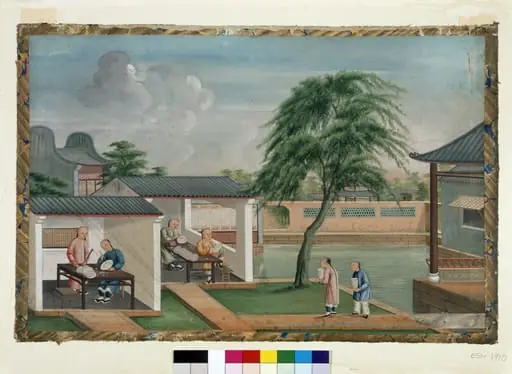 Potters Painting in Enamel Colours