Artwork
Husain Ali Khan Entertaining His Brothers (The Sayyid Brothers)
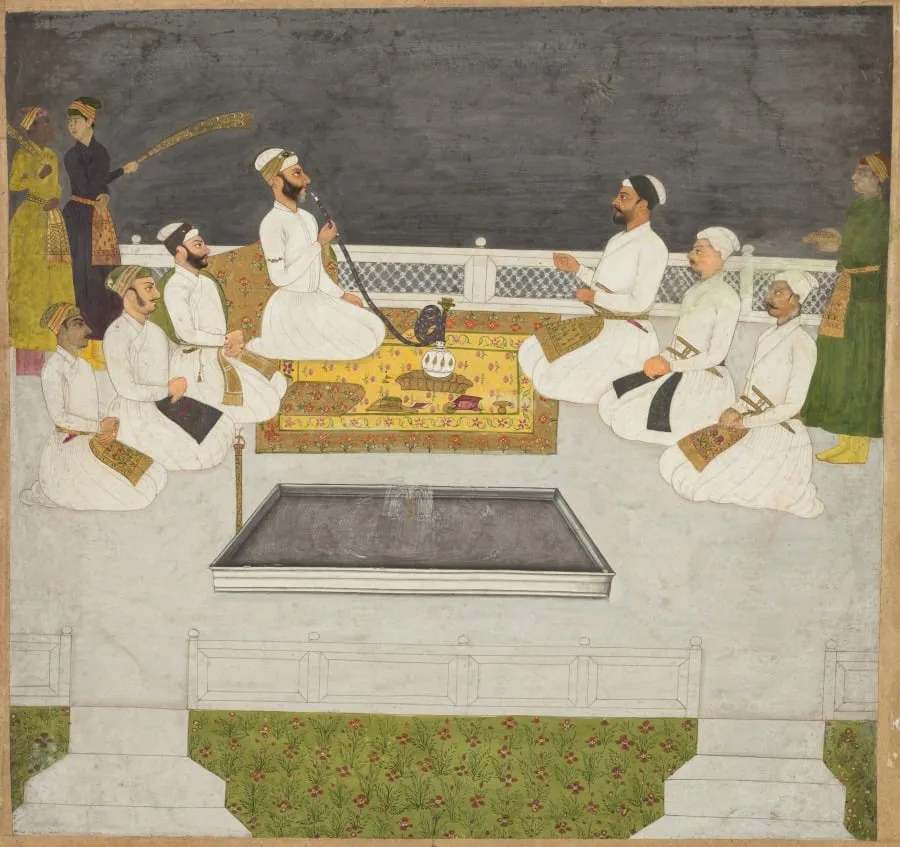
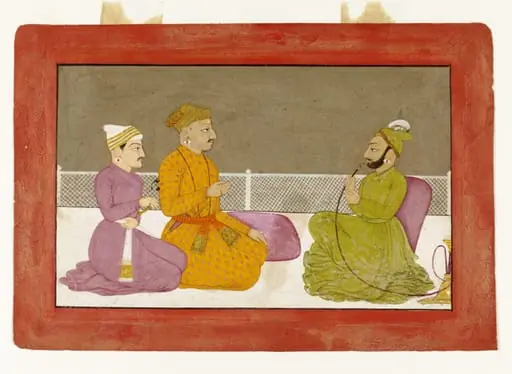
Husain Ali Khan Entertaining His Brothers (The Sayyid Brothers) is an unspecified painting by the Baroque artist Unknown. It dates from 1716 and is held in the collection of the Cleveland Museum of Art. The painting depicts three figures in white garments positioned on a white marble terrace.
About this work
This painting shows the Sayyid brothers, powerful kingmakers who controlled the Mughal throne in the early 1700s.
You see three men in white robes on a marble terrace, one smoking a hookah while two servants stand behind them.
This painting shows the Sayyid brothers, powerful kingmakers who controlled the Mughal throne in the early 1700s. The servants’ nervous glance hints at the danger of their rule. The flat gray sky feels like a quiet warning—rare in Indian art of this time.
To see more work like this, look up mughal dynasty (1526-1756).
Overview
The painting depicts three figures in white garments positioned on a white marble terrace. The central figure is seated, smoking a hookah, while two attendants stand behind him, casting uneasy glances toward one another. Above the scene a flat, gray sky stretches across the background, an uncommon atmospheric choice for early‑18th‑century Indian court paintings.
Subject & Meaning
The central trio represents the Sayyid brothers, the de facto rulers of the Mughal empire after Emperor Alamgir’s death in 1707 until Muhammad Shah’s accession in 1719. Their dominance as kingmakers, marked by a series of assassinations and rapid successions, is hinted at by the nervous expressions of the attendants and the somber sky, suggesting the precariousness of their authority.
Technique & Style
Executed in the Mughal court tradition, the work combines precise linear drawing with a restrained palette. The white marble terrace is rendered with subtle shading to convey depth, while the flat gray sky lacks the typical atmospheric perspective found in contemporary Indian paintings, indicating the artist’s deliberate emphasis on mood over realism.
History & Provenance
The composition reflects the political climate of the early 1700s, a period when the Sayyid brothers effectively controlled imperial administration. Though the painting’s exact origin remains undocumented, its style aligns with courtly works produced during the later Mughal era, a time when artists increasingly incorporated European compositional elements such as simplified backgrounds.
Artist & collection

 Domestic Scene
 Giacomo and Cardinal Marco, investing Andrea, Abbot of San Zeno, with his Benefice
 The Nymph of Fontainebleau
 Portrait of a Woman
 Madonna and Child with Saints in the Enclosed Garden
 Venus and Minerva
 Family Group of Four on Sofa
 Wall painting from Room H of the Villa of P. Fannius Synistor at Boscoreale