Artwork
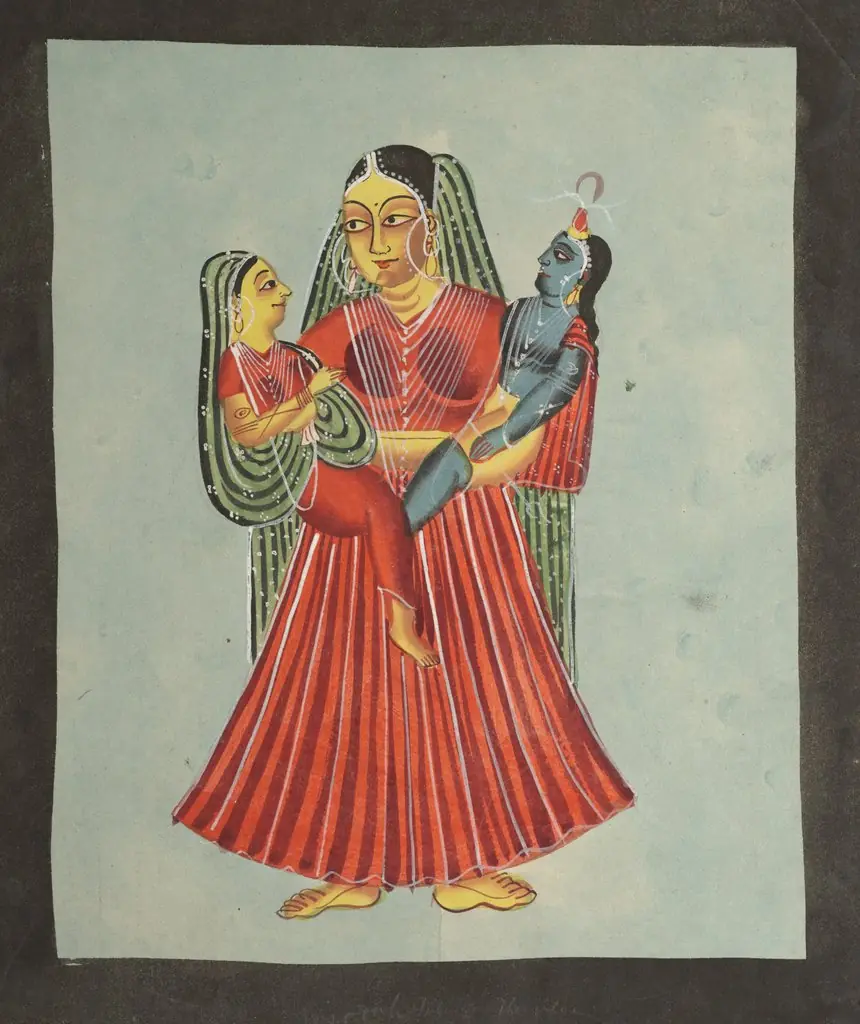
Jasoda, Radha and Krishna
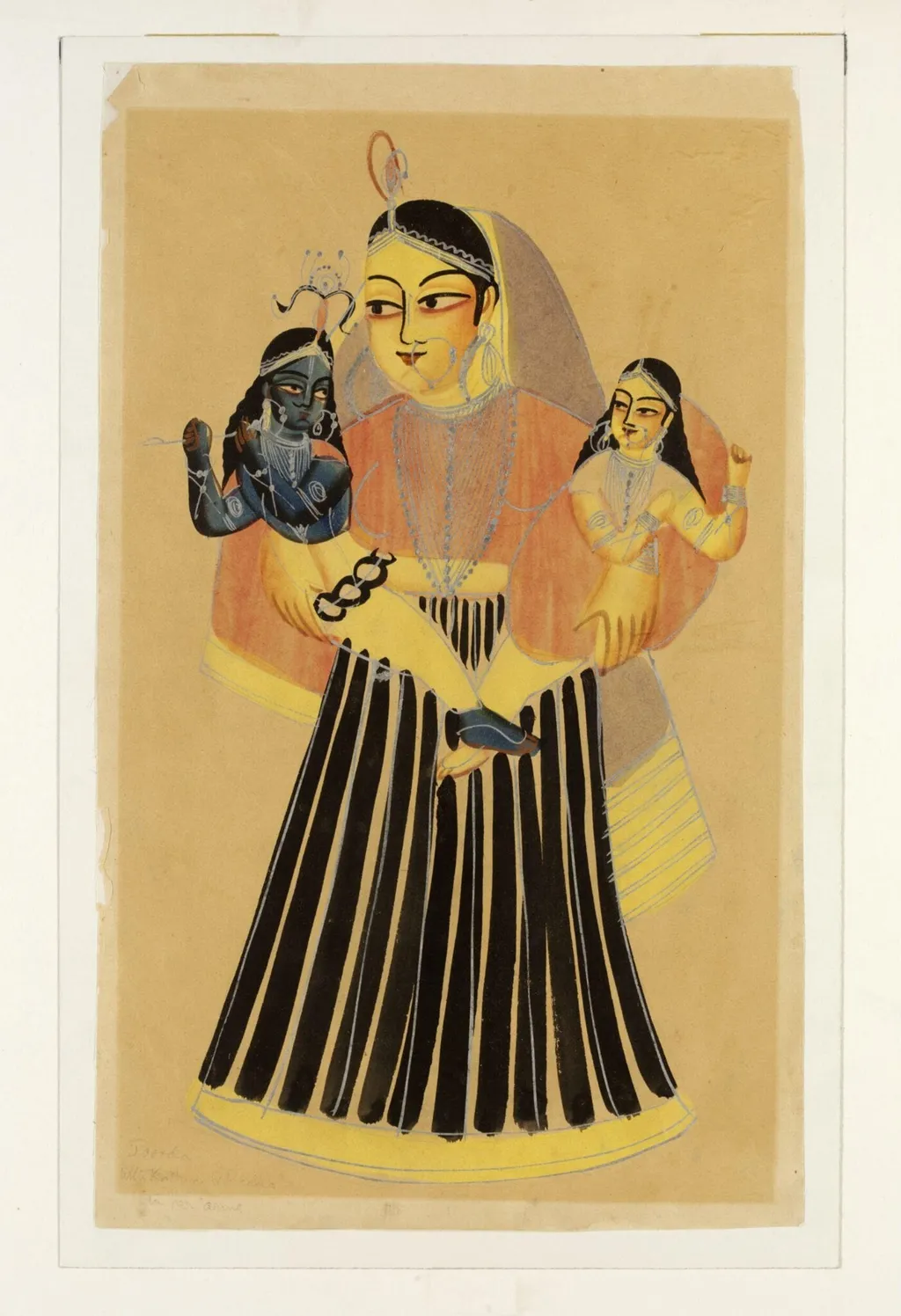
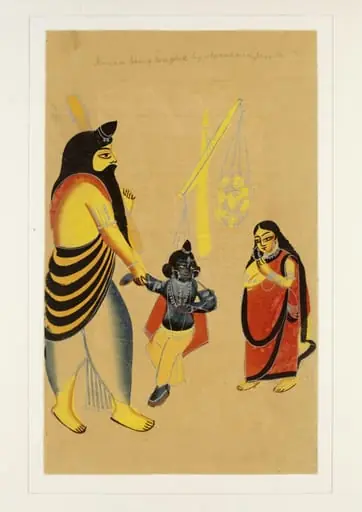
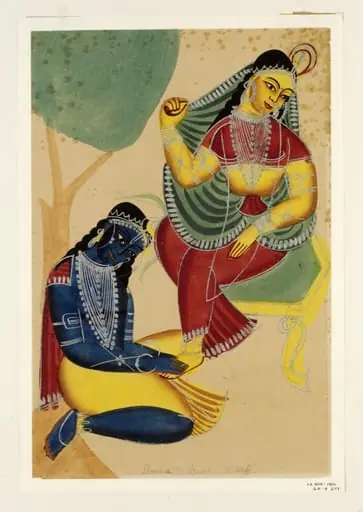
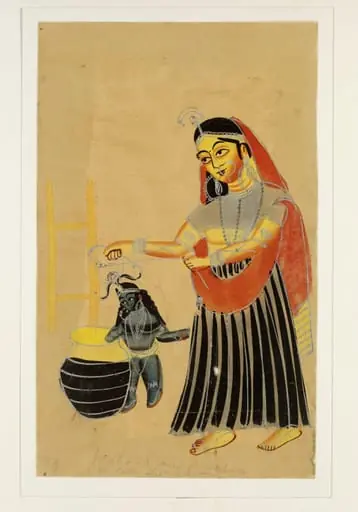
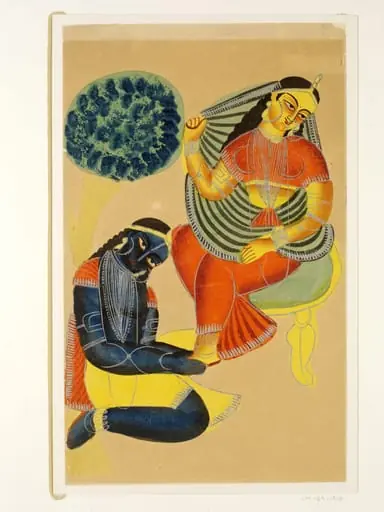
Jasoda, Radha and Krishna is a paint painting by the Impressionist artist Unknown. It dates from 1885 and is held in the collection of the Victoria and Albert Museum. Created in 1885, this opaque watercolour on paper depicts a domestic moment involving Jasoda, Radha, and the infant Krishna.
About this work
She holds a small dark figure in one arm, while another woman stands to her right, dressed in yellow with dark hair.
This painting shows three figures standing close together. The central woman wears a bright orange top and a long black skirt with yellow trim. She holds a small dark figure in one arm, while another woman stands to her right, dressed in yellow with dark hair. All three have simple, bold outlines and flat colors.
The small dark figure looks like a child, and the central woman’s face is calm but serious. This style is part of the kalighat tradition, a type of Indian painting from the 19th century.
Next, check out the Victoria and Albert Museum to see more works like this.
Overview
Created in 1885, this opaque watercolour on paper depicts a domestic moment involving Jasoda, Radha, and the infant Krishna. Attributed to an anonymous artist, the work belongs to the Kalighat tradition of 19th-century Bengal, known for its bold outlines and flat, unmodulated colours. It was acquired by the museum in 1950 from Miss M. Steele, whose family had collected Indian artworks over multiple generations.
Subject & Meaning
The scene portrays Jasoda, Krishna’s foster mother, cradling the infant while Radha stands beside her. Though drawn from Hindu devotional narratives, the composition emphasizes familial tenderness over mythological grandeur. The calm, serious expression on Jasoda’s face suggests quiet devotion, grounding the divine in an intimate, everyday setting characteristic of Kalighat’s humanized religious imagery.
Technique & Style
The painting employs opaque watercolour with strong, simplified contours and areas of unshaded colour—hallmarks of Kalighat art. Figures are rendered with minimal detail, focusing on silhouette and symbolic costume: Jasoda wears a bright orange upper garment with a black skirt edged in yellow, while Radha is dressed in yellow. The palette is restrained, and the background is left blank, directing attention entirely to the three figures.
History & Provenance
The painting entered the museum’s collection in 1950 through Miss M. Steele, who inherited it from her mother, a Cambridge Sanskrit scholar. Steele believed the work originated in a collection assembled by her grandmother, who lived in India during the 19th century. This lineage reflects the movement of Indian art into British private collections during the colonial era, often through familial networks rather than formal acquisition.
Context
Kalighat paintings emerged near the Kalighat temple in Kolkata, produced by itinerant artists for pilgrims and urban patrons. These works blended religious themes with contemporary social observations, often rendered quickly for mass appeal. Unlike elaborate courtly styles, Kalighat art embraced immediacy and accessibility, making it a vital record of 19th-century Bengali visual culture and devotional life.
Legacy
This painting exemplifies how traditional Indian iconography was adapted for a changing society, merging spiritual subjects with domestic realism. Though unsigned and anonymous, its survival in Western collections highlights the cross-cultural transmission of regional art forms. Today, it remains a key example of Kalighat’s influence on modern Indian visual identity and the preservation of folk traditions within institutional archives.
Artist & collection

 Domestic Scene
 Giacomo and Cardinal Marco, investing Andrea, Abbot of San Zeno, with his Benefice
 The Nymph of Fontainebleau
 Portrait of a Woman
 Madonna and Child with Saints in the Enclosed Garden
 Venus and Minerva
 Family Group of Four on Sofa
 Wall painting from Room H of the Villa of P. Fannius Synistor at Boscoreale