Artwork
Krishna, Narada and Jasoda
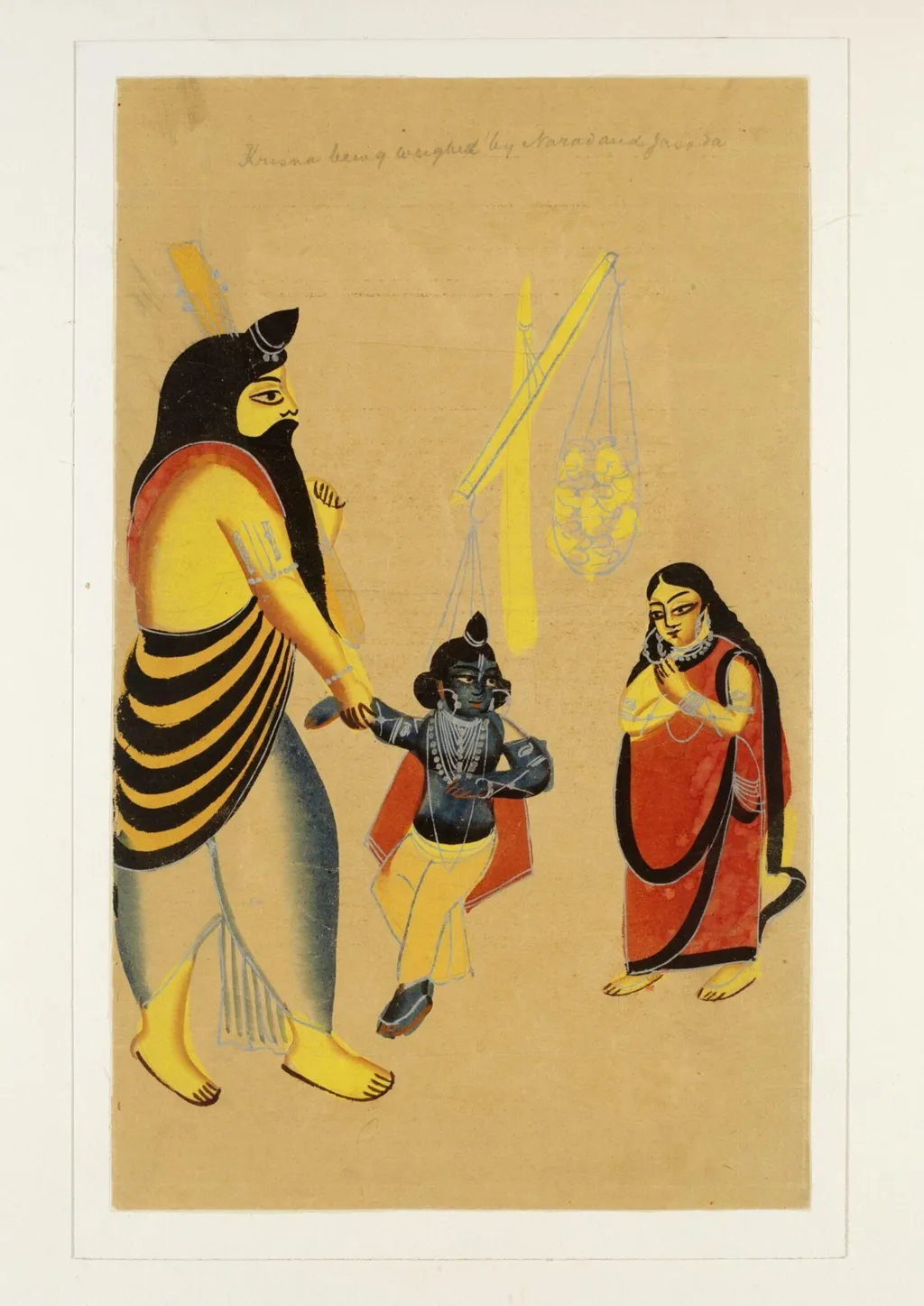
Krishna, Narada and Jasoda is a paint painting by the Patna School of Painting artist Unknown. It dates from 1885 and is held in the collection of the Victoria and Albert Museum.
About this work
Overview
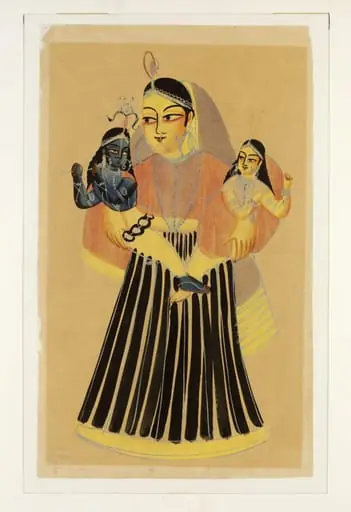
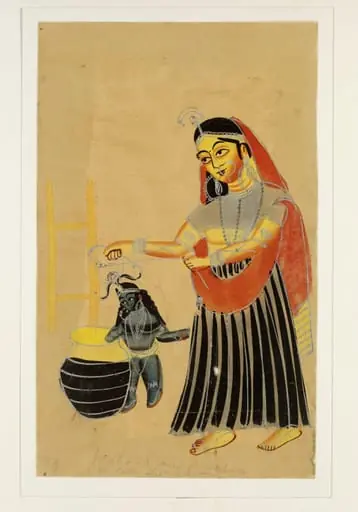
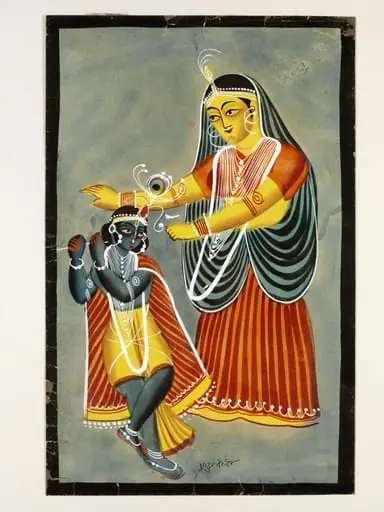
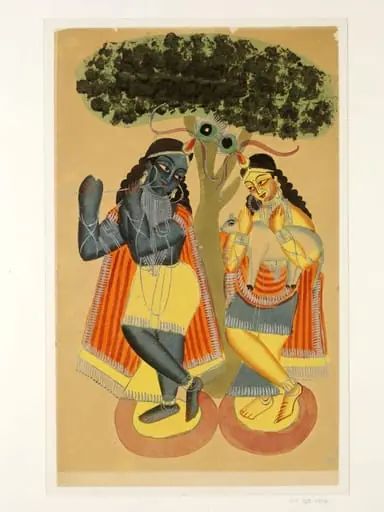
This opaque watercolour on paper portrays a moment from Krishna’s childhood, when the sage Narada weighs him against precious objects to test his divine nature.
This opaque watercolour on paper portrays a moment from Krishna’s childhood, when the sage Narada weighs him against precious objects to test his divine nature. Jasoda, his foster mother, watches closely. The painting was acquired by the museum in 1950 from Miss M. Steele, who inherited it from her mother, a Cambridge Sanskrit scholar. It likely originated in India and formed part of a larger illustrated series, possibly collected by Steele’s grandmother.
Subject & Meaning
The scene references a legend in which Narada, seeking to demonstrate Krishna’s divine worth, places the infant on one side of a scale and gold, jewels, and scriptures on the other. Jasoda’s presence underscores the emotional weight of the moment, as a mortal guardian witnesses the supernatural. The inclusion of a musician and a frowning observer suggests a ritual atmosphere, where divine truth is revealed through symbolic comparison and silent witness.
Technique & Style
Fine, precise brushwork defines Krishna’s blue skin, delicate jewelry, and the folds of Jasoda’s sari, which bears a faint gold pattern. Warm earth tones contrast with the child’s luminous complexion, drawing focus to his form. The background figures are rendered with minimal detail, enhancing the intimacy of the central trio. The use of opaque watercolour on paper reflects a tradition of Indian miniature painting, emphasizing clarity and decorative precision over atmospheric depth.
History & Provenance
The painting passed through the Steele family, descending from a Cambridge Sanskrit scholar who acquired it in India around 1894. It is believed her mother may have collected it during travels or through connections with Indian artists or patrons. Miss M. Steele retained the work until its donation to the museum in 1950. Its journey reflects colonial-era cultural exchanges, though its exact origin within India remains undocumented.
Context
This work belongs to a broader tradition of Pahari or Rajasthani miniature painting, where episodes from Krishna’s life were popular subjects among royal and scholarly patrons. Such paintings often served devotional or educational purposes, illustrating sacred texts for private contemplation. The attention to textile detail and symbolic composition aligns with regional styles preserved in collections like the Victoria and Albert Museum’s.
Legacy
Though not attributed to a named artist, the painting contributes to the understanding of how Krishna’s legends were visually transmitted in 19th-century India. Its survival within a European scholarly family highlights the cross-cultural circulation of Indian art. Today, it remains a quiet testament to the continuity of devotional imagery and the personal histories embedded in colonial-era collections.
Artist & collection

 Domestic Scene
 Giacomo and Cardinal Marco, investing Andrea, Abbot of San Zeno, with his Benefice
 The Nymph of Fontainebleau
 Portrait of a Woman
 Madonna and Child with Saints in the Enclosed Garden
 Venus and Minerva
 Family Group of Four on Sofa
 Wall painting from Room H of the Villa of P. Fannius Synistor at Boscoreale