Artwork
Ki-zeto-yaki
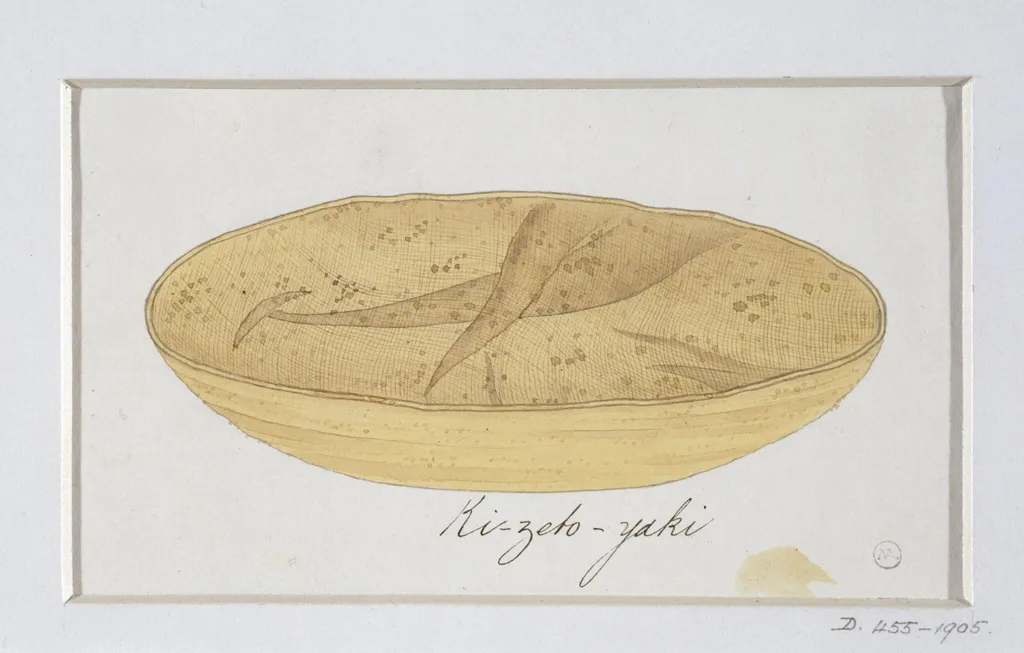
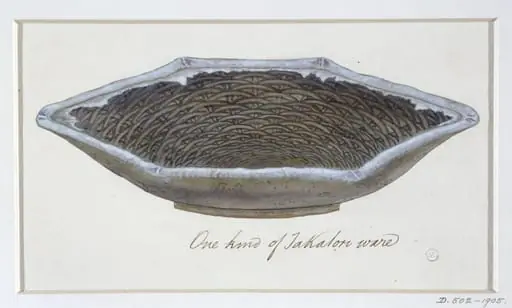
Ki-zeto-yaki is a paint painting by the Impressionist artist Unknown. It dates from 1877 and is held in the collection of the Victoria and Albert Museum.
About this work
Overview
Created in 1877, this ceramic vessel is an example of Ki-zeto-yaki, a Japanese pottery tradition valued for its unadorned, earthy aesthetic.
Created in 1877, this ceramic vessel is an example of Ki-zeto-yaki, a Japanese pottery tradition valued for its unadorned, earthy aesthetic. Though the artist remains unidentified, the piece was acquired by the museum in 1905 from Miss Mary Dresser, who inherited it from Christopher Dresser, a British designer with a keen interest in Japanese ceramics. Its inclusion in the Register of Drawings suggests it was documented as part of a broader study of decorative arts.
Subject & Meaning
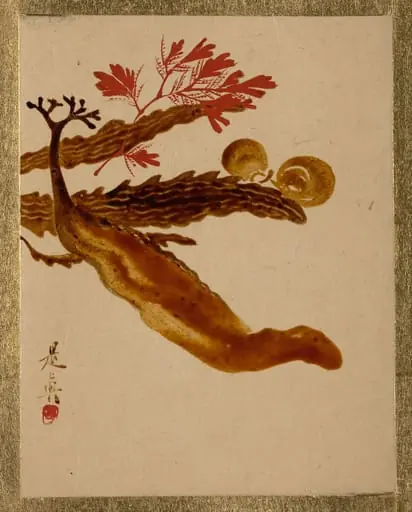
The work depicts a simple, unglazed bowl containing a single leaf, both rendered in muted browns with subtle variations in tone. The composition emphasizes natural forms and quiet asymmetry, reflecting the Japanese aesthetic of wabi-sabi—finding beauty in imperfection and transience. The leaf, likely chosen for its seasonal character, reinforces a contemplative relationship between object and nature.
Technique & Style
Ki-zeto-yaki pottery is fired at low temperatures using local clays, resulting in a porous, textured surface. This piece exhibits irregular dark speckles from ash glaze and uneven firing, typical of the style. The hand-built form shows minimal refinement, avoiding symmetry or polish, aligning with the tradition’s emphasis on material honesty and the imprint of the maker’s hand.
History & Provenance
The vessel passed from its original maker to Christopher Dresser, a 19th-century British designer who collected and promoted Japanese ceramics in Europe. After his death, it entered the possession of his daughter, Miss Mary Dresser, before being acquired by the museum in 1905. Its documentation in the Register of Drawings indicates it was studied as part of a scholarly effort to catalog non-Western craft traditions.
Context
In the late 19th century, Japanese ceramics gained attention in Europe as part of the Japonisme movement, influencing Western design and aesthetics. Ki-zeto-yaki, produced in rural kilns, stood in contrast to industrialized European pottery. Its quiet simplicity appealed to designers like Dresser, who sought alternatives to ornate Victorian styles, helping to shape early modernist sensibilities.
Legacy
This piece contributes to the historical record of cross-cultural artistic exchange between Japan and the West. While not widely known outside specialist circles, it represents a quiet but significant thread in the development of modern ceramic appreciation. Its preservation underscores the value placed on humble, functional objects as carriers of cultural and aesthetic philosophy.
Artist & collection

 Domestic Scene
 Giacomo and Cardinal Marco, investing Andrea, Abbot of San Zeno, with his Benefice
 The Nymph of Fontainebleau
 Portrait of a Woman
 Madonna and Child with Saints in the Enclosed Garden
 Venus and Minerva
 Family Group of Four on Sofa
 Wall painting from Room H of the Villa of P. Fannius Synistor at Boscoreale