Artwork
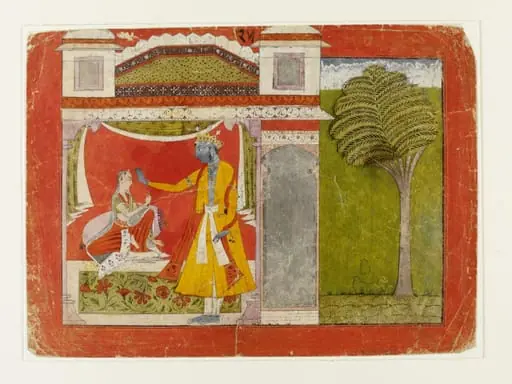
Krishna Abhisarika Nayika, from a Rasikapriya manuscript
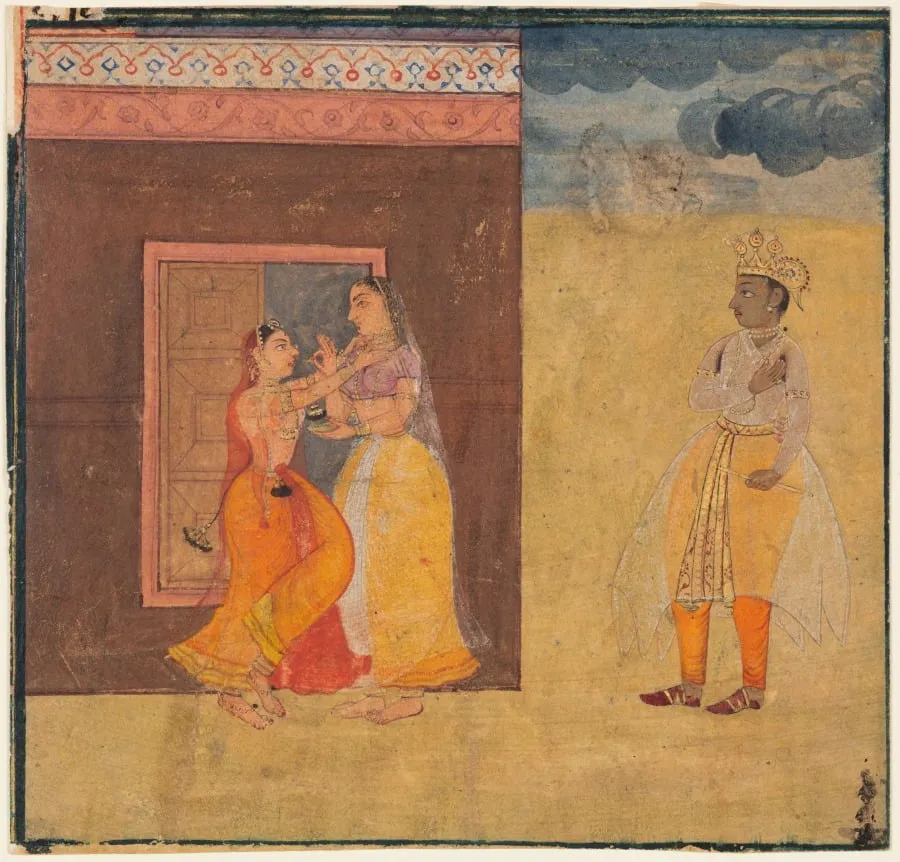
Krishna Abhisarika Nayika, from a Rasikapriya manuscript is an unspecified painting by the Baroque artist Unknown. It dates from 1620 and is held in the collection of the Cleveland Museum of Art.
About this work
The artist didn’t sign the work, so we don’t know who painted it, but the style is common in Rajasthan around 1600.
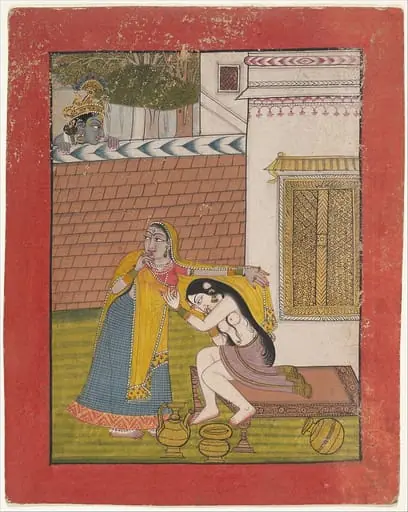
A woman in a red scarf strangles another woman while a man watches from a balcony. The scene is packed into a small, bright painting with flat colors and no shadows.
This is a moment from a love poem called the *Rasikapriya*. The woman in red is the hero’s wife—she’s caught him cheating and is taking her anger out on his mistress. The artist didn’t sign the work, so we don’t know who painted it, but the style is common in Rajasthan around 1600.
To see more paintings like this, look up the Rajput kingdom of Amber.
Overview
The miniature illustrates a dramatic episode from the love poem *Rasikapriya*, depicting a domestic dispute in which a woman in a red scarf confronts another woman while the male protagonist observes from a balcony. The composition is confined to a compact format, employing bright, flat pigments without chiaroscuro, characteristic of early‑sixteenth‑century Rajasthani manuscript art.
Subject & Meaning
The central figure, identified as the hero’s wife, has discovered her husband’s infidelity and reacts by choking the rival woman, presumed to be the lover, and preparing to strike her. The scene captures a moment of personal betrayal and retribution, reflecting the emotional intensity and moral themes explored in the *Rasikapriya* narrative.
Technique & Style
Executed in the Rajput miniature tradition, the work features a limited palette of saturated colors applied in uniform washes, creating a two‑dimensional effect. Figures are rendered with stylised gestures and minimal shading, while the architectural backdrop is suggested by simple lines, emphasizing the narrative action over spatial realism.
History & Provenance
The painting originates from a manuscript of the *Rasikapriya* produced in the Amber court of Rajasthan around the early 1600s. No artist’s signature survives, but the stylistic traits align with other contemporary works from the Amber workshop, indicating a shared visual language among courtly illustrators of the period.
Context
During the early modern era, Rajput courts commissioned illustrated poetry to celebrate courtly love and moral dilemmas. This piece exemplifies how visual art was employed to complement literary texts, providing a vivid, didactic illustration of the poem’s moral conflict within a domestic setting.
Artist & collection

 Domestic Scene
 Giacomo and Cardinal Marco, investing Andrea, Abbot of San Zeno, with his Benefice
 The Nymph of Fontainebleau
 Portrait of a Woman
 Madonna and Child with Saints in the Enclosed Garden
 Venus and Minerva
 Family Group of Four on Sofa
 Wall painting from Room H of the Villa of P. Fannius Synistor at Boscoreale