Artwork
Krishna and Bakasura
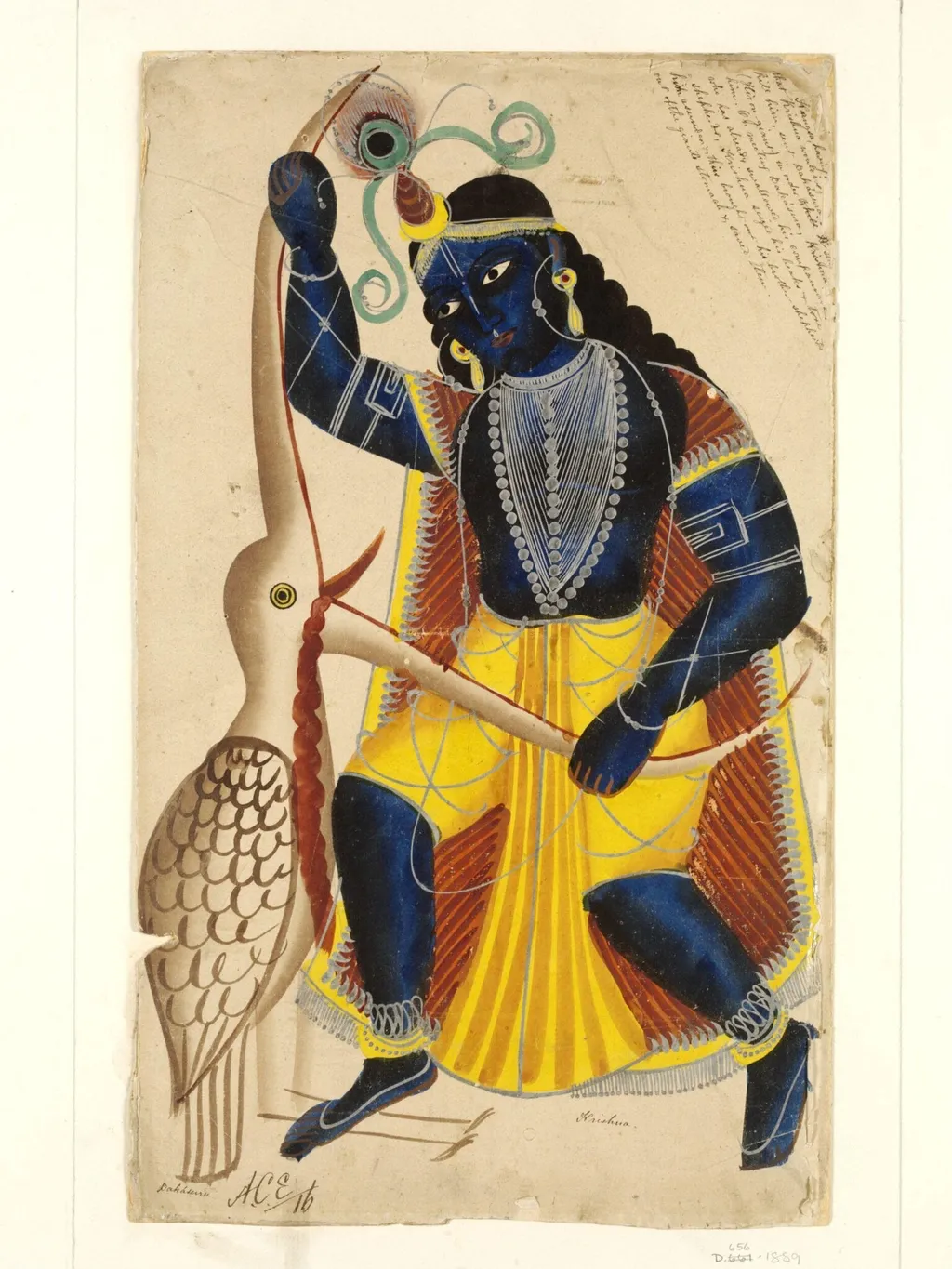
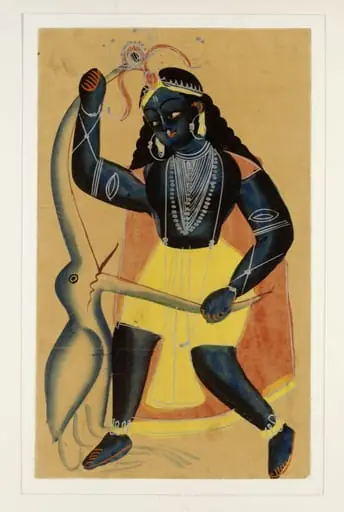
Krishna and Bakasura is a paint painting by the Impressionist artist Unknown. It dates from 1850 and is held in the collection of the Victoria and Albert Museum. This watercolour on paper, enhanced with tin-alloy accents, portrays a moment from Hindu mythology in the Kalighat style.
About this work
Overview
This watercolour on paper, enhanced with tin-alloy accents, portrays a moment from Hindu mythology in the Kalighat style.
This watercolour on paper, enhanced with tin-alloy accents, portrays a moment from Hindu mythology in the Kalighat style. The scene captures Krishna confronting the demon Bakasura, rendered with bold, flat pigments and minimal shading. The composition emphasizes symbolic clarity over naturalism, typical of 19th-century Bengali folk painting traditions. The work was collected in 1889 from G. Wild and remains part of a curated group of related Kalighat images.
Subject & Meaning
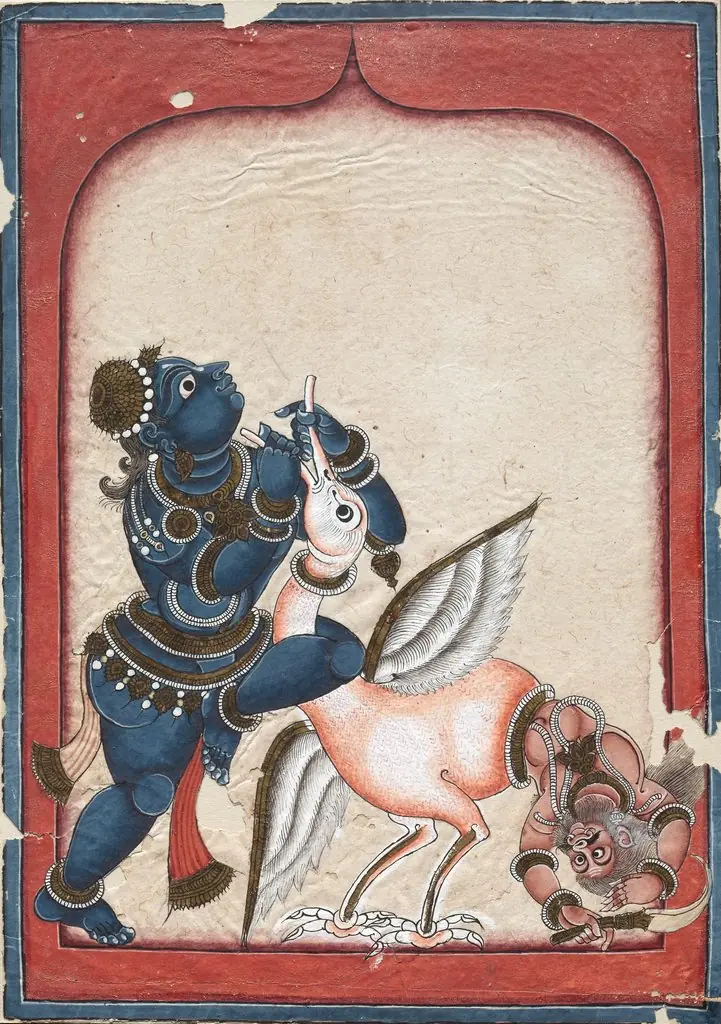
Krishna, an avatar of Vishnu, defeats Bakasura, a demonic heron sent to destroy him. The act symbolizes divine intervention against malevolent forces. Krishna’s calm demeanor contrasts with the violence of the moment, reflecting the belief that spiritual power transcends brute force. The demon’s elongated beak, split by Krishna’s staff, visually marks the triumph of dharma over adharma, a core theme in Vaishnavite narratives.
Technique & Style
The painting employs flat, unmodulated colours and simplified forms, characteristic of Kalighat art. Outlines are sharp, details are stylized rather than realistic, and decorative elements—such as the peacock-feather crown and ornate jewelry—are rendered with precision. Tin-alloy highlights add subtle metallic sheen, enhancing sacred attributes. The lack of perspective and background focuses attention entirely on the figures and their symbolic interaction.
History & Provenance
Acquired in 1889 from G. Wild, the painting entered a broader collection of Kalighat works assembled during the colonial era. These pieces were often sourced from artists near the Kalighat temple in Kolkata, who produced devotional imagery for pilgrims and collectors. The work’s survival and cataloging reflect early Western interest in Indian folk art, though its original religious context was often overlooked by collectors.
Context
Kalighat paintings emerged in the early 19th century as affordable devotional art for temple visitors. Artists adapted traditional iconography to contemporary tastes, blending mythological themes with social commentary. This piece reflects a period when religious imagery was both spiritually significant and commercially produced, responding to urban audiences seeking portable, vivid representations of divine stories.
Legacy
As part of a larger corpus of Kalighat art, this painting contributes to the understanding of how Hindu narratives were visually codified in popular culture. Its preservation in institutional collections highlights its role as both religious artifact and cultural document. While no longer used in worship, it remains a key example of how folk art sustained mythological traditions through accessible, stylized representation.
Artist & collection

 Domestic Scene
 Giacomo and Cardinal Marco, investing Andrea, Abbot of San Zeno, with his Benefice
 The Nymph of Fontainebleau
 Portrait of a Woman
 Madonna and Child with Saints in the Enclosed Garden
 Venus and Minerva
 Family Group of Four on Sofa
 Wall painting from Room H of the Villa of P. Fannius Synistor at Boscoreale