Artwork
Krishna and Bakasura
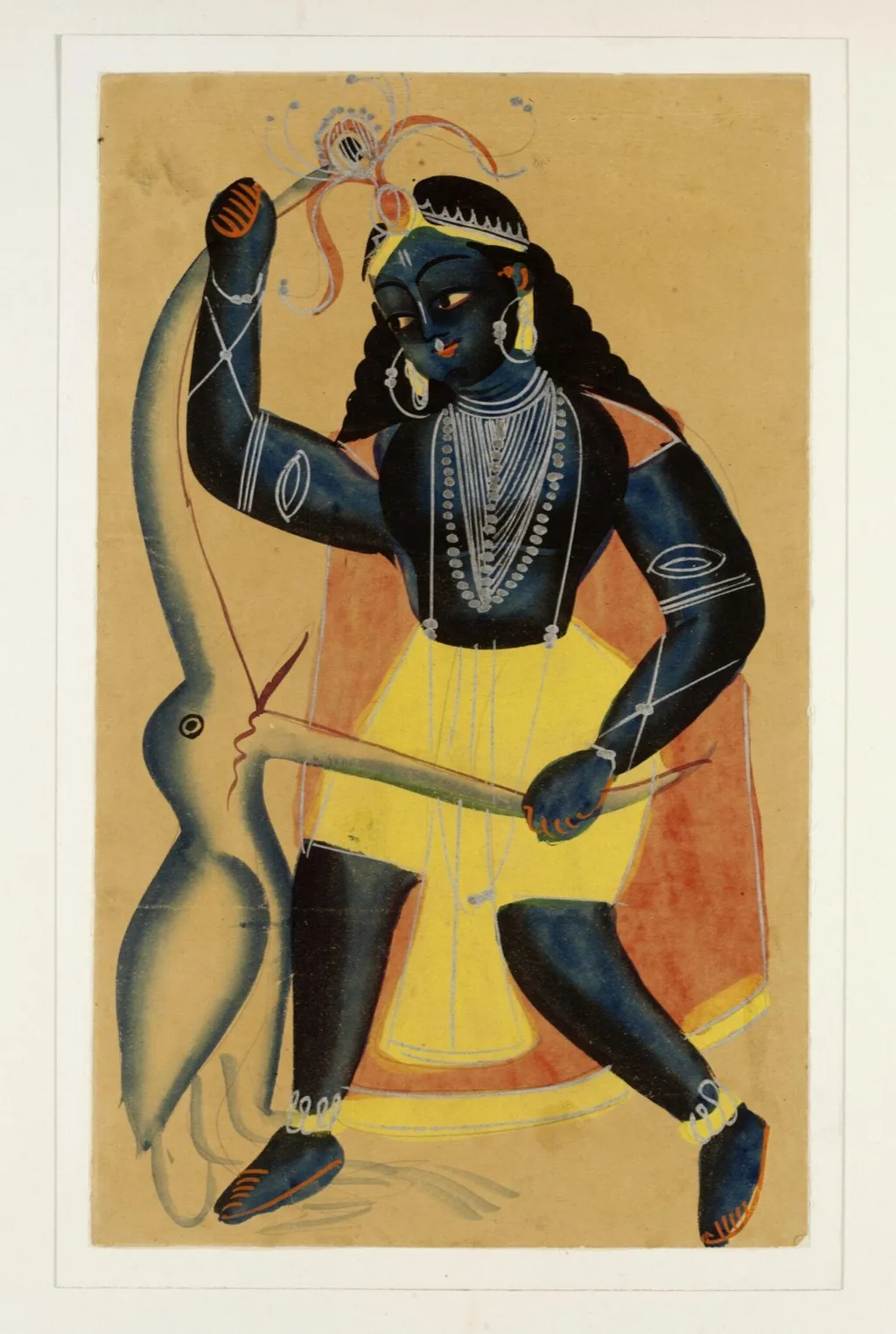
Krishna and Bakasura is a paint painting by the Impressionist artist Unknown. It dates from 1885 and is held in the collection of the Victoria and Albert Museum.
About this work
Overview
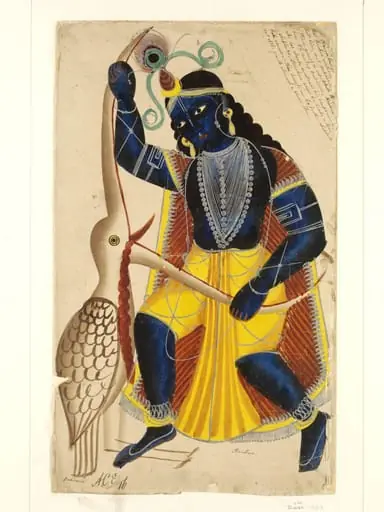
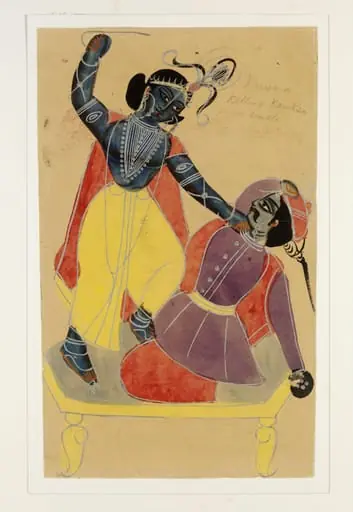
This 1885 opaque watercolour on paper portrays a moment from Krishna’s mythological encounters, specifically his confrontation with the demon Bakasura.
This 1885 opaque watercolour on paper portrays a moment from Krishna’s mythological encounters, specifically his confrontation with the demon Bakasura. Executed in the Kalighat style, it reflects the commercial art traditions of 19th-century Bengal. The work was acquired by the museum in 1950 from Miss M. Steele, whose family had connections to Indian cultural collections through generations of scholarly engagement.
Subject & Meaning
The scene captures Krishna, identified by his dark blue skin and flute, in a moment of divine triumph over Bakasura, a demon in the form of a crane-like creature. The upward reach of the beast suggests its final struggle, while Krishna’s calm posture implies control and spiritual authority. This imagery draws from Hindu devotional narratives, where Krishna’s interventions symbolize the restoration of cosmic order.
Technique & Style
The painting employs flat, unmodulated areas of vivid colour—yellow, red, and black—outlined in bold, clean lines typical of Kalighat art. There is no use of perspective or shading; forms are simplified and stylized. The background remains untextured, directing focus to the figures. This approach prioritizes symbolic clarity over naturalism, aligning with the rapid, accessible aesthetic developed for urban audiences in colonial Calcutta.
History & Provenance
The painting entered the museum’s collection in 1950 through Miss M. Steele, who inherited it from her mother, a Cambridge Sanskrit scholar. The collection likely originated with Steele’s grandmother, who lived in India during the 19th century and may have acquired the work locally. Its journey reflects the movement of South Asian art into private Western collections through familial and intellectual networks.
Context
Created during the height of Kalighat painting’s popularity, this work emerged from artists near the Kalighat temple in Calcutta who catered to pilgrims and colonial buyers. These paintings blended religious themes with contemporary social commentary, often rendered quickly for mass appeal. The depiction of Krishna as a serene, almost detached figure reflects both devotional reverence and the commercial demands of the time.
Legacy
As a representative of Kalighat art, this painting contributes to the understanding of how traditional Indian iconography adapted to changing audiences in the colonial era. It preserves a visual language that bridged sacred narrative and urban commerce, influencing later modernist reinterpretations of Indian folk art. Its presence in a Western museum underscores the global circulation of regional artistic traditions.
Artist & collection

 Domestic Scene
 Giacomo and Cardinal Marco, investing Andrea, Abbot of San Zeno, with his Benefice
 The Nymph of Fontainebleau
 Portrait of a Woman
 Madonna and Child with Saints in the Enclosed Garden
 Venus and Minerva
 Family Group of Four on Sofa
 Wall painting from Room H of the Villa of P. Fannius Synistor at Boscoreale