Artwork
Krishna
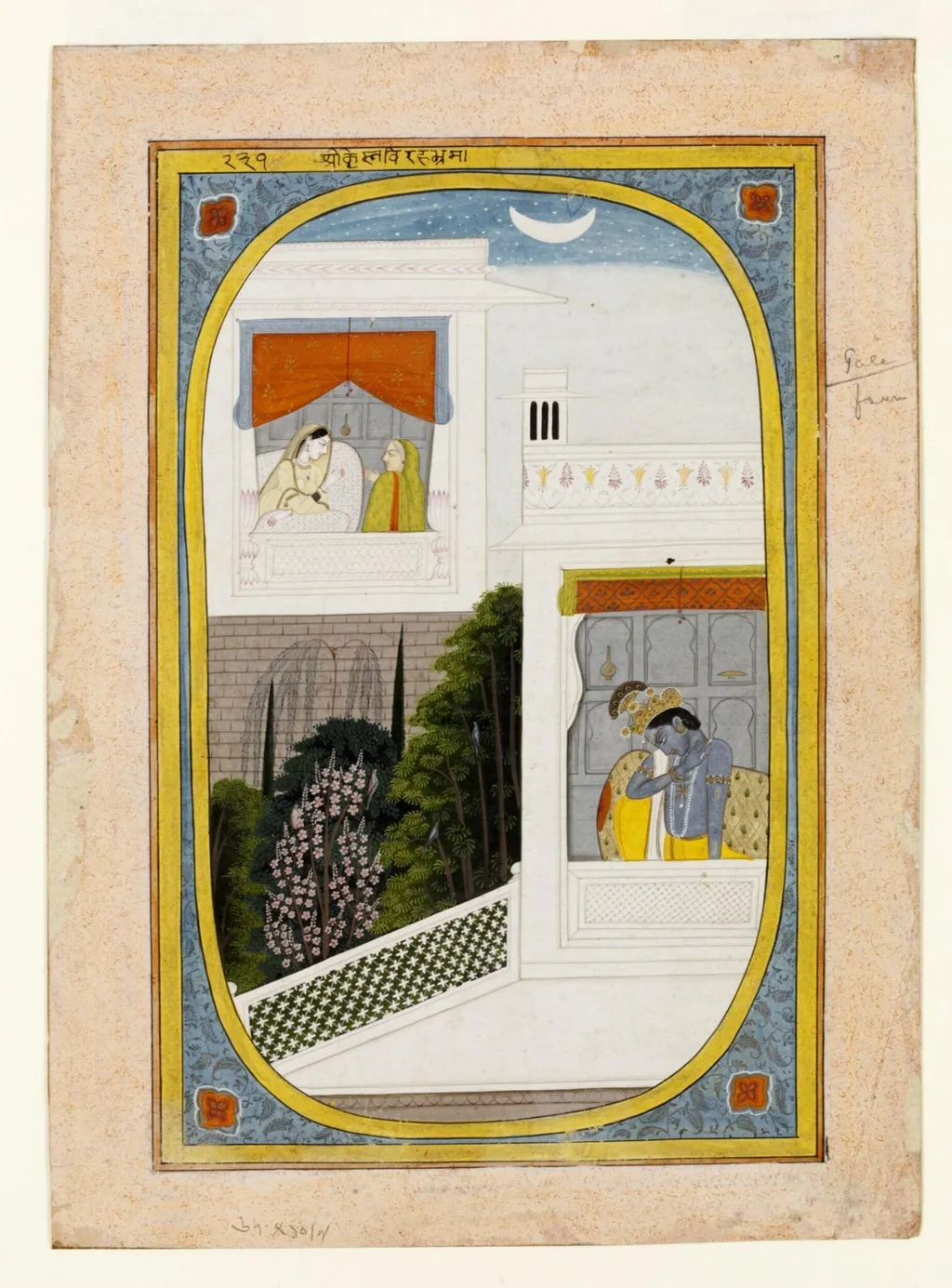
Krishna is a paint painting by the Mughal Painting artist Unknown. It dates from 1820 and is held in the collection of the Victoria and Albert Museum.
About this work
Overview
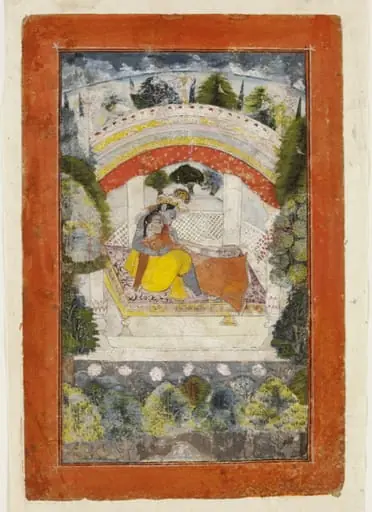
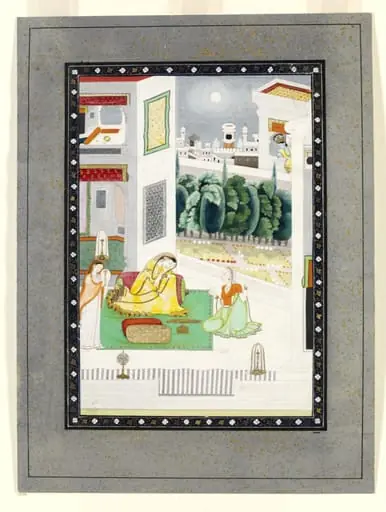
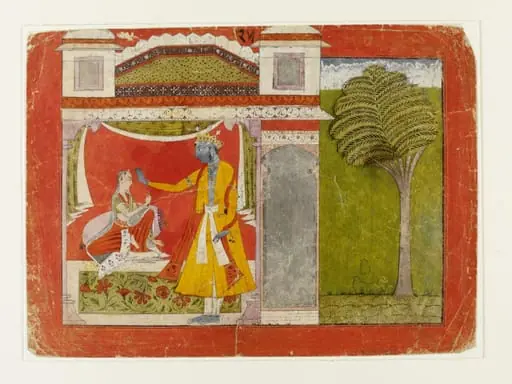
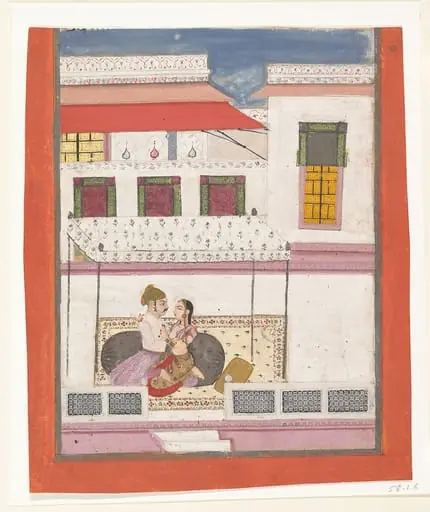
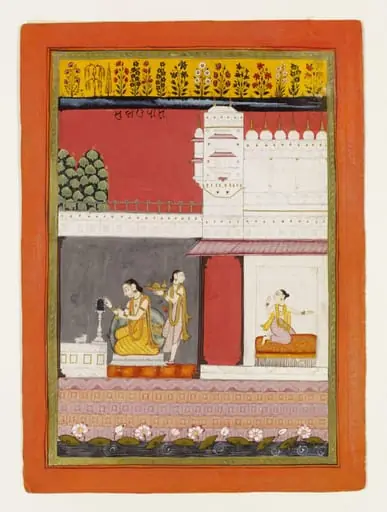
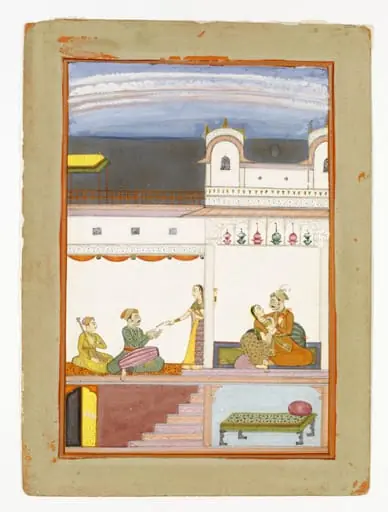
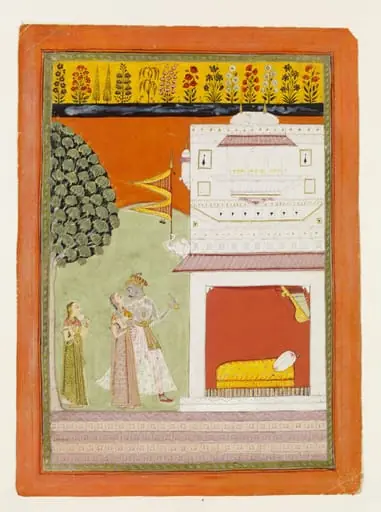
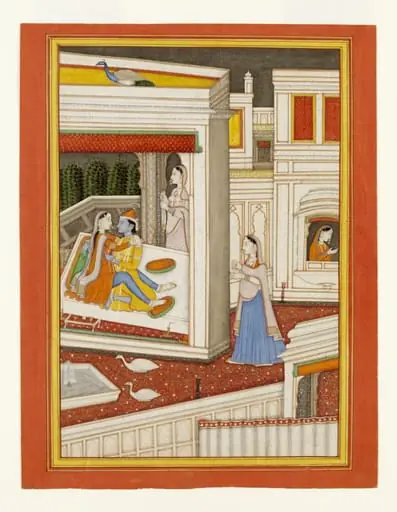
Created in 1820 as part of the Rasika Priya series, this opaque water‑colour on paper presents a bifurcated interior scene under a golden arch. The composition is divided into two vignettes: a lower chamber where Krishna sits alone, and an upper room where Radha converses with another woman. A decorative border of stars and swirling motifs frames the work, lending it a lyrical atmosphere.
Subject & Meaning
The left panel focuses on Krishna, depicted in a solitary pose that conveys melancholy, while the right panel captures a social exchange between Radha and a companion, suggesting themes of longing and relational distance. The juxtaposition of the solitary deity with the lively dialogue hints at the tension between divine contemplation and human interaction within the mythic narrative.
Technique & Style
The use of a golden arch to frame the scenes, along with decorative star‑filled borders, creates a dream‑like visual field.
Executed in opaque water‑colour, the artist employs vivid pigments—rich reds, luminous yellows, and deep blues—that contrast sharply with the surrounding white walls. The use of a golden arch to frame the scenes, along with decorative star‑filled borders, creates a dream‑like visual field. Fine brushwork renders the red curtain and garden blossoms, while broader strokes define the figures' bright attire.
History & Provenance
The work originates from the early nineteenth‑century Rasika Priya series, a collection that explored devotional subjects through intimate interior settings. Though specific ownership records are limited, the painting now resides in a public collection, where it is displayed alongside other contemporaneous Indian water‑colour works, illustrating the period’s cross‑cultural artistic exchanges.
Artist & collection

 Domestic Scene
 Giacomo and Cardinal Marco, investing Andrea, Abbot of San Zeno, with his Benefice
 The Nymph of Fontainebleau
 Portrait of a Woman
 Madonna and Child with Saints in the Enclosed Garden
 Venus and Minerva
 Family Group of Four on Sofa
 Wall painting from Room H of the Villa of P. Fannius Synistor at Boscoreale