Artwork
La Place de Meir, Antwerp
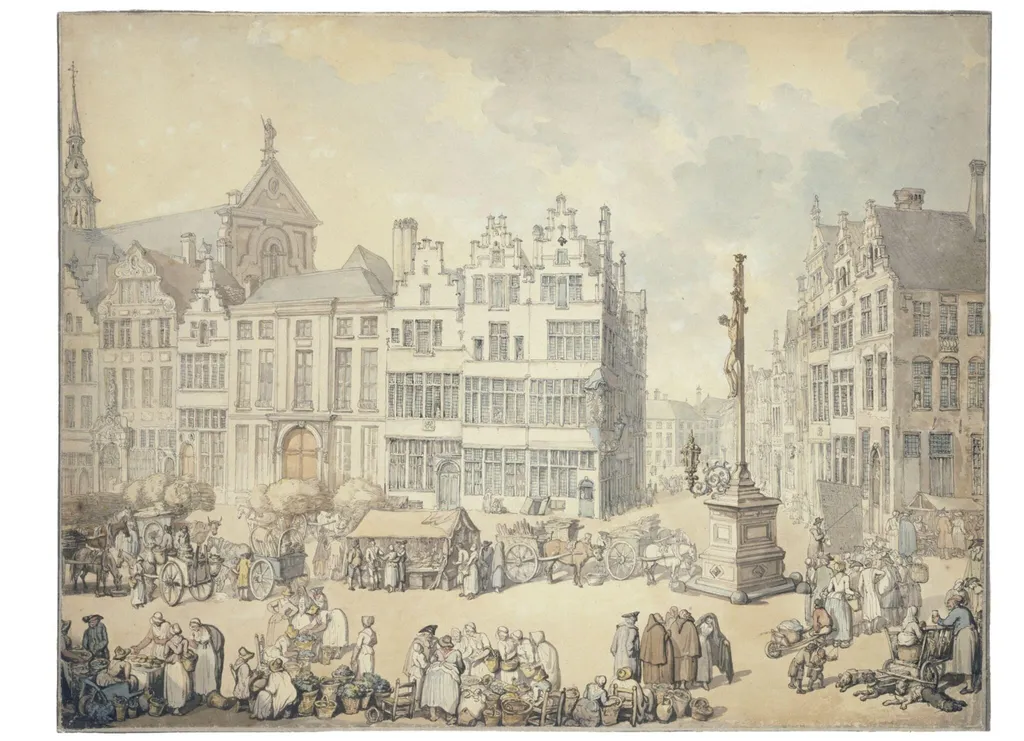
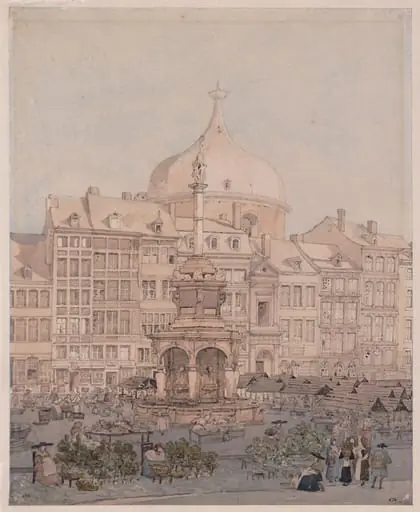
La Place de Meir, Antwerp is a watercolor work on paper by the Romanticist artist Unknown. It dates from 1794 and is held in the collection of the Victoria and Albert Museum.
About this work
Overview
La Place de Meir, Antwerp is a watercolour created in 1794, capturing the vibrant atmosphere of Antwerp's market square, characterized by prominent architectural features and daily life activities.
Subject & Meaning
The scene focuses on the intersection of religious and commercial life, featuring a large crucifix, the Church of the Carmelites, and bustling market stalls, highlighting the coexistence of spirituality and everyday commerce in late 18th-century Antwerp.
Technique & Style
Executed in soft colours with light shading, the watercolour conveys a sense of calm amidst activity, employing detailed renderings of architectural elements to evoke depth and texture, aligning with emerging interests in quotidian life and emotional resonance.
History & Provenance
Initially documented as 'Place du Midi' in a sale catalogue, the work may have inspired a 1797 engraving by Rudolf Ackermann. Notably, the depicted crucifix and Church of the Carmelites were demolished later in 1797 under French occupation.
Context
Created on the cusp of the French occupation, this work reflects the pre-revolutionary landscape of Antwerp, capturing a moment before significant architectural and possibly societal changes.
Legacy
While its direct influence is noted through a potential connection to Ackermann's engraving, the watercolour's broader legacy lies in its detailed, emotive portrayal of late 18th-century Antwerp life, contributing to the broader artistic shift towards capturing everyday existence.
Artist & collection

 Domestic Scene
 Giacomo and Cardinal Marco, investing Andrea, Abbot of San Zeno, with his Benefice
 The Nymph of Fontainebleau
 Portrait of a Woman
 Madonna and Child with Saints in the Enclosed Garden
 Venus and Minerva
 Family Group of Four on Sofa
 Wall painting from Room H of the Villa of P. Fannius Synistor at Boscoreale