Artwork
Landscape
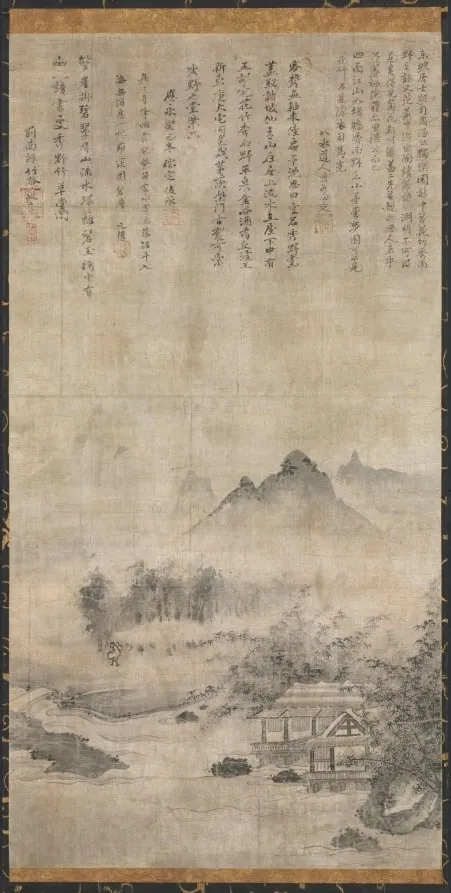
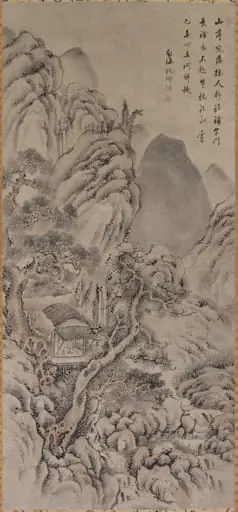
Landscape is an unspecified painting by the Baroque artist Unknown. It dates from 1704 and is held in the collection of the Cleveland Museum of Art. The work is an ink painting on paper depicting a modest wooden studio nestled within a bamboo grove.
About this work
This mix of picture and poem was common in Japan’s Zen temples long before this painting was made.
You see a quiet ink painting of a bamboo grove around a small wooden studio.
The artist copied an old Chinese idea: a poem written above the scene. The words talk about a scholar’s garden, turning simple bamboo into a symbol of wisdom. This mix of picture and poem was common in Japan’s Zen temples long before this painting was made.
Look up *Japan, Edo period (1615–1868)* to see more works like this.
Overview
The work is an ink painting on paper depicting a modest wooden studio nestled within a bamboo grove. Above the image, a calligraphic inscription presents verses drawn from Su Shi’s commentary on the Song‑era scholar Sima Guang. The composition follows the shigajiku format, a hanging scroll that unites poetry and landscape, a tradition inherited from Muromachi‑period Zen monasteries.
Subject & Meaning
The bamboo surrounding the studio functions as a visual metaphor for the cultivated garden of Sima Guang, a Song‑dynasty official who, like the Tang poet Bai Juyi, retreated to an isolated garden during exile in Luoyang. The accompanying verses interpret the natural setting as a symbol of scholarly contemplation and the pursuit of wisdom.
Technique & Style
Executed in monochrome ink, the painting employs the restrained brushwork characteristic of Chinese literati art, emphasizing tonal variation and the suggestion of form over detailed rendering. The calligraphy above follows the classical Chinese style, integrating text and image in a seamless vertical arrangement typical of Zen shigajiku scrolls.
Context
The piece reflects a Japanese appropriation of Chinese artistic conventions that flourished among Zen monks in the Muromachi era (1392–1573). By echoing the earlier practice of pairing Chinese poems with ink landscapes, the work situates itself within a lineage that continued into the Edo period, illustrating the enduring cross‑cultural dialogue between Japanese Zen aesthetics and Chinese scholarly tradition.
Artist & collection

 Domestic Scene
 Giacomo and Cardinal Marco, investing Andrea, Abbot of San Zeno, with his Benefice
 The Nymph of Fontainebleau
 Portrait of a Woman
 Madonna and Child with Saints in the Enclosed Garden
 Venus and Minerva
 Family Group of Four on Sofa
 Wall painting from Room H of the Villa of P. Fannius Synistor at Boscoreale
 같은 해에 태어난 관리들의 친목 모임 조선|同庚契會圖 朝鮮|Gathering of government officials
 清 法若真 雲山圖軸|Cloudy Mountains
 Landscape in the Style of Dong Yuan and Juran
 元/明 佚名 舊傳 燕文貴 秋山蕭寺圖 軸|Buddhist Temples amid Autumn Mountains
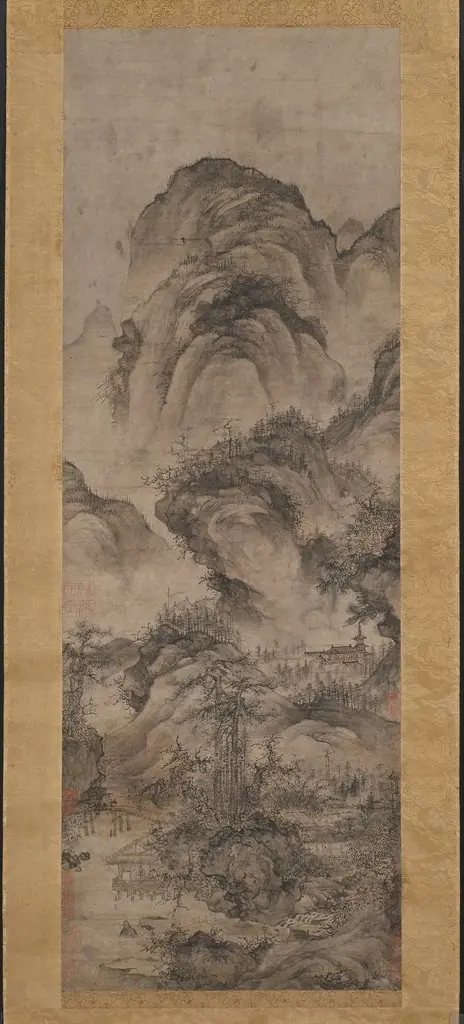 Water Pavilion by Twin Pines
![Summer Mountains (after Dong Yuan [active about ad 937-975]), by Huang Gongwang](https://artifactworldgallery.com/img/huang-gongwang--summer-mountains-after-dong-yuan-active-about-ad-937-975--a5e22b9ec870e011-w320.webp) Summer Mountains (after Dong Yuan [active about ad 937-975])
Summer Mountains (after Dong Yuan [active about ad 937-975])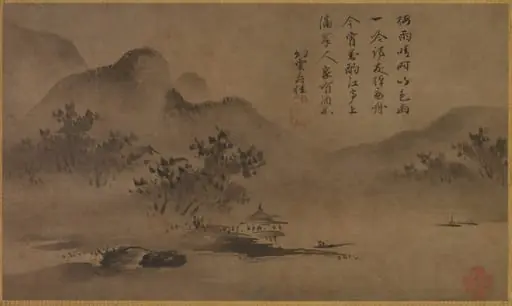 Landscape
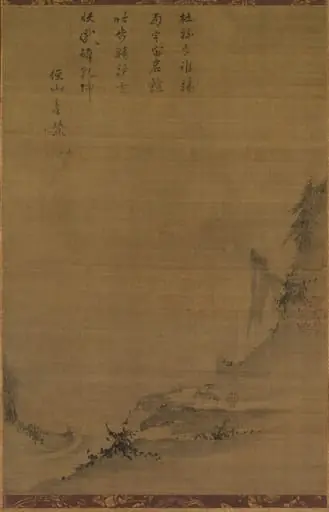 Mountain Landscape in Moonlight
 Untitled
 Landscape
 Mountain Market, Clear with Rising Mist
 Landscape