Artwork
Maharao Ram Singh II of Kota (r. 1828–66) Hunting Buffalo
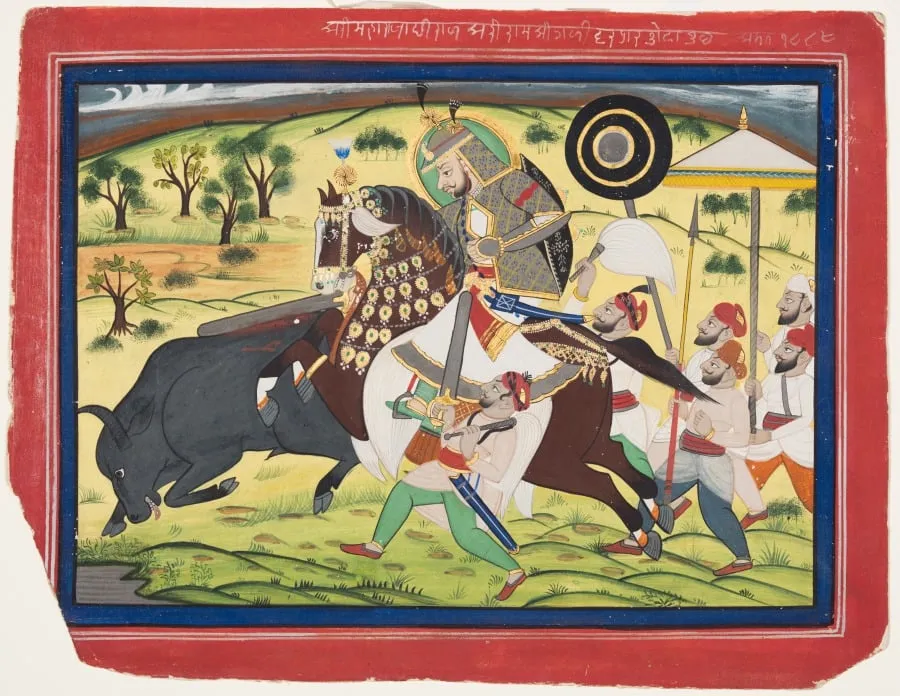
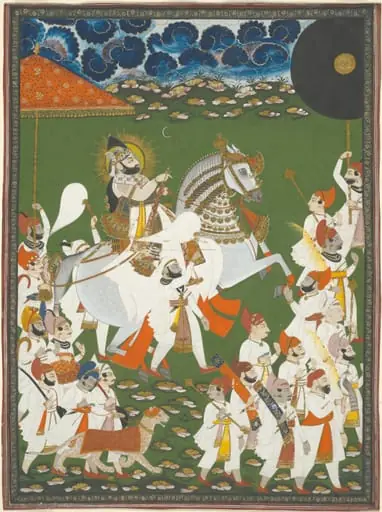
Maharao Ram Singh II of Kota (r. 1828–66) Hunting Buffalo is an unspecified painting by the Patna School of Painting artist Unknown. It dates from 1832 and is held in the collection of the Cleveland Museum of Art. This painting depicts Maharao Ram Singh II of Kota during a buffalo hunt, capturing a moment of royal spectacle rather than mere sport.
About this work
Overview
This painting depicts Maharao Ram Singh II of Kota during a buffalo hunt, capturing a moment of royal spectacle rather than mere sport. The scene is densely populated with attendants and regalia, emphasizing performance over practicality. The ruler, mounted on a white horse, raises his sword against a charging animal, surrounded by symbols of status that frame the act as ceremonial display.
Subject & Meaning
The buffalo, though powerful, is rendered as a foil to the ruler’s control, reinforcing the ideological link between royal power and mastery over nature.
The hunt functions as a ritual of authority, where the king’s dominance is affirmed not through necessity but through orchestrated display. Servants carry parasols, fly whisks, and spare weapons—not for utility, but to underscore his elevated station. The buffalo, though powerful, is rendered as a foil to the ruler’s control, reinforcing the ideological link between royal power and mastery over nature.
Technique & Style
Rendered in the Kota school’s vibrant, detailed style, the painting uses bold colors and dynamic lines to convey motion. Figures are arranged in layered planes, with rich textiles and ornamental details highlighting courtly luxury. The composition directs focus to the ruler’s gesture, while the background remains minimally defined, keeping attention on the ritualized action and its participants.
History & Provenance
Commissioned during Ram Singh II’s reign (1828–66), the work reflects the Kota court’s tradition of documenting royal activities through painting. Likely produced in the royal atelier, it served both as archival record and political statement. The painting remained within royal collections until the 20th century, later entering institutional holdings as part of broader efforts to preserve Rajput visual culture.
Context
In 19th-century Rajput courts, hunting scenes were common subjects, blending martial tradition with courtly pageantry. As British influence grew, such imagery became a means of asserting indigenous sovereignty through visual language. The inclusion of elaborate retinues and ceremonial objects aligns with broader regional practices, where rulers used art to project continuity of power amid changing political landscapes.
Legacy
This painting exemplifies how Rajput rulers employed art to codify authority through performance. It contributes to a larger corpus of royal hunt imagery that continues to inform scholarly understanding of pre-colonial Indian court culture. Its preservation allows ongoing study of how visual symbolism reinforced social hierarchy and royal identity in a period of transition.
Artist & collection

 Domestic Scene
 Giacomo and Cardinal Marco, investing Andrea, Abbot of San Zeno, with his Benefice
 The Nymph of Fontainebleau
 Portrait of a Woman
 Madonna and Child with Saints in the Enclosed Garden
 Venus and Minerva
 Family Group of Four on Sofa
 Wall painting from Room H of the Villa of P. Fannius Synistor at Boscoreale