Artwork
Maharawat Ram Singh
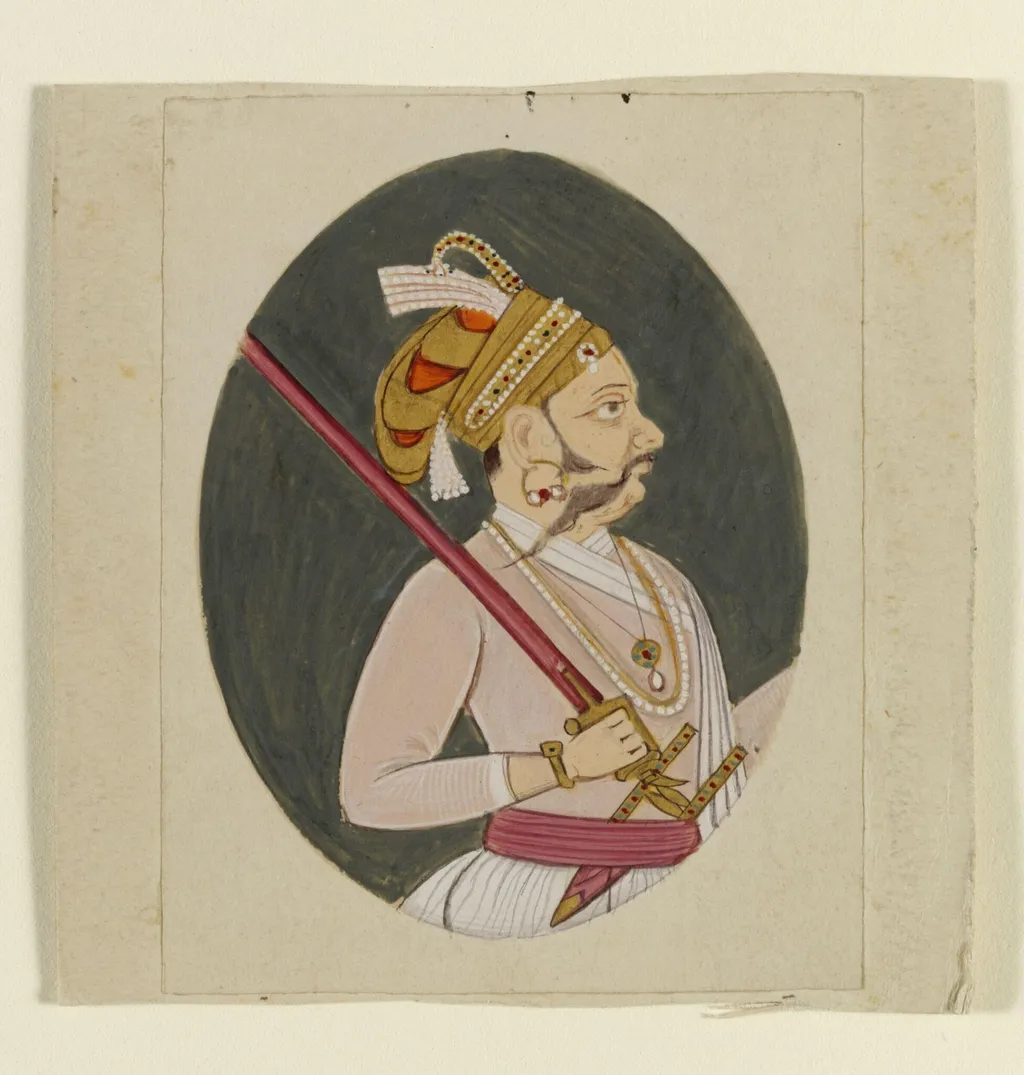
Maharawat Ram Singh is a paint painting by the Patna School of Painting artist Unknown. It dates from 1850 and is held in the collection of the Victoria and Albert Museum.
About this work
Overview
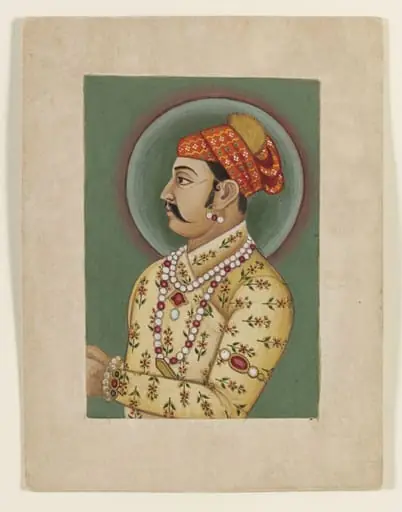
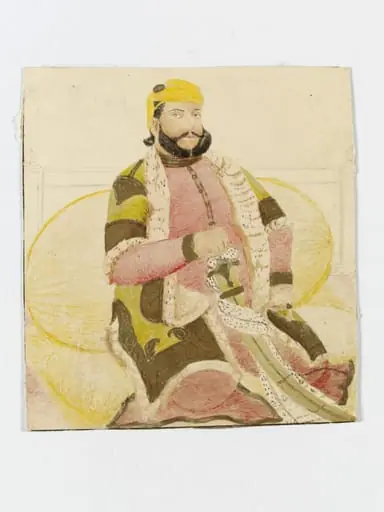
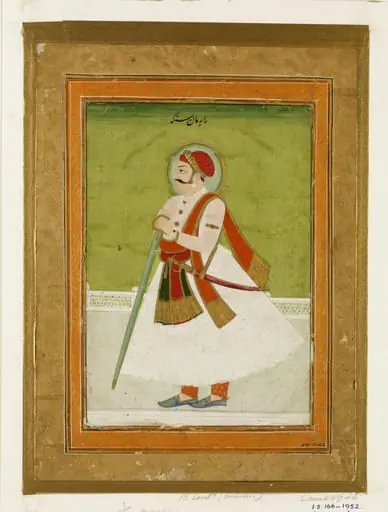
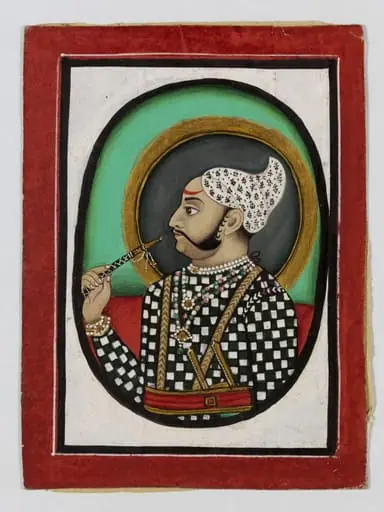
This portrait depicts Maharawat Ram Singh of Dungarpur, rendered in opaque watercolour and gold on paper, then mounted on cardboard. The composition isolates the figure against a deep black semicircular backdrop, emphasizing his presence through stark contrast. The palette is restrained yet luminous, relying on white, crimson, and gold to convey status and dignity without ornate detail.
Subject & Meaning
Ram Singh is portrayed as a ruler of quiet authority. His calm expression and composed posture suggest composure, while the curved sword in his hand implies vigilance and martial readiness. The regalia—elaborate hat, feather, and jewelry—affirms his rank, but the absence of courtly context focuses attention on the individual as both noble and armed, embodying the dual role of ruler and protector.
Technique & Style
The artist employed fine brushwork in opaque watercolour to define textures—fabric folds, metallic embellishments, and facial features—with precision.
The artist employed fine brushwork in opaque watercolour to define textures—fabric folds, metallic embellishments, and facial features—with precision. Gold leaf highlights accentuate jewelry and embroidery, while the black background eliminates spatial distraction. The style reflects Rajput portraiture traditions, favoring symbolic clarity over naturalism, where identity is conveyed through costume and gesture rather than environmental narrative.
History & Provenance
The painting originates from the court of Dungarpur in Rajasthan, likely created in the late 18th or early 19th century. It entered the Victoria and Albert Museum’s collection through British colonial acquisitions, a common path for Rajput artworks during that period. Its preservation on cardboard suggests it was once part of a bound album or personal collection, valued for its intimate scale and refined execution.
Context
This portrait aligns with a broader Rajput tradition of depicting rulers in formal, frontal poses, often holding weapons to signify sovereignty. Unlike Mughal court paintings, which emphasized elaborate settings, Rajput artists frequently used plain or dark backgrounds to isolate the subject, reinforcing personal authority. Such portraits served as both personal mementos and public symbols of lineage and power.
Legacy
The work remains a representative example of Rajput miniature portraiture, valued for its restrained elegance and psychological presence. It contributes to scholarly understanding of how regional courts expressed identity through visual symbols. Today, it continues to inform exhibitions on Indian artistic traditions, offering insight into the visual language of power outside the Mughal sphere.
Artist & collection

 Domestic Scene
 Giacomo and Cardinal Marco, investing Andrea, Abbot of San Zeno, with his Benefice
 The Nymph of Fontainebleau
 Portrait of a Woman
 Madonna and Child with Saints in the Enclosed Garden
 Venus and Minerva
 Family Group of Four on Sofa
 Wall painting from Room H of the Villa of P. Fannius Synistor at Boscoreale