Artwork
Maica Domnului jalnică
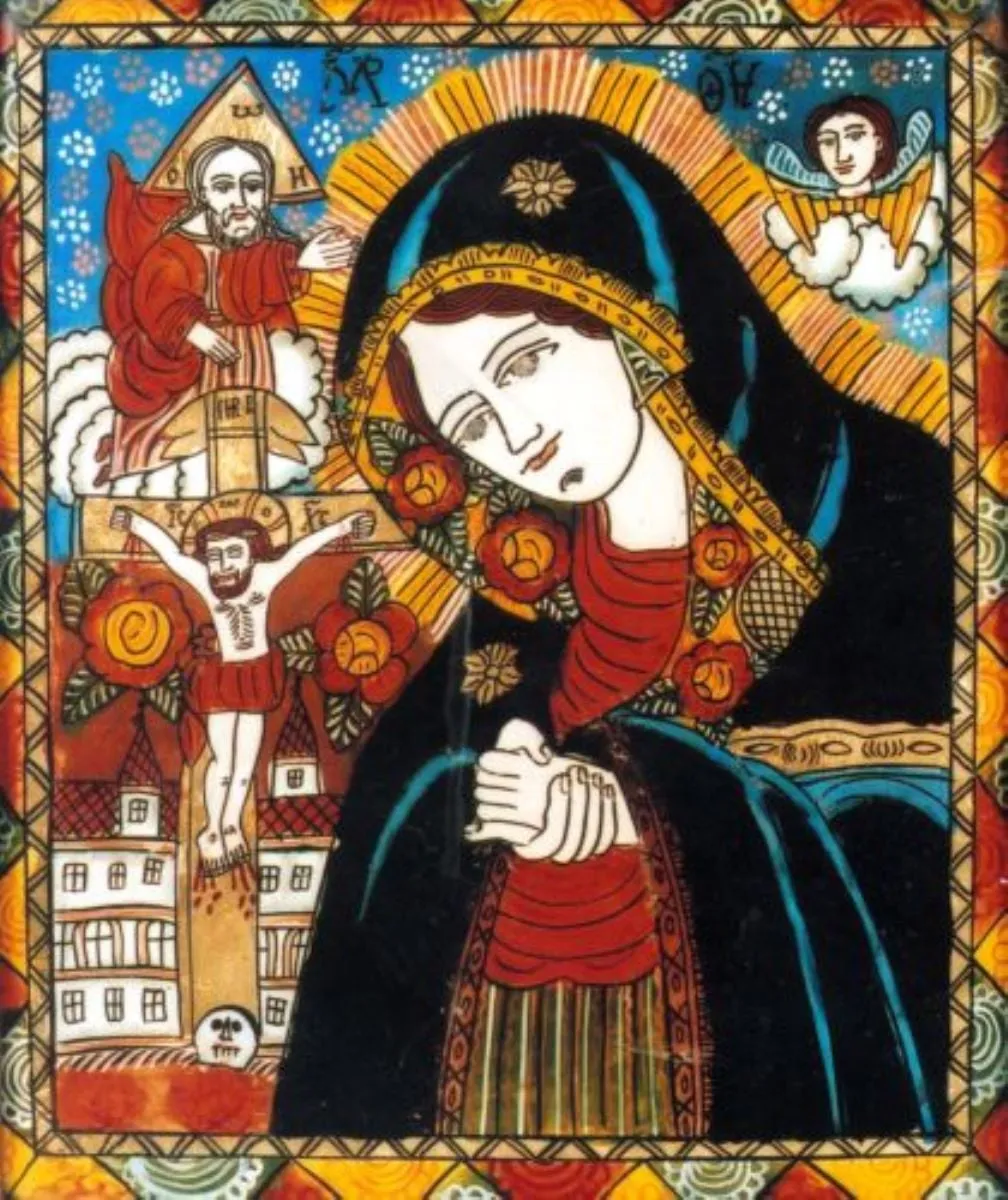
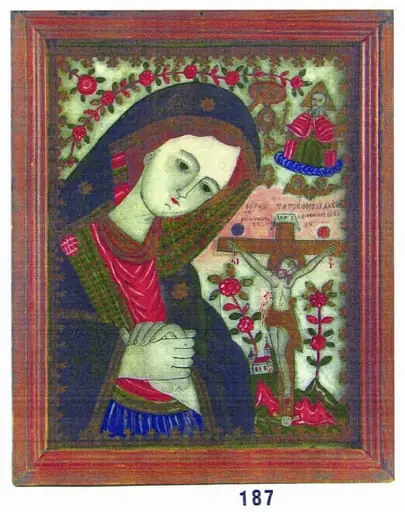
Maica Domnului jalnică is a drawing by Unknown. It dates from 1850 and is held in the collection of the Bran National Museum. This work is a devotional drawing depicting the Virgin Mary in a sorrowful pose, rendered in red, yellow, and blue pigments.
About this work
Overview
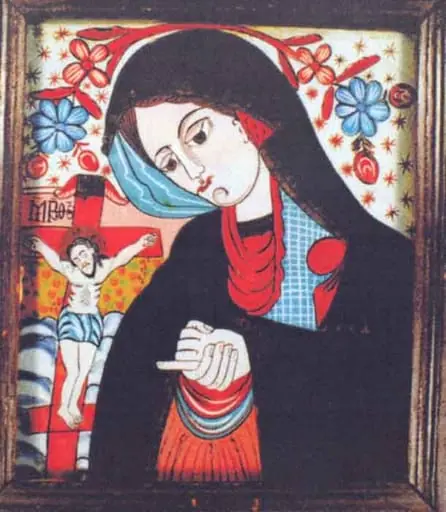
This work is a devotional drawing depicting the Virgin Mary in a sorrowful pose, rendered in red, yellow, and blue pigments.
This work is a devotional drawing depicting the Virgin Mary in a sorrowful pose, rendered in red, yellow, and blue pigments. She is centrally positioned, clad in a black robe and adorned with a gold headpiece, hands folded in prayer. Floral motifs encircle her neck and headdress, while architectural elements and symbolic figures frame the scene. The piece is held in the collection of the Museum of Ethnography, where it is preserved as a religious artifact.
Subject & Meaning
The figure represents the Virgin Mary in her role as the Sorrowful Mother, her clasped hands and somber attire signaling grief. The crucified man in the background alludes to Christ’s Passion, reinforcing her anguish. The man in red with a triangular symbol may denote a saint or divine presence, possibly Michael or a Trinitarian reference. Flowers suggest both earthly beauty and spiritual purity, common in Marian iconography of the region.
Technique & Style
Executed as a linear drawing with flat, saturated colors, the work employs minimal shading and stylized forms. The figures lack naturalistic perspective, emphasizing symbolic presence over realism. Gold accents on the headpiece and floral details suggest hand-applied metallic pigment, typical of folk religious art. The composition is hieratic, with Mary scaled larger than surrounding figures to denote spiritual importance.
History & Provenance
The drawing originates from a region with strong Orthodox or Eastern Christian traditions, likely created for private devotion. It entered the Museum of Ethnography’s collection through documented ethnographic fieldwork, possibly collected in the late 19th or early 20th century. Its preservation suggests it was valued as a cultural artifact, not merely a religious object, reflecting local piety and artistic practice.
Context
This image aligns with regional traditions of Marian veneration found in Eastern Europe, where visual representations of the Virgin’s sorrow were used in home altars and processions. The inclusion of architectural elements and symbolic figures reflects a blend of liturgical imagery with folk motifs. Such works were often made by local artisans for communities with limited access to formal ecclesiastical art.
Legacy
The drawing remains a rare surviving example of vernacular religious art from its region and period. It contributes to scholarly understanding of how Marian devotion was expressed outside institutional churches. Its preservation in an ethnographic museum underscores its role as both spiritual object and cultural record, continuing to inform studies of popular piety and visual tradition.
Artist & collection
 Domestic Scene
 Giacomo and Cardinal Marco, investing Andrea, Abbot of San Zeno, with his Benefice
 The Nymph of Fontainebleau
 Portrait of a Woman
 Madonna and Child with Saints in the Enclosed Garden
 Venus and Minerva
 Family Group of Four on Sofa
 Wall painting from Room H of the Villa of P. Fannius Synistor at Boscoreale