Artwork
Învierea lui Iisus Hristos
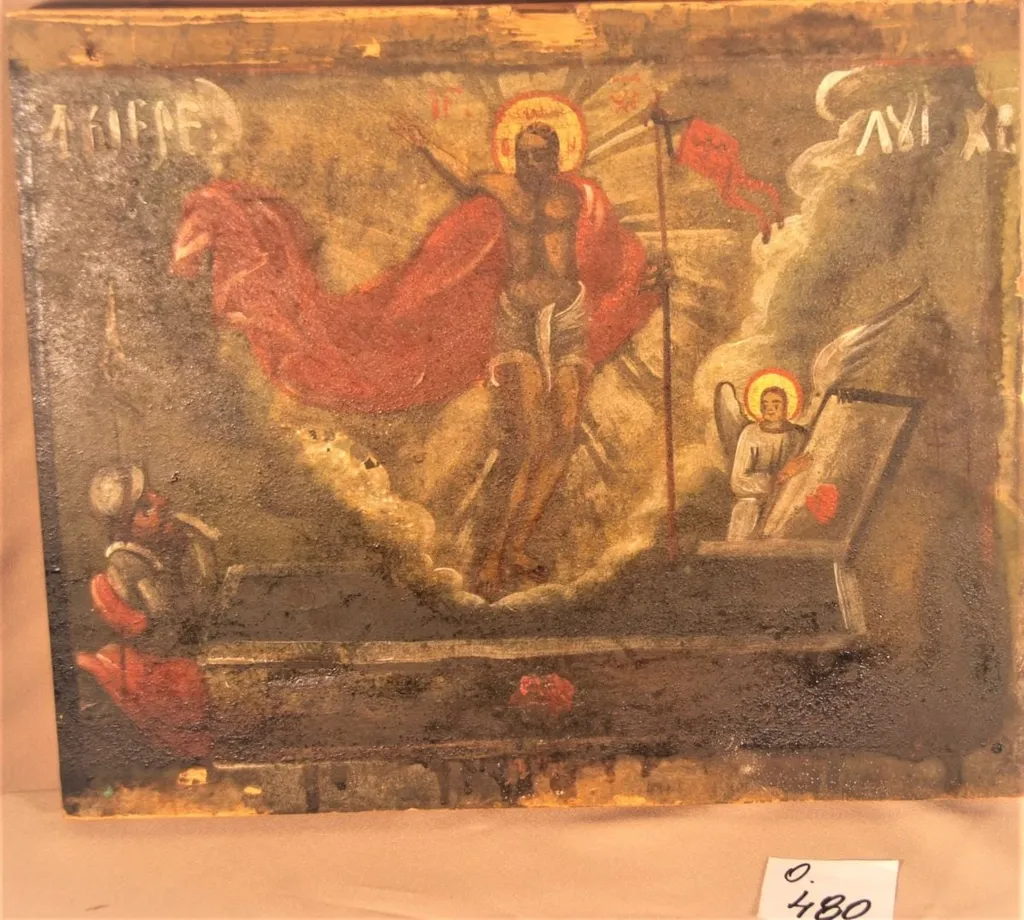
Învierea lui Iisus Hristos is a drawing by Unknown. It dates from 1850 and is held in the collection of the Maramureș Ethnography and Folk Art County Museum.
About this work
Overview
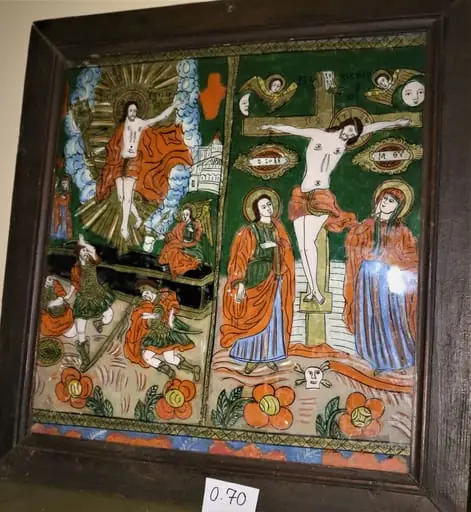
This religious painting portrays the Resurrection of Jesus Christ, centered on his upright figure clad in red and white garments, crowned by a halo.
This religious painting portrays the Resurrection of Jesus Christ, centered on his upright figure clad in red and white garments, crowned by a halo. A seated angel rests beside a stone structure to his right, while a kneeling figure on the left faces him in supplication. The muted brown and gray background, accented with subtle reds, reinforces a solemn, contemplative atmosphere consistent with devotional iconography of Eastern Orthodox tradition.
Subject & Meaning
The scene illustrates Christ’s triumph over death, depicted through his upright posture and staff, symbols of authority and divine power. The angel, present at the tomb in biblical accounts, witnesses the event, while the kneeling figure represents human reverence and submission. Together, the composition conveys theological themes of resurrection, grace, and worship, aligning with liturgical imagery used in Orthodox Christian worship.
Technique & Style
The painting employs flat, stylized forms and limited spatial depth, typical of traditional religious iconography. Figures are rendered with clear outlines and symbolic color—red for divinity and sacrifice, white for purity. The background lacks naturalistic detail, focusing attention on the sacred figures. The use of halos and rigid postures reflects conventions inherited from Byzantine and post-Byzantine ecclesiastical art.
History & Provenance
Though specific origins are unrecorded, the work’s visual language closely resembles devotional panels produced in Eastern European religious workshops during the 18th or 19th century. Its style and subject align with icons housed in institutions such as the Museum of Ethnography, suggesting it may have been created for private or parish use in a region with strong Orthodox traditions, possibly Romania or Moldova.
Context
Created within a cultural milieu where religious imagery served as both spiritual aid and doctrinal instruction, the painting reflects the enduring influence of Byzantine iconography in Eastern Christianity. Unlike Western Renaissance depictions, it avoids naturalism in favor of symbolic clarity, prioritizing theological message over physical realism, a hallmark of Orthodox sacred art.
Legacy
As a representative of vernacular religious art, the work contributes to the broader corpus of Eastern Christian iconography preserved in regional museums. Its continued presence in collections underscores the persistence of traditional forms in devotional practice, even as modern artistic trends emerged elsewhere in Europe.
Artist & collection
Museum
Maramureș Ethnography and Folk Art County Museum
Continue through works from the same source collection.
 Domestic Scene
 Giacomo and Cardinal Marco, investing Andrea, Abbot of San Zeno, with his Benefice
 The Nymph of Fontainebleau
 Portrait of a Woman
 Madonna and Child with Saints in the Enclosed Garden
 Venus and Minerva
 Family Group of Four on Sofa
 Wall painting from Room H of the Villa of P. Fannius Synistor at Boscoreale