Artwork
One of twenty-seven paintings, mainly depicting hunting scenes.
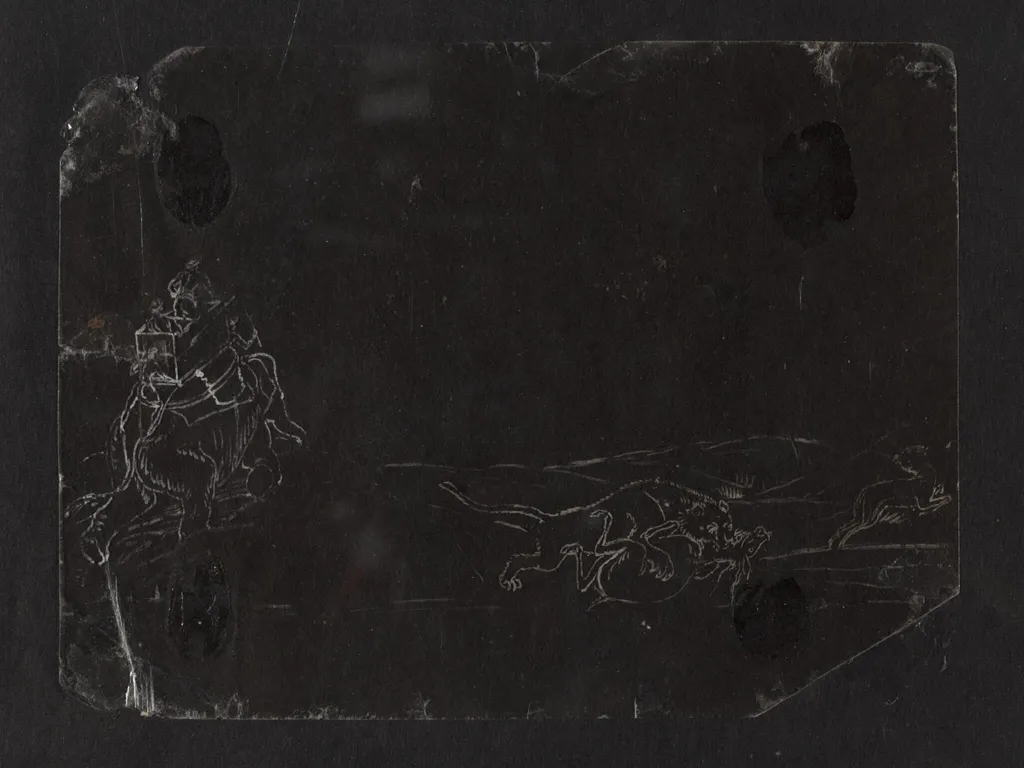
One of twenty-seven paintings, mainly depicting hunting scenes. is a gouache painting by the Romanticist artist Unknown. It dates from 1835 and is held in the collection of the Victoria and Albert Museum. ‘Death of the Antelope’ is a small-format work executed in gouache with linear drawing on a sheet of mica.
About this work
Overview
‘Death of the Antelope’ is a small-format work executed in gouache with linear drawing on a sheet of mica. It belongs to a series of twenty‑seven paintings that share a consistent visual approach, each portraying a hunting episode. The use of mica as a support gives the surface a glossy, translucent quality that distinguishes the series from more conventional paper or canvas works.
Subject & Meaning
The composition records a moment of a hunt, focusing on an antelope that has been struck down, surrounded by hunters and their dogs. The scene emphasizes the immediacy of the kill and the interaction between human figures and the animal, reflecting the cultural fascination with the sport of hunting and its associated rituals.
Technique & Style
Gouache provides an opaque, matte coloration that contrasts with the fine line work outlining figures and terrain. Applied to mica, the pigments adhere to a smooth, non‑absorbent surface, requiring careful layering. The overall style is concise and schematic, with a limited palette and clear, economical drawing that unifies the series.
History & Provenance
The painting is catalogued in Mundy’s first volume (page 51) as part of the larger group of hunting scenes. While specific ownership details are scarce, the series was likely produced for a patron interested in documenting or celebrating hunting practices, a common theme in decorative art of the period.
Context
Hunting imagery was a popular motif in decorative panels and portable works during the era, often serving both as a record of aristocratic pastime and as a didactic illustration of skill and bravery. The choice of mica, a material more associated with scientific instruments, suggests an experimental or luxury market for such portable artworks.
Artist & collection

 Domestic Scene
 Giacomo and Cardinal Marco, investing Andrea, Abbot of San Zeno, with his Benefice
 The Nymph of Fontainebleau
 Portrait of a Woman
 Madonna and Child with Saints in the Enclosed Garden
 Venus and Minerva
 Family Group of Four on Sofa
 Wall painting from Room H of the Villa of P. Fannius Synistor at Boscoreale
 Untitled
 Sketch (verso)
 Crochiu 9
 Peisaj
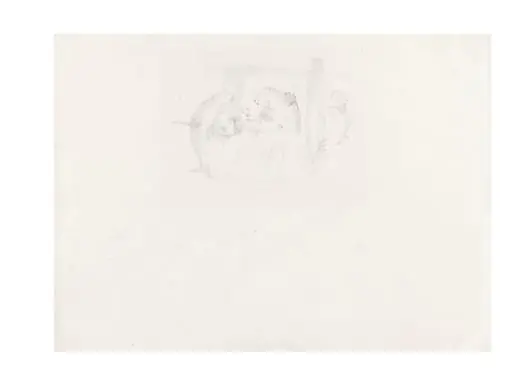 Fish
Fish Crochiu 1
 S 20 - Natură statică la Sulina (Fructe pe un platou și dovleac)
 S 21 - Pervaz cu flori la Sulina
 Interpretare după „În Salonul de pe Strada Moulins” de Henri de Toulouse-Lautrec
 S 14 - Omagiul meu Sulinei (Mal de Dunăre cu trandafir și bărci)
 Nuntă tătărască
 Footed Vessel with Handle (verso)