Artwork
Painted Door
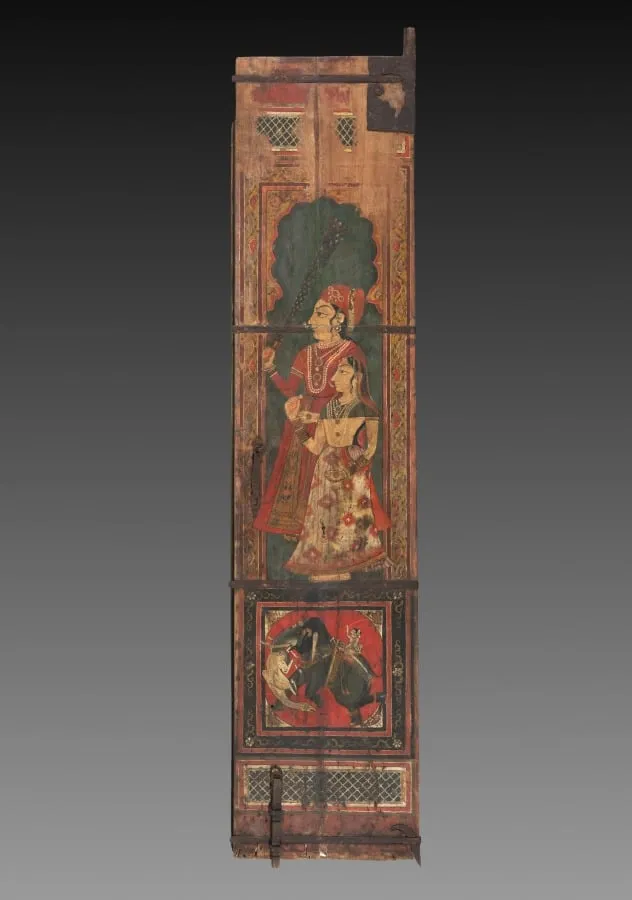
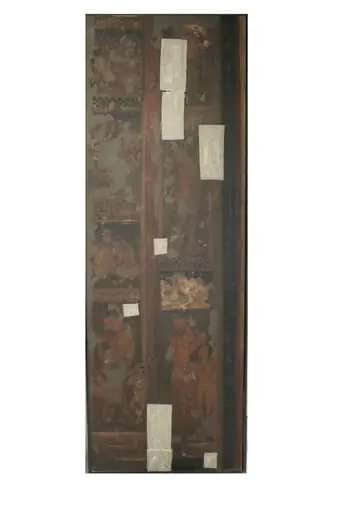
Painted Door is an unspecified painting by the Patna School of Painting artist Unknown. It dates from 1820 and is held in the collection of the Cleveland Museum of Art.
About this work
Overview
This painted door is a decorative panel featuring two distinct narrative scenes, rendered in vivid pigments and gold leaf.
This painted door is a decorative panel featuring two distinct narrative scenes, rendered in vivid pigments and gold leaf. The object retains the physical form of a door, with visible signs of age and use, suggesting it once served a functional role before becoming a painted surface for storytelling. Its composition balances ornamental richness with narrative clarity, typical of portable or architectural art from a period that valued layered visual symbolism.
Subject & Meaning
The upper scene depicts a man and woman beneath a tree, their attire in red and gold signaling status; the woman’s fan and the man’s gaze suggest an intimate, possibly courtly interaction. Below, two men in darker tones sit together, engaged in conversation or music-making, evoking social camaraderie. Together, the scenes may represent contrasting spheres of private life—romantic contemplation and communal leisure—offering a glimpse into ideals of leisure and relationship in its cultural context.
Technique & Style
The artist employed bold, saturated colors and extensive gold leaf to create a sense of luxury and luminosity. Details are rendered with precision, particularly in the folds of clothing and the texture of the tree’s foliage. The flat, decorative space and lack of perspective indicate a stylistic preference for symbolic representation over naturalism, aligning with traditions that prioritized pattern and ritualized form over spatial realism.
History & Provenance
The door’s origins are not fully documented, but its materials and style suggest it was created in a region with a strong tradition of painted architectural elements, possibly in East Asia or the Islamic world during the late medieval or early modern period. Its survival with visible wear implies it was used in a domestic or ceremonial setting before being preserved as an artifact, later entering a museum collection.
Context
Painted doors like this were often part of larger interior schemes, used in residences or religious structures to convey cultural values through imagery. The pairing of intimate and social scenes reflects a common thematic duality in decorative arts of the time, where personal and communal life were visually intertwined. Such objects served both aesthetic and didactic purposes, reinforcing social norms through visual narrative.
Legacy
Though no longer functional, the door endures as a material witness to the artistic priorities of its era. Its preservation in a museum setting allows continued study of how everyday objects carried symbolic weight. It contributes to broader understandings of how non-canonical surfaces—like doors—were transformed into vehicles for cultural expression beyond traditional canvas or scroll formats.
Artist & collection

 Domestic Scene
 Giacomo and Cardinal Marco, investing Andrea, Abbot of San Zeno, with his Benefice
 The Nymph of Fontainebleau
 Portrait of a Woman
 Madonna and Child with Saints in the Enclosed Garden
 Venus and Minerva
 Family Group of Four on Sofa
 Wall painting from Room H of the Villa of P. Fannius Synistor at Boscoreale