Artwork
Painting
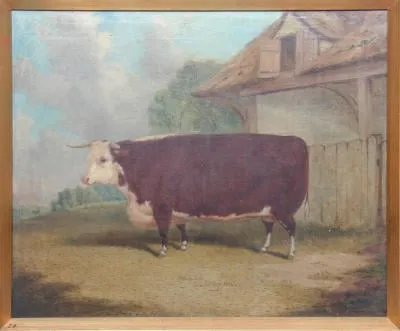
Painting is a paint painting by the British Romanticist artist Unknown. It dates from 1865 and is held in the collection of the Museum of English Rural Life, University of Reading.
About this work
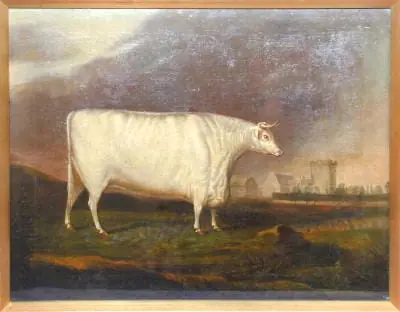
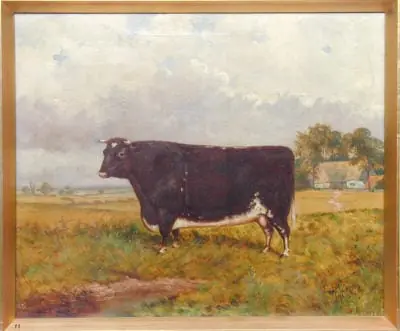
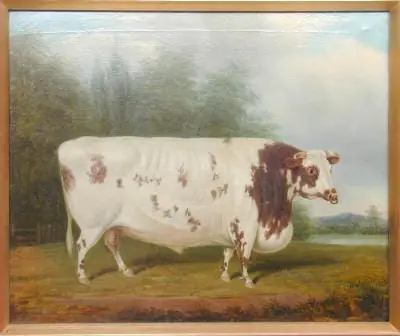
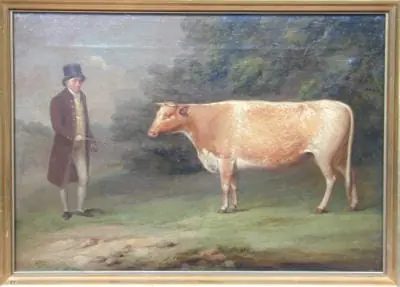
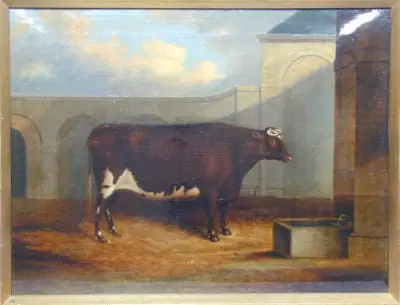
This painting shows a formal portrait of a Hereford Ox.
The ox is the main focus, with a simple background.
It was painted by R. Whitford, an animal painter to the Queen, in 1865.
The painting has an inscription with details about the ox, including its age and breeder.
To learn more about similar artworks, check out the museum: Museum of Ethnography.
Overview
Whitford, who held the official title of animal painter to the Queen, the work serves as a documented record of a prize-winning livestock specimen.
This oil painting depicts a Hereford ox, rendered with precise detail and a restrained composition. Created in 1865 by R. Whitford, who held the official title of animal painter to the Queen, the work serves as a documented record of a prize-winning livestock specimen. The ox’s physical attributes and lineage are inscribed directly on the frame and canvas, emphasizing its value in agricultural competition rather than purely aesthetic intent.
Subject & Meaning
The subject is a two-year-old Hereford ox that won first prize at a 1864 agricultural show in Islington Hall. The inclusion of its breeder, age, and monetary reward underscores the painting’s role as a trophy of rural industry. It reflects the Victorian era’s reverence for selective breeding and the economic significance of livestock, transforming an animal into a symbol of agricultural achievement and social status.
Technique & Style
Whitford employed a naturalistic style, rendering the ox’s muscular form and reddish-brown coat with careful attention to texture and lighting. The background is minimal and neutral, ensuring focus remains on the animal’s anatomy and presence. Brushwork is controlled and precise, avoiding romanticism or dramatic flair, aligning with the documentary function of the piece rather than expressive artistry.
History & Provenance
The painting was completed in 1865, following the ox’s 1864 victory. Inscriptions on both the stretcher and canvas confirm its origin and ownership by Aaron Pike, Esq., and its connection to Mr. Percy Hall of Malvern Wells, Worcestershire. It belongs to a broader collection of livestock portraits and prints produced between the late 1700s and 1860s, reflecting a sustained tradition of documenting prize animals for agricultural and aristocratic audiences.
Context
During the mid-19th century, agricultural exhibitions became central to British rural life, with breeders competing for prestige and financial reward. Official animal painters like Whitford were commissioned to immortalize winning livestock, merging scientific documentation with social celebration. This work exemplifies how art served practical, economic, and class-based interests within Victorian agrarian society.
Legacy
Though not widely exhibited in fine art contexts, this painting contributes to the historical record of British livestock breeding practices. It remains a tangible artifact of a time when animal husbandry was both science and status, preserved through the medium of portraiture. Its survival offers insight into the intersection of art, agriculture, and class in 19th-century England.
Artist & collection
Museum
Museum of English Rural Life, University of Reading
Continue through works from the same source collection.
 Domestic Scene
 Giacomo and Cardinal Marco, investing Andrea, Abbot of San Zeno, with his Benefice
 The Nymph of Fontainebleau
 Portrait of a Woman
 Madonna and Child with Saints in the Enclosed Garden
 Venus and Minerva
 Family Group of Four on Sofa
 Wall painting from Room H of the Villa of P. Fannius Synistor at Boscoreale