Artwork
Painting
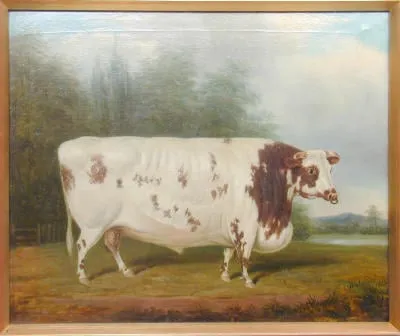
Painting is a paint painting by the Realist artist Unknown. It dates from 1845 and is held in the collection of the Museum of English Rural Life, University of Reading. Painted in 1845 by J.
About this work
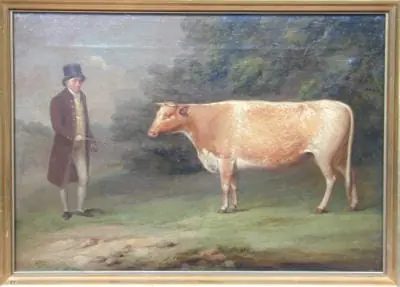
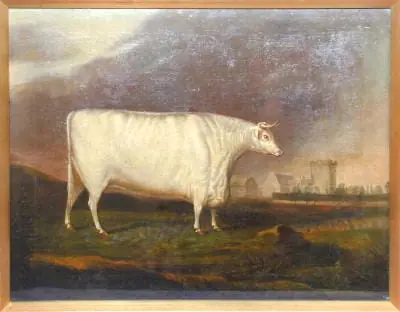
The painting shows a shorthorn bull in a landscape with a wood and lake.
This is a formal animal portrait, which was common in the 19th century. The artist paid attention to details like the bull's muscles and the trees in the background.
The artist used a technique to create depth, you can learn more about this style by looking into chiaroscuro.
Overview
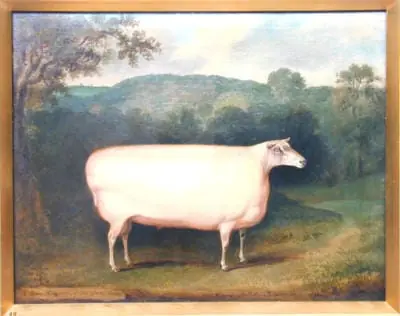
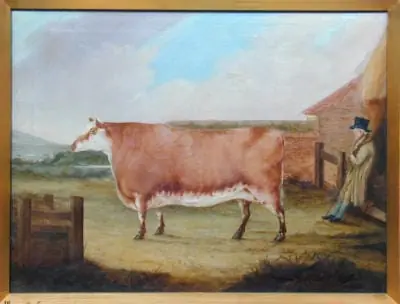
Painted in 1845 by J. Loder, this work presents a formal portrait of a shorthorn bull within a naturalistic landscape. The composition places the animal centrally, framed by a wooded area and a distant lake. It belongs to a broader group of British animal portraits produced between the late 1700s and mid-1800s, reflecting contemporary interest in agricultural improvement and livestock breeding.
Subject & Meaning
The shorthorn bull, a breed prized for its meat and dairy qualities, symbolizes agricultural progress in early Victorian England.
The shorthorn bull, a breed prized for its meat and dairy qualities, symbolizes agricultural progress in early Victorian England. Its dignified posture and detailed musculature suggest value placed on physical excellence in livestock. The tranquil landscape implies harmony between human husbandry and nature, reinforcing ideals of rural prosperity and economic stability during a period of industrial change.
Technique & Style
Loder employed careful modeling to define the bull’s form, using subtle gradations of light and shadow to enhance volume and texture. The background trees and water are rendered with softer focus, creating spatial depth. While not strictly chiaroscuro, the technique demonstrates an awareness of tonal contrast to anchor the subject within its environment, typical of animal portraiture of the era.
History & Provenance
The painting is part of a documented collection of animal-themed works spanning from the late 18th century to around 1860. Though little is known of J. Loder’s biography, his signed work aligns with regional artists who catered to landowners and agricultural societies. Its survival suggests it was commissioned or acquired by someone invested in livestock improvement, likely in the English countryside.
Context
During the first half of the 19th century, selective breeding of cattle became a scientific pursuit, supported by agricultural societies and illustrated in art. Portraits of prize animals served both as records of genetic achievement and as status symbols. Loder’s painting fits within this trend, where realism and precision replaced romanticized depictions, reflecting a growing empirical approach to farming.
Legacy
This work contributes to a niche but enduring genre of British art that documented the transformation of rural life. While not widely exhibited today, such paintings remain valuable as historical records of livestock development and the visual culture of agrarian society. They offer insight into how economic priorities shaped artistic subject matter in the pre-industrialized countryside.
Artist & collection
Museum
Museum of English Rural Life, University of Reading
Continue through works from the same source collection.
 Domestic Scene
 Giacomo and Cardinal Marco, investing Andrea, Abbot of San Zeno, with his Benefice
 The Nymph of Fontainebleau
 Portrait of a Woman
 Madonna and Child with Saints in the Enclosed Garden
 Venus and Minerva
 Family Group of Four on Sofa
 Wall painting from Room H of the Villa of P. Fannius Synistor at Boscoreale