Artwork
Painting Five from Illustrated Book of Flowers and Butterflies
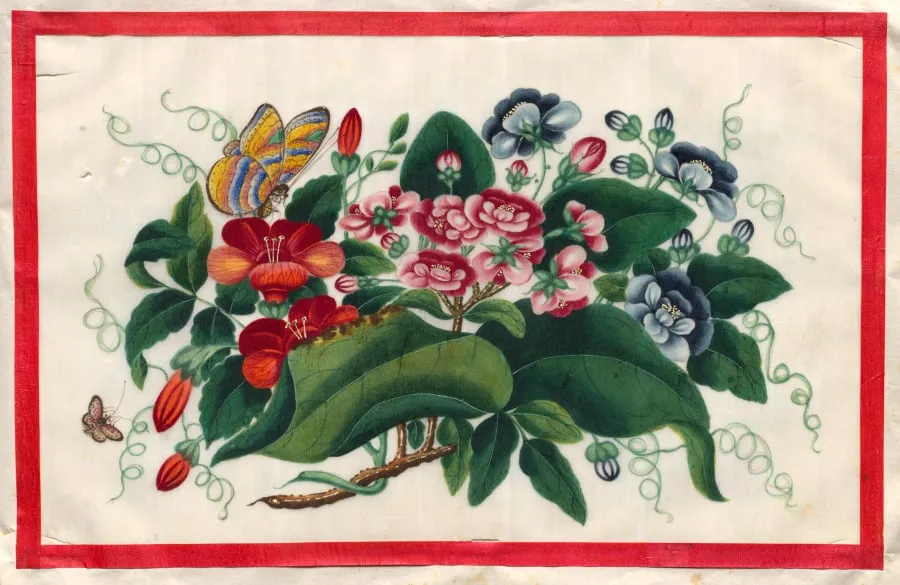
Painting Five from Illustrated Book of Flowers and Butterflies is an unspecified painting by the Romanticist artist Unknown. It dates from 1804 and is held in the collection of the Cleveland Museum of Art. This painting is one of a series from an illustrated book depicting flowers and butterflies.
About this work
Overview
A narrow red border encloses the scene, emphasizing its status as a refined, contained study rather than a broad landscape.
This painting is one of a series from an illustrated book depicting flowers and butterflies. It features a compact arrangement of vividly colored blossoms—red, pink, and blue—set against a neutral background. Delicate green vines curl around the composition, while two butterflies rest among the petals. A narrow red border encloses the scene, emphasizing its status as a refined, contained study rather than a broad landscape.
Subject & Meaning
The subject centers on transient natural beauty, with flowers and butterflies symbolizing fleeting life and delicate balance. The careful rendering of each petal and wing suggests an interest in the precision of nature, not as a metaphor for grand emotion, but as an object of quiet observation. The absence of a narrative or human presence directs focus to the intrinsic elegance of the natural forms.
Technique & Style
The artist employs fine brushwork to render botanical details with near-scientific accuracy, capturing the texture of petals and the translucency of butterfly wings. Colors are applied with clarity and restraint, avoiding heavy shading or dramatic contrast. The flat background and framed composition reflect a tradition of decorative illustration, prioritizing clarity and harmony over spatial depth or emotional intensity.
History & Provenance
The painting originates from a hand-painted illustrated book, likely produced in the late 18th or early 19th century for a private or scholarly audience. Such volumes were often commissioned to document flora and fauna with aesthetic precision. Its survival as a single panel suggests it was later removed from the original binding, possibly for display or preservation.
Context
Created during a period when natural history illustration flourished, this work aligns with scientific and artistic efforts to classify and depict the natural world. While contemporaneous Romantic painters emphasized nature’s sublime power, this piece reflects a quieter, more observational approach—rooted in tradition rather than emotional expression.
Legacy
As part of a larger illustrated series, this painting contributes to a historical record of botanical art that bridged science and aesthetics. Its preservation offers insight into how natural forms were studied and valued in pre-photographic eras. Though not widely known today, it remains a quiet example of meticulous craftsmanship in naturalist illustration.
Artist & collection

 Domestic Scene
 Giacomo and Cardinal Marco, investing Andrea, Abbot of San Zeno, with his Benefice
 The Nymph of Fontainebleau
 Portrait of a Woman
 Madonna and Child with Saints in the Enclosed Garden
 Venus and Minerva
 Family Group of Four on Sofa
 Wall painting from Room H of the Villa of P. Fannius Synistor at Boscoreale
 Painting Seven from Illustrated Book of Flowers and Butterflies
 Painting Eight from Illustrated Book of Flowers and Butterflies
 Painting Ten from Illustrated Book of Flowers and Butterflies
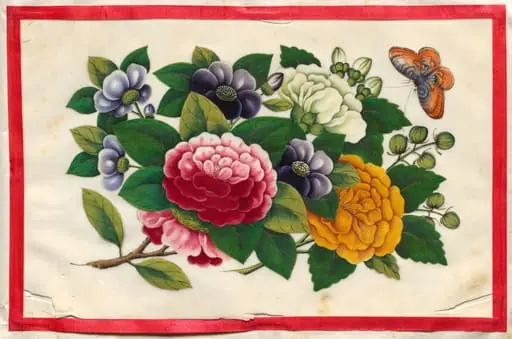 Painting Three from Illustrated Book of Flowers and Butterflies
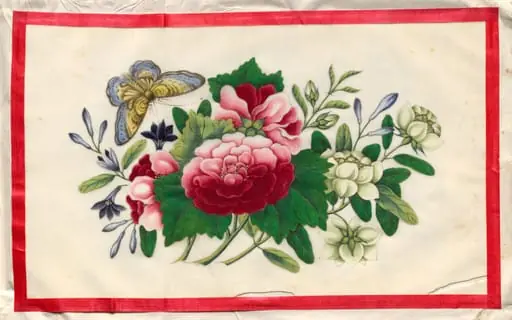 Painting Nine from Illustrated Book of Flowers and Butterflies
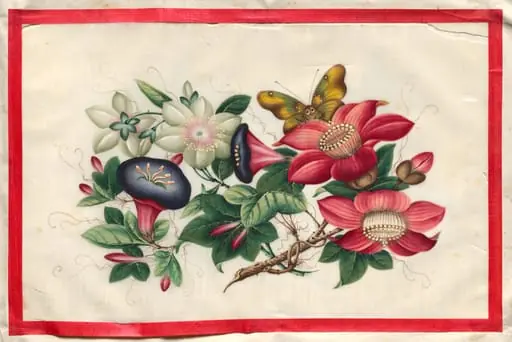 Painting Eleven from Illustrated Book of Flowers and Butterflies