Artwork
Partial Architectural Study (verso)
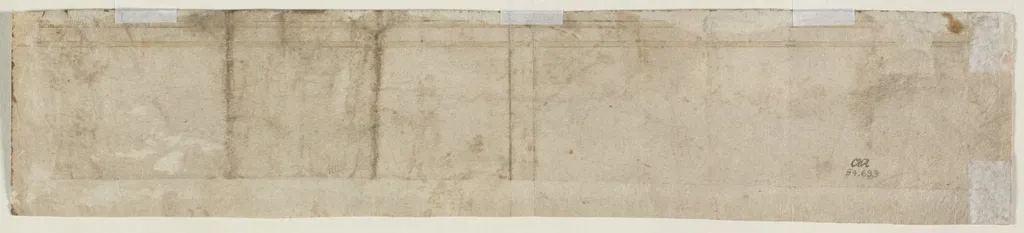
Partial Architectural Study (verso) is a drawing by the Renaissance artist Unknown. It dates from 1504 and is held in the collection of the Cleveland Museum of Art. This drawing is the reverse side of a sheet once used for architectural studies.
About this work
Overview
This drawing is the reverse side of a sheet once used for architectural studies. Faint pencil lines suggest three rectangular forms, lightly sketched and barely visible. The paper shows signs of wear, with uneven edges and a small inked notation, '59.693,' likely a catalog or inventory mark. Its simplicity and fragility reflect the utilitarian nature of preparatory work in the artist’s studio.
Subject & Meaning
The three rectangles may represent architectural elements—windows, doorways, or structural divisions—drawn without context or detail. Their emptiness suggests they were not intended as finished compositions but as spatial experiments. The absence of shading or annotation implies these were quick, functional marks, possibly for measuring proportions or testing layout.
Technique & Style
The lines are delicate and uneven, made with a soft pencil, indicating a tentative, exploratory hand. The lack of erasure or revision points to spontaneity rather than refinement. The paper’s texture and age have softened the graphite, contributing to the drawing’s muted presence. The verso format reveals how artists reused materials efficiently.
History & Provenance
The notation '59.693' aligns with the Cleveland Museum of Art’s early accession system, suggesting the work entered the collection in the mid-20th century. Its survival as a verso fragment implies it was separated from its primary drawing, perhaps during handling or rehousing. No artist attribution is recorded, but its material and form are consistent with 18th- or 19th-century studio practice.
Context
In pre-industrial art studios, paper was valuable and often used on both sides. Sketches on reverses were typically discarded or overlooked, making such fragments rare survivors of the creative process. This piece reflects a common practice among draftsmen who prioritized function over preservation, leaving behind traces of thought rather than polished results.
Legacy
Though unattributed and incomplete, this fragment offers insight into the quiet, repetitive labor behind architectural design. It stands as evidence of how artists engaged with space through minimal means, valuing utility over permanence. Its preservation today underscores a shift in how such ephemeral works are now viewed as records of process.
Artist & collection

 Domestic Scene
 Giacomo and Cardinal Marco, investing Andrea, Abbot of San Zeno, with his Benefice
 The Nymph of Fontainebleau
 Portrait of a Woman
 Madonna and Child with Saints in the Enclosed Garden
 Venus and Minerva
 Family Group of Four on Sofa
 Wall painting from Room H of the Villa of P. Fannius Synistor at Boscoreale
 Page from Tales of a Parrot (Tuti-nama): blank page
 Cartouche (verso)
 Sketches of Windows and Pilasters of the Attic Storey of the Collegio di Propaganda Fide (verso)
 Cattle (verso)
 H 1 - Portret de băiat la Hârșova (Olteanu Eugen)
 Border Lines (verso)
 Page from Tales of a Parrot (Tuti-nama): blank page
 The Head of Saint George and Architectural Plans (verso)