Artwork
Raga Hindola
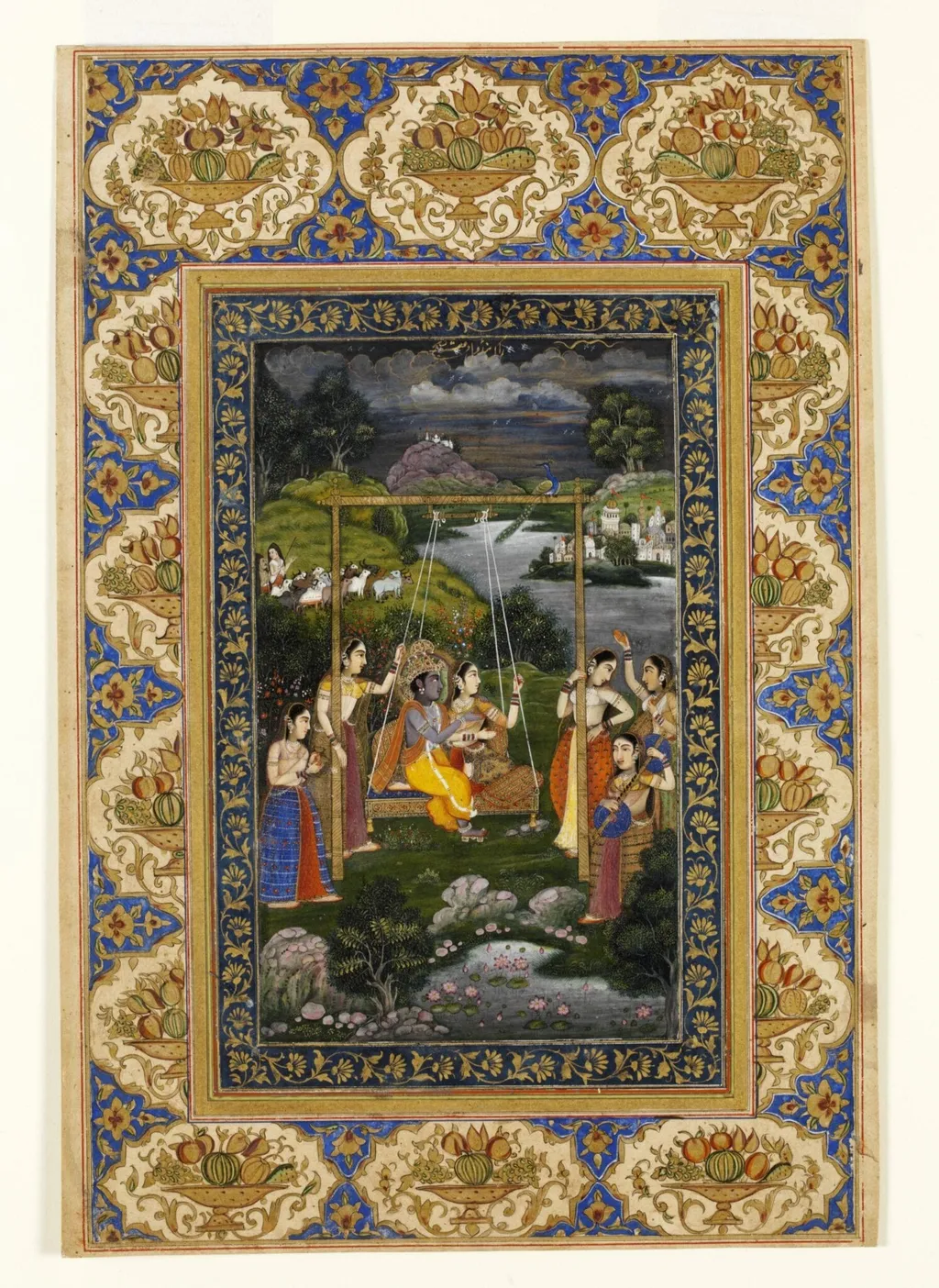
Raga Hindola is a paint painting by the Mughal Painting artist Unknown. It dates from 1850 and is held in the collection of the Victoria and Albert Museum.
About this work
Overview
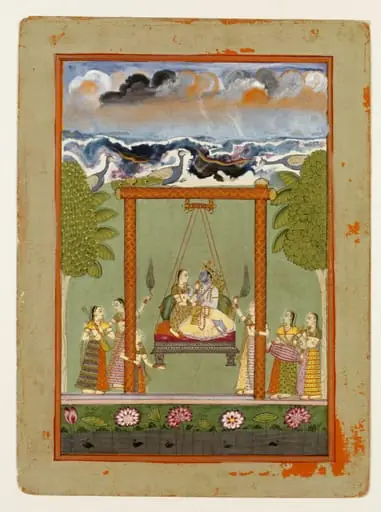
This 1850 Indian miniature painting, executed in opaque watercolour and gold on paper, illustrates the musical mode Raga Hindola through a devotional scene.
This 1850 Indian miniature painting, executed in opaque watercolour and gold on paper, illustrates the musical mode Raga Hindola through a devotional scene. It captures Radha and Krishna seated on a swing, surrounded by female attendants in a verdant garden. The composition is richly detailed, with ornate borders of floral and fruit motifs, and a luminous palette of gold, crimson, and azure that enhances its ceremonial tone.
Subject & Meaning
The scene references the Hindola raga, traditionally associated with the playful swinging of Krishna and Radha during spring festivals. The presence of gopis and the lush setting evoke divine love and seasonal renewal, common themes in Pahari and Rajasthani devotional art. While the narrative is not explicitly scripted, the imagery aligns with poetic traditions that link music, movement, and spiritual joy in Krishna worship.
Technique & Style
The work employs fine brushwork typical of late 19th-century North Indian court painting, with meticulous attention to textile patterns, foliage, and architectural details. Gold leaf highlights the swing, garments, and borders, while layered washes of opaque pigment create depth. The crowded, decorative frame mirrors the scene’s intensity, reinforcing the painting’s function as an object of contemplative beauty rather than narrative clarity.
History & Provenance
The painting was acquired by Sir Robert Nathan, a British administrator in India, from Maulvi Muhammad Hussain, a Delhi-based judge, prior to 1921. Nathan later donated it to a museum that year. Its entry into the collection was formally recorded in the Asia Department registers, and its provenance was later verified through a 2023 research initiative, confirming its documented transfer from private Indian ownership to institutional care.
Context
Produced during a period when regional courts still patronized miniature painting despite colonial influence, this work reflects the persistence of Hindu devotional themes in visual culture. Similar scenes appear in Pahari schools, particularly from Kangra and Guler, where music and divine romance were frequent subjects. The painting’s survival in private hands before museum acquisition suggests its value among collectors of Indian art during the British Raj.
Legacy
Though not widely exhibited, the painting contributes to scholarly understanding of how musical modes were visually interpreted in Indian art. Its preservation in a major museum collection ensures continued access for study. The work stands as an example of the enduring link between classical Indian music, poetry, and miniature painting, even as artistic patronage shifted under colonial rule.
Artist & collection

 Domestic Scene
 Giacomo and Cardinal Marco, investing Andrea, Abbot of San Zeno, with his Benefice
 The Nymph of Fontainebleau
 Portrait of a Woman
 Madonna and Child with Saints in the Enclosed Garden
 Venus and Minerva
 Family Group of Four on Sofa
 Wall painting from Room H of the Villa of P. Fannius Synistor at Boscoreale