Artwork
Rao Narain Das
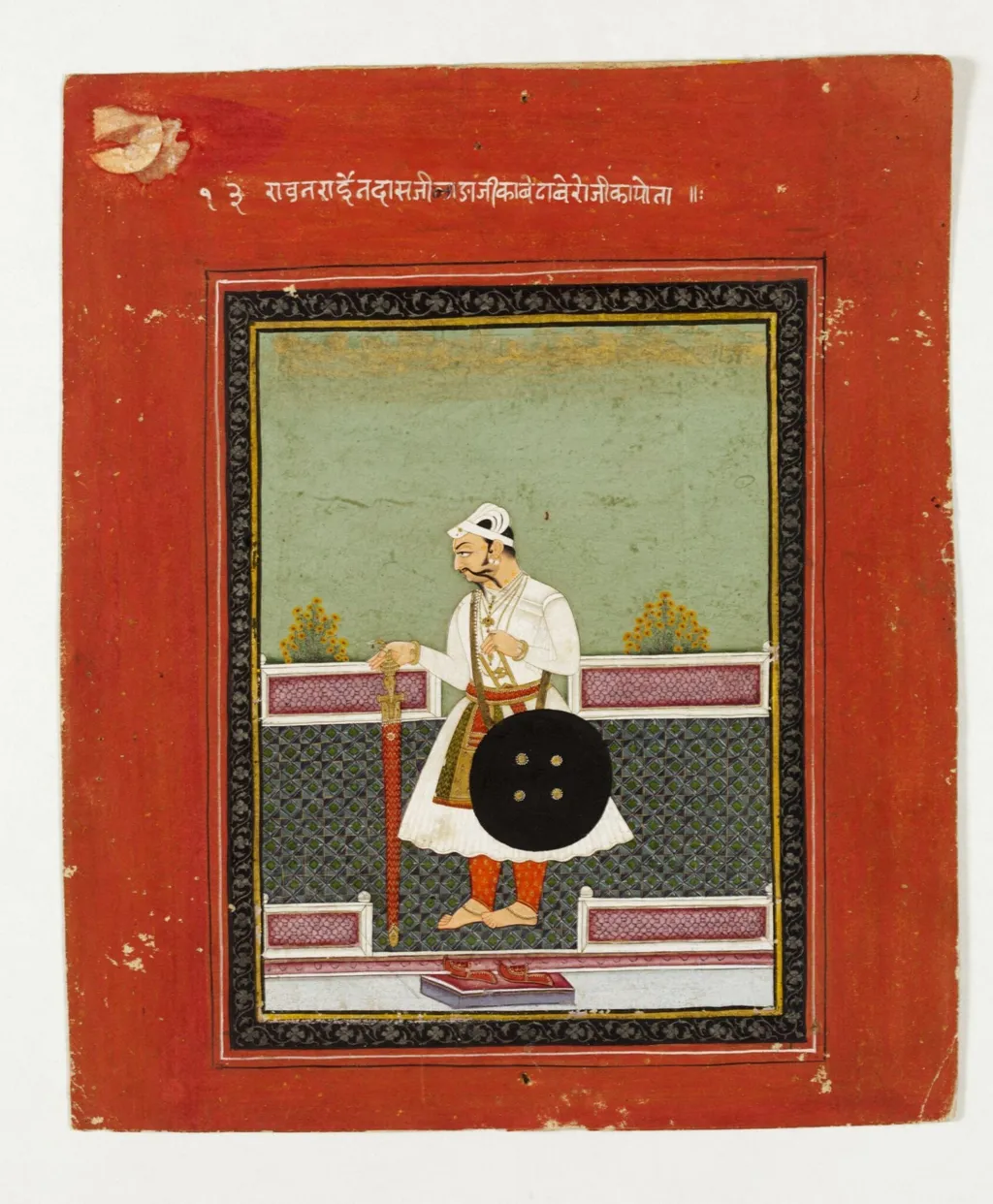
Rao Narain Das is a paint painting by the Patna School of Painting artist Unknown. It dates from 1830 and is held in the collection of the Victoria and Albert Museum.
About this work
Overview
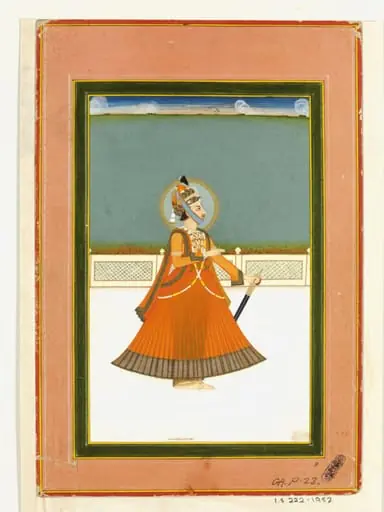
This painting portrays Rao Narain Das, a Rajput noble, standing on a terraced balcony. Executed in opaque watercolour and gold on paper, it reflects the refined aesthetic of late 18th-century North Indian court art. The composition emphasizes stillness and dignity, with the figure framed by an ornate railing and a softly patterned background that enhances the sense of quiet authority.
Subject & Meaning
Rao Narain Das is depicted as a warrior-ruler, holding a sword and shield, symbols of his martial role and protective duty. His white garments signify purity and status, while the vividly colored belt underscores his rank. The setting—a private terrace—suggests introspection or readiness, aligning with ideals of Rajput nobility that valued both martial prowess and cultivated restraint.
Technique & Style
The background’s muted green and faint floral motifs create depth without distraction.
The artist employed fine brushwork and layered opaque watercolour to achieve subtle tonal transitions, enhanced by delicate gold detailing in the belt and railing. The background’s muted green and faint floral motifs create depth without distraction. The precision in textile patterns and architectural elements reflects a tradition of courtly illustration, prioritizing clarity and symbolic detail over dramatic expression.
History & Provenance
The painting likely originated in a Rajput court, possibly in Rajasthan or nearby regions, during the late 1700s. It was probably commissioned to commemorate Rao Narain Das’s status or a significant event in his life. Its survival suggests it remained within a family or regional collection, preserved for its association with local lineage rather than as a public display.
Context
Created during a period when Rajput courts maintained distinct artistic traditions amid Mughal influence, this work exemplifies regional portraiture that blended indigenous styles with refined materials. Unlike Mughal naturalism, it favors symbolic clarity and decorative elegance, reflecting the cultural priorities of local elites who valued lineage, ritual, and visual distinction.
Legacy
This painting contributes to the understanding of non-Mughal portraiture in early modern India, illustrating how regional rulers used art to assert identity. Its preservation offers insight into the material culture and visual language of Rajput aristocracy, serving as a reference for scholars studying the diversity of Indian artistic practices beyond imperial centers.
Artist & collection

 Domestic Scene
 Giacomo and Cardinal Marco, investing Andrea, Abbot of San Zeno, with his Benefice
 The Nymph of Fontainebleau
 Portrait of a Woman
 Madonna and Child with Saints in the Enclosed Garden
 Venus and Minerva
 Family Group of Four on Sofa
 Wall painting from Room H of the Villa of P. Fannius Synistor at Boscoreale