Artwork
Sf. Ierarh Nicolae; Icoană de catapeteasmă
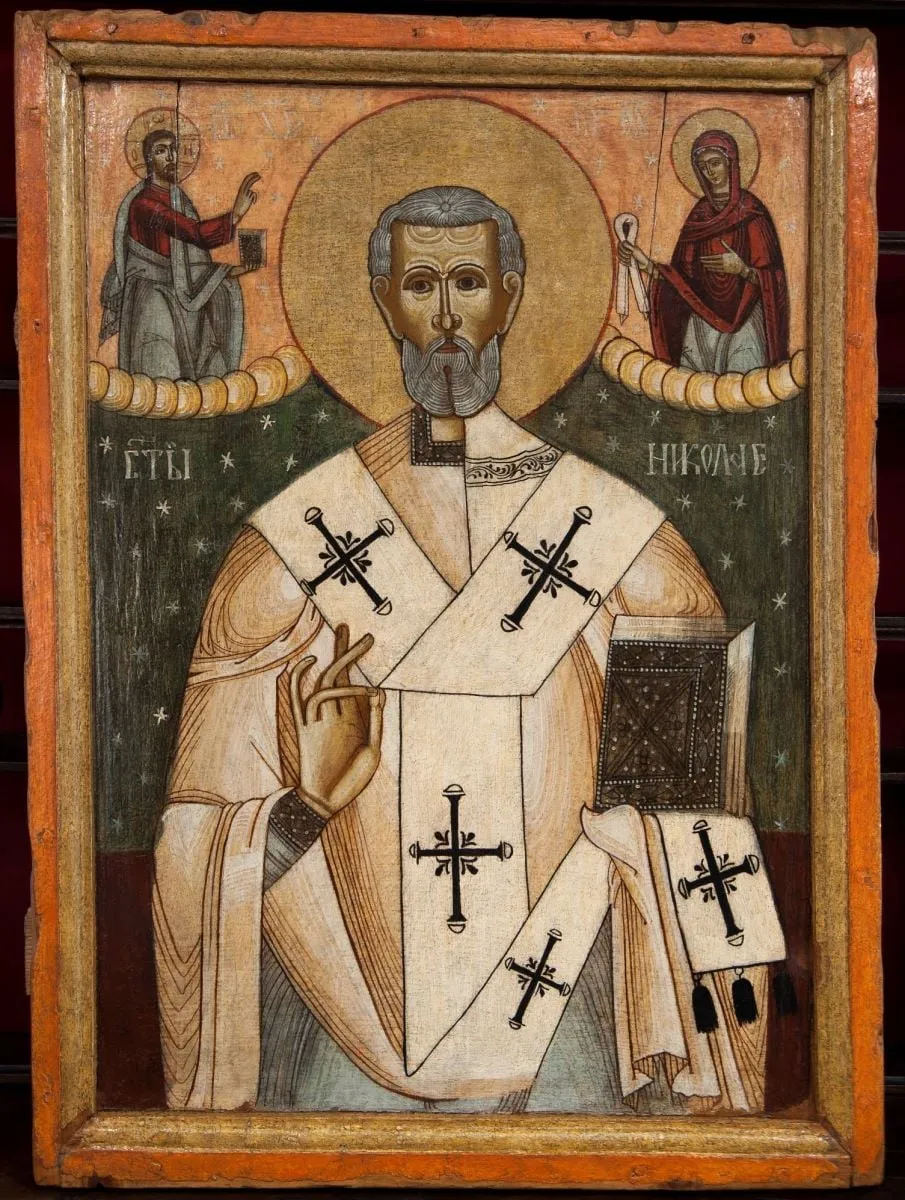
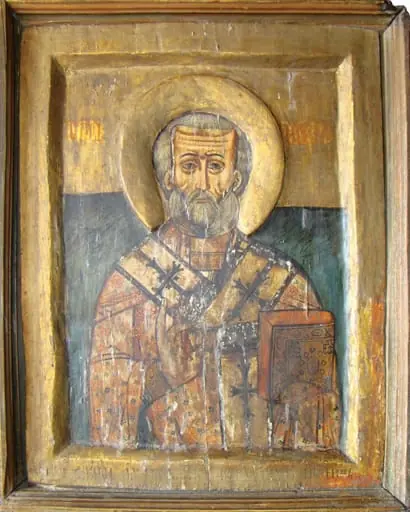
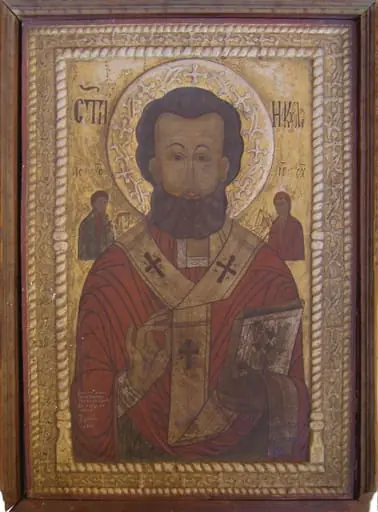
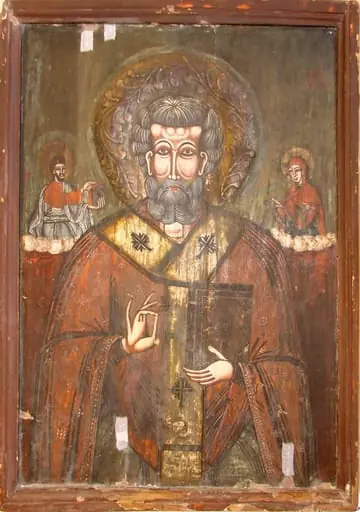
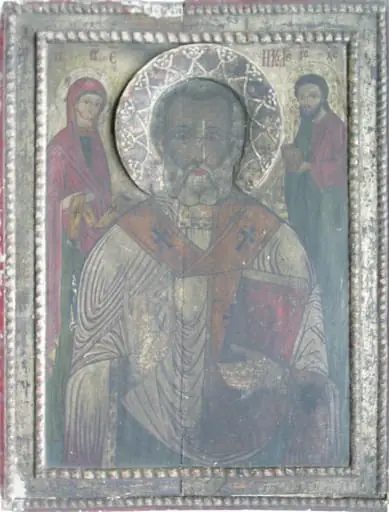
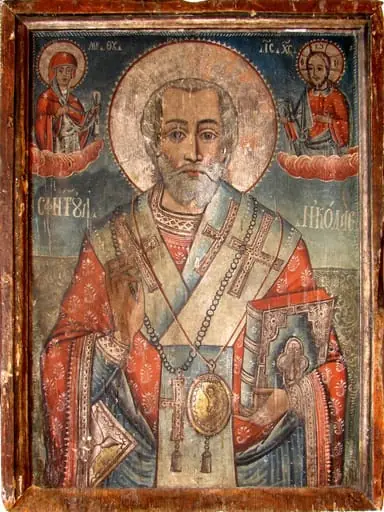
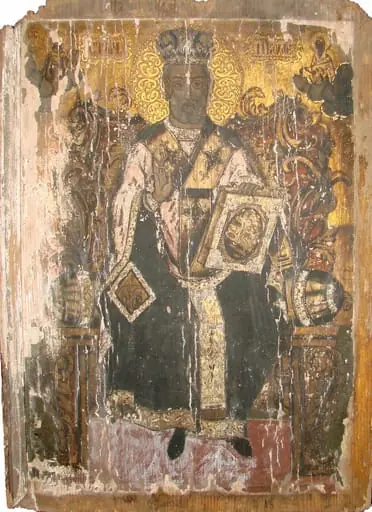
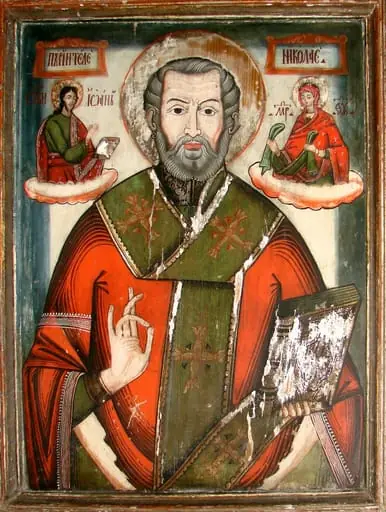
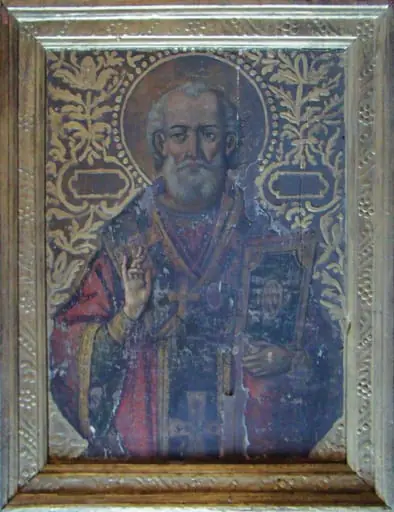
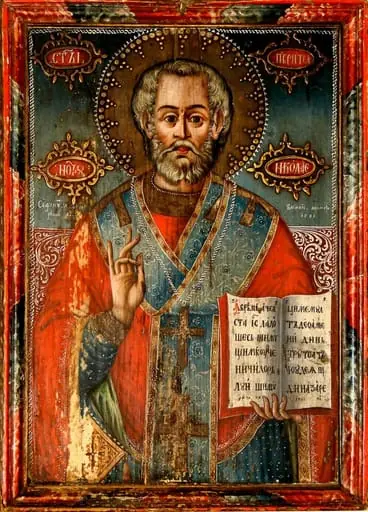
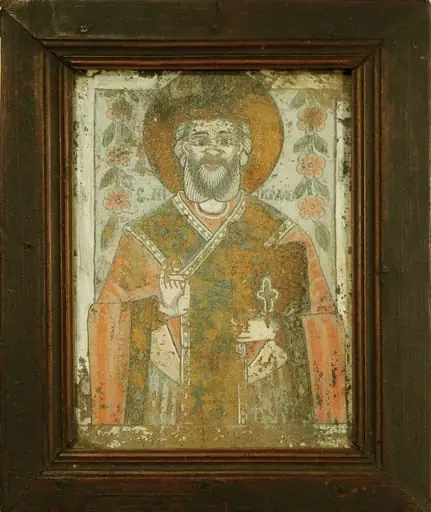
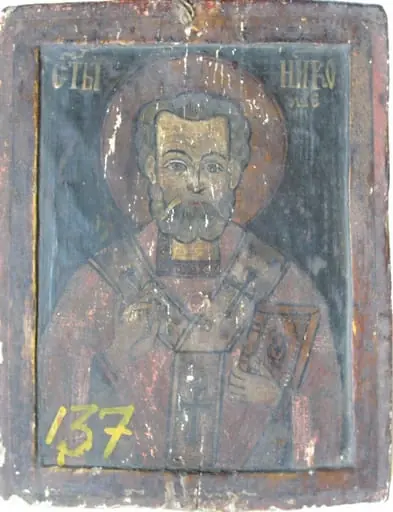
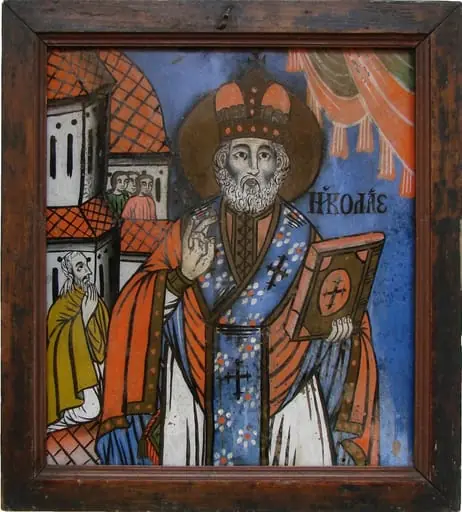
Sf. Ierarh Nicolae; Icoană de catapeteasmă is a drawing by Unknown. It dates from 1850 and is held in the collection of the National Museum of Art of Romania. This icon depicts Saint Nicholas, a revered Christian bishop, rendered in the traditional Byzantine style.
About this work
Overview
Two smaller attendant figures, haloed and standing behind him, hold a book and a scroll, suggesting their roles as bearers of sacred knowledge.
This icon depicts Saint Nicholas, a revered Christian bishop, rendered in the traditional Byzantine style. The figure is centrally positioned, clad in a white robe adorned with black crosses, holding a staff topped with a cross. Two smaller attendant figures, haloed and standing behind him, hold a book and a scroll, suggesting their roles as bearers of sacred knowledge. The dark background, punctuated by gold stars, enhances the sacred presence of the figures.
Subject & Meaning
The central figure is Saint Nicholas, recognized in Orthodox tradition as a protector of the faithful and a miracle-worker. The book and scroll held by the attendant figures likely represent the Gospels and ecclesiastical teachings, reinforcing his authority as a spiritual leader. The gold halos and inscribed name affirm his sanctity, while the cross-topped staff symbolizes his pastoral role and connection to divine authority.
Technique & Style
The painting employs flat, non-naturalistic color fields and simplified forms typical of medieval iconography. Gold leaf highlights the halos and stars, creating a luminous, otherworldly effect. Texture is suggested through fine cross-hatching on the robe and garments, a method used to imply fabric folds without perspective. The lack of depth and emphasis on symbolic clarity align with liturgical conventions meant for veneration rather than realism.
History & Provenance
This icon likely originated in a Byzantine or post-Byzantine religious context, possibly from the Balkans or Eastern Europe, where such depictions of Saint Nicholas were common in church screens. Its function as a catapeteasma—part of an iconostasis—suggests it was used to separate the sanctuary from the nave in an Orthodox church. The preservation of gold lettering and pigment indicates it was valued and maintained over time.
Context
In Orthodox liturgical practice, icons like this served as visual prayers, mediating between the faithful and the divine. Saint Nicholas, as a widely venerated saint, was frequently portrayed in church settings, especially in regions under Byzantine influence. The use of gold, halos, and formal composition reflected theological beliefs about the heavenly realm, where sacred figures existed beyond earthly time and space.
Legacy
This icon exemplifies the enduring tradition of Byzantine icon painting, where symbolic representation took precedence over naturalism. Its stylistic choices influenced later Orthodox iconography across Eastern Europe. Though created for devotional use, such works are now studied as cultural artifacts, preserving the spiritual aesthetics and theological priorities of medieval Christian communities.
Artist & collection

 Domestic Scene
 Giacomo and Cardinal Marco, investing Andrea, Abbot of San Zeno, with his Benefice
 The Nymph of Fontainebleau
 Portrait of a Woman
 Madonna and Child with Saints in the Enclosed Garden
 Venus and Minerva
 Family Group of Four on Sofa
 Wall painting from Room H of the Villa of P. Fannius Synistor at Boscoreale