Artwork
Sf. Mare Ierarh Nicolae
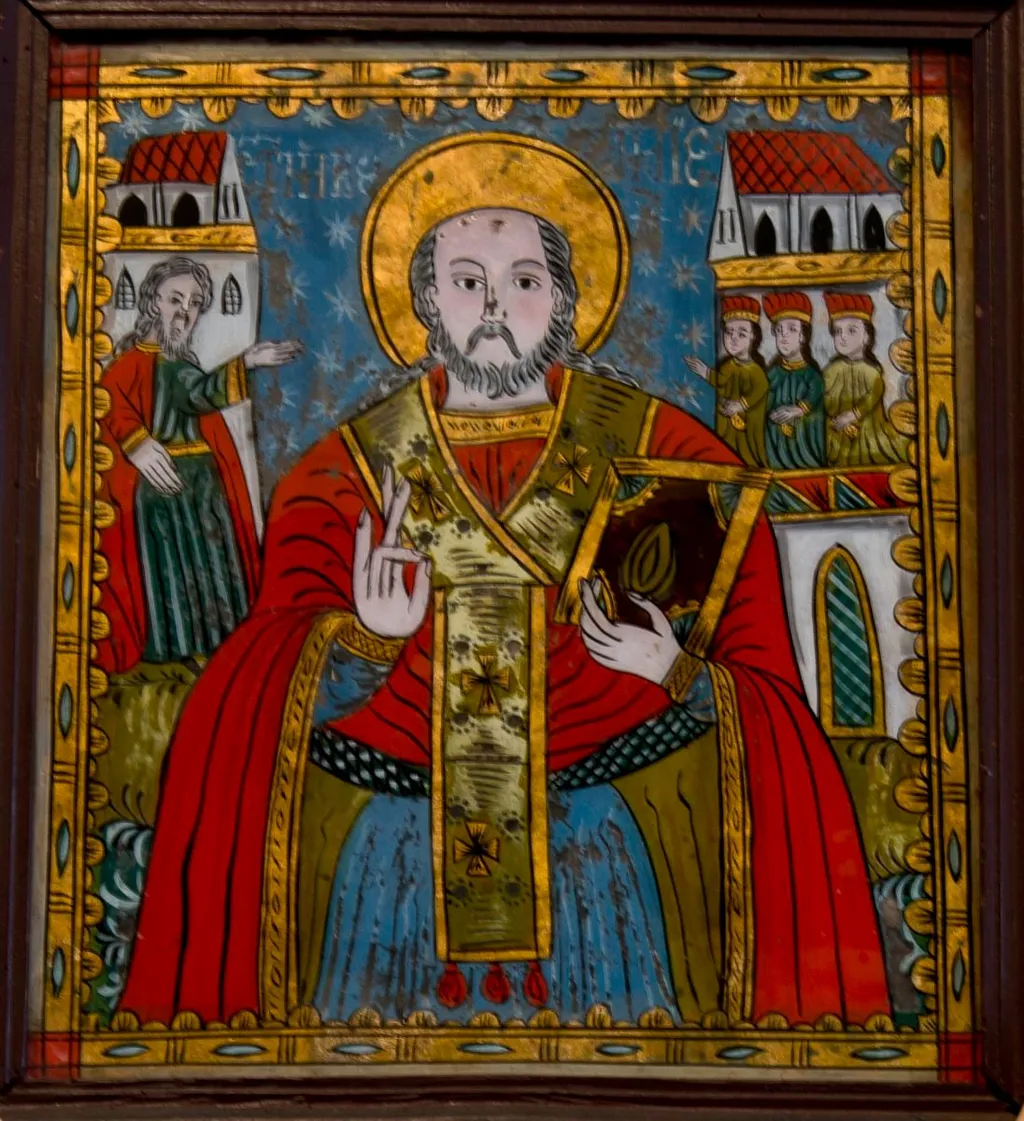
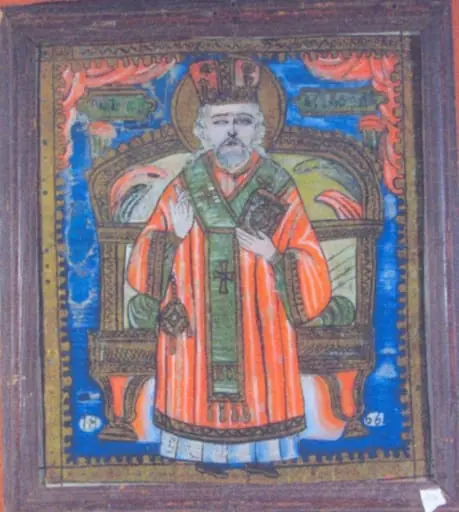
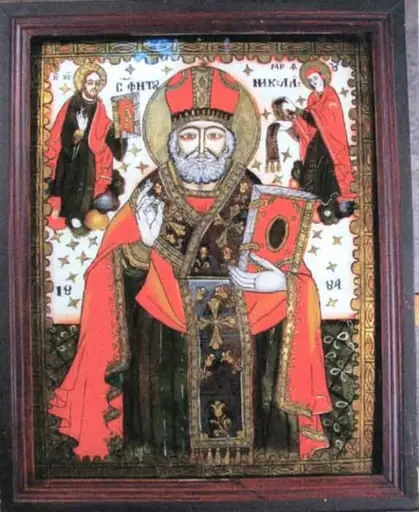
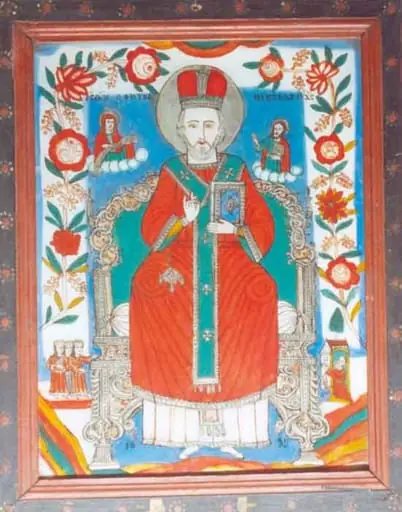
Sf. Mare Ierarh Nicolae is a drawing by Unknown. It dates from 1850 and is held in the collection of the National Museum of Art of Romania. This religious panel depicts Saint Nicholas, a revered bishop, rendered in a stylized, non-naturalistic manner.
About this work
Overview
He is centrally positioned, clad in rich red and gold vestments, holding a staff and a book, with a luminous halo encircling his head.
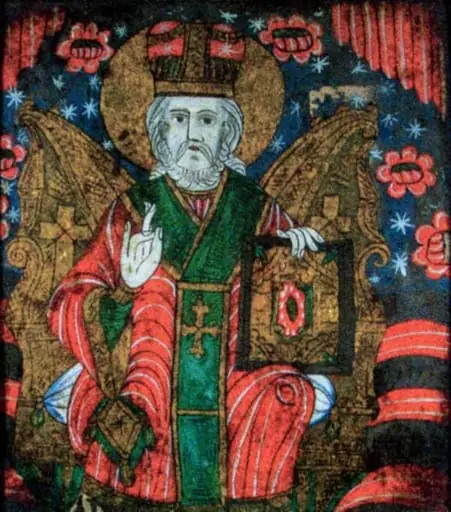
This religious panel depicts Saint Nicholas, a revered bishop, rendered in a stylized, non-naturalistic manner. He is centrally positioned, clad in rich red and gold vestments, holding a staff and a book, with a luminous halo encircling his head. Two smaller figures flank him, while simplified architecture appears in the background. The composition emphasizes symbolic presence over spatial realism, typical of medieval iconographic traditions.
Subject & Meaning
Saint Nicholas, known for his charity and episcopal authority, is shown in the act of blessing or instruction. The book likely represents scripture or church doctrine, while the staff signifies his ecclesiastical office. The two attendant figures may represent disciples or donors, reinforcing his role as spiritual guide. The golden halo underscores his sanctity, aligning with Orthodox Christian iconography that prioritizes divine presence over individual likeness.
Technique & Style
The painting employs flat, unmodulated colors and lacks perspective or chiaroscuro, characteristic of Byzantine-influenced icon painting. Details in the robes are rendered with intricate patterns rather than shading, drawing attention to symbolic ornamentation. The figures are outlined clearly, and the background is minimal, focusing attention on the holy figure. Texture is suggested through linear patterns, not through cross-hatching or gradation.
History & Provenance
The work originates from a region with strong Orthodox Christian traditions, likely produced in a monastic workshop during the late medieval period. Its preservation suggests it was venerated in a church or private chapel. The style and materials point to local artistic practices rather than Western European influences, indicating a regional tradition of religious image-making that remained consistent over centuries.
Context
Created in a time when religious imagery served as a visual catechism for largely illiterate communities, this painting functioned as a devotional aid. Its formal rigidity reflects theological priorities: the depiction of sacred figures as eternal and unchanging, not as historical individuals. Similar icons were used in liturgy, home altars, and processions, anchoring faith in tangible, repeated visual forms.
Legacy
This image continues to reflect the enduring conventions of Eastern Christian iconography, where spiritual meaning overrides naturalism. Though later artistic movements embraced realism, such works preserved their original purpose: to evoke reverence through symbolic clarity. Today, it stands as an example of how religious art sustained communal identity and belief across generations through consistent visual language.
Artist & collection

 Domestic Scene
 Giacomo and Cardinal Marco, investing Andrea, Abbot of San Zeno, with his Benefice
 The Nymph of Fontainebleau
 Portrait of a Woman
 Madonna and Child with Saints in the Enclosed Garden
 Venus and Minerva
 Family Group of Four on Sofa
 Wall painting from Room H of the Villa of P. Fannius Synistor at Boscoreale